Results by title
5 books match the query 'Kinney, Arthur F.'

Faulkner's Narrative Poetics
Style as VisionArthur F. Kinney
University of Massachusetts Press, 1978
We are currently updating our website and have not yet posted complete information for this title. Many of our books are in the Google preview program, which allows readers to view up to 20% of the book. If this title is active in the program, you will find the Google Preview button in the sidebar below.
[more]
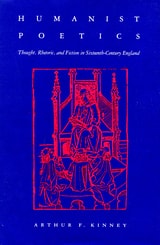
Humanist Poetics
Thought, Rhetoric, and Fiction in Sixteenth-Century EnglandArthur F. Kinney
University of Massachusetts Press, 1986
This important contribution to the study of English Renaissance culture redefines the humanist movement, employs humanist rhetoric in new ways, and argues that English fiction in the sixteenth century should be seen as a major genre with its own strategies for the imaginative artist. Arthur F. Kinney argues that the main purpose of Renaissance humanism was the cultivation and perfection of the individual and society by the use of rhetoric—by persuasion. Humanist poetics, then, is the poetics of rhetoric: the attempt to fashion the self or the reader by a fiction that employs rhetoric's means.
By tracing classical resources and the intertextuality of major English works from More's Utopia to Lodge's Rosalynde and Nashe's Unfortunate Traveller, Kinney not only locates basic Elizabethan habits of mind but also shows where the roots of the English novel may ultimately lie.
By tracing classical resources and the intertextuality of major English works from More's Utopia to Lodge's Rosalynde and Nashe's Unfortunate Traveller, Kinney not only locates basic Elizabethan habits of mind but also shows where the roots of the English novel may ultimately lie.
[more]

Renaissance Reflections
Selected EssaysArthur F. Kinney
University of Massachusetts Press, 2014
"Arthur Kinney has made so many contributions to the study of English literature, in so many different roles, that it can be difficult to reckon with the true sum of his achievement. . . . His curiosity encompasses an entire world and all the things in it, the very world that English Renaissance thinkers inhabited and approached with the same comprehensive spirit of inquiry. . . . Every topic to which he turns in these pages is pursued with impeccable scholarly rigor. . . . To pursue new approaches as Kinney has done year after year and decade after decade requires the nerve to risk failure, even repeated failure. It demands that the scholar constantly explore unfamiliar ground where the feet are still unsure and use analytical tools before they have grown familiar in the hand. It asks the thinker to move outside the security of expertise, the writer to advance arguments that may not succeed. . . . [Kinney] has provided us a wholly different model of a distinguished scholarly career, spending decades in pursuit of intellectual risk and adventure."—James J. Marino, author of Owning William Shakespeare: The King's Men and Their Intellectual Property
[more]
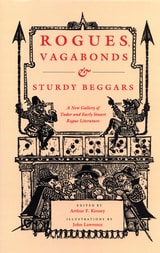
Rogues, Vagabonds, and Sturdy Beggars
A New Gallery of Tudor and Early Stuart Rogue Literature Exposing the Lives, Times, and Cozening Tricks of the Elizabethan UnderworldArthur F. Kinney
University of Massachusetts Press, 1990
The Elizabethan age was one of unbounded vitality and exuberance; nowhere is the color and action of life more vividly revealed than in the rogue books and cony-catching (confidence game) pamphlets of the sixteenth century. This book presents seven of the age's liveliest works: Walker's Manifest Detection of Dice Play; Awdeley's Fraternity of Vagabonds; Harman's Caveat for Common Cursitors Vulgarly Called Vagabonds; Greene's Notable Discovery of Cozenage and Black Book's Messenger; Dekker's Lantern and Candle-light; and Rid's Art of Juggling. From these pages spring the denizens of the Elizabethan underworld: cutpurses, hookers, palliards, jarkmen, doxies, counterfeit cranks, bawdy-baskets, walking morts, and priggers of prancers.
In his introduction, Arthur F. Kinney discusses the significance of these works as protonovels and their influence on such writers as Shakespeare. He also explores the social, political, and economic conditions of a time that spawned a community of renegades who conned their way to fame, fortune, and, occasionally, the rope at Tyburn.
In his introduction, Arthur F. Kinney discusses the significance of these works as protonovels and their influence on such writers as Shakespeare. He also explores the social, political, and economic conditions of a time that spawned a community of renegades who conned their way to fame, fortune, and, occasionally, the rope at Tyburn.
[more]
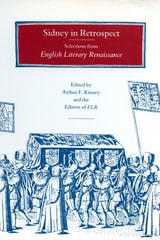
Sidney in Retrospect
Selections from "English Literary Renaissance"Arthur F. Kinney
University of Massachusetts Press, 1988
Four hundred years after his death on a Dutch battlefield, Sir Philip Sidney is being honored with international conferences across the United States and in Europe. One of the three master writers of the English Renaissance along with Shakespeare and Spenser, Sidney gave to his own time the first sonnet sequence in English and the best English defense of poetry ever written. His book Arcadia—the first novel in English—was the best-selling English novel for two hundred years. In our own time he is seen, unlike his contemporaries, as a writer whose political life at Elizabeth's court and whose diplomatic and religious ties to the leading rulers of Europe make the interrelationship of his work and his culture singularly important in the present reassessment of his age.
Sidney in Retrospect, a special quatercentenary volume, brings together for the first time the landmark essays from English Literary Renaissance that reinterpret the significance of his life and reassess all of his major work. In addition, two newly discovered letters appear in book form for the first time.
Sidney in Retrospect, a special quatercentenary volume, brings together for the first time the landmark essays from English Literary Renaissance that reinterpret the significance of his life and reassess all of his major work. In addition, two newly discovered letters appear in book form for the first time.
[more]