Results by title
4 books match the query 'Knapp, Sandra'
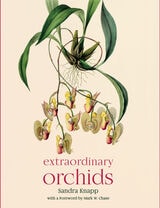
Extraordinary Orchids
Sandra Knapp
University of Chicago Press, 2021
Perching on tropical trees, partnering with fungi to reproduce, or deceiving birds and amorous insects to promote pollination, orchids fascinate. In the exquisitely illustrated Extraordinary Orchids, award-winning botanist and writer Sandra Knapp tells the stories behind some of the bizarre lifestyles and interactions that scientists have uncovered among many species of the orchid family.
Orchids deserve such a visual celebration: parts of the orchid flower have shapes unlike any other flowering plant, and the sheer number of species means they have a seemingly endless ability to create ever more fantastical forms. In fact, many orchid common names refer to the shape-shifting forms of their flowers—the “man-orchids” or “monkey-orchids” are so called because of their resemblance to the primate form. Orchids lend themselves to depiction, and botanical artworks of them abound. Who could resist painting or drawing such odd shapes?
Illustrated with stunning artwork, much from the archives of the Natural History Museum in London and never before published, Extraordinary Orchids includes depictions from celebrated botanical artists such as Ferdinand and Franz Bauer, Arthur Harry Church, and Sydney Parkinson, revealing the weird and wonderful lives of this most diverse of plant families.
[more]
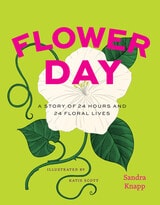
Flower Day
A Story of 24 Hours and 24 Floral LivesSandra Knapp
University of Chicago Press, 2025
An illustrated hourly guide that spotlights twenty-four flowers as they attract pollinators, resist predators, and survive on our changing planet.
Is it 4 AM or chicory o’clock? In this short book, botanist and award-winning author Sandra Knapp walks us through a day in a global garden. Each chapter of Flower Day introduces a single flower during a single hour, highlighting twenty-four different species from around the world.
Beginning at midnight in the Americas, we spot the long tubular flowers of the moonflower, Ipomoea alba; they attract a frenzy of hawk moths before the dawn arrives and the flowers wither and collapse. As day breaks, dandelions and chicory open their heads—actually made up of many individual flowers tightly packed together—and flies and bees visit to get the energy they need to lay eggs and raise their young. Later, at eight o’clock in the morning, the sun rises over the watery Amazon basin, and we meet the giant waterlily, slowly turning from white to pink and purple. Trapped inside are the beetles who feasted on the flowers during the night. That evening, at seven o’clock, we travel to the Caribbean to smell night-blooming jessamine’s powerful—some may say nauseating—sweet scent. But this member of the nightshade family isn’t just a thing of beauty—it has a reputation as both a poison and invasive species, crowding out endangered native trees.
For each hour in our flower day, celebrated artist Katie Scott has depicted these scenes with gorgeous pen-and-ink illustrations. Working closely together to narrate and illustrate these unique moments in time, Knapp and Scott have created an engaging read that is a perfect way to spend an hour or two—and a true gift for amateur botanists, gardeners, and anyone who wants to stop and appreciate the flowers.
[more]
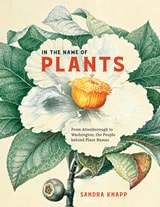
In the Name of Plants
From Attenborough to Washington, the People behind Plant NamesSandra Knapp
University of Chicago Press, 2022
A vividly illustrated meeting with thirty plants and their inspiring namesakes
Shakespeare famously asserted that “a rose by any other name would smell as sweet,” and that’s as true for common garden roses as it is for the Megacorax, a genus of evening primroses. Though it may not sound like it, the Megacorax was actually christened in honor of famed American botanist Peter Raven, its name a play on the Latin words for “great raven.”
In this lush and lively book, celebrated botanist Sandra Knapp explores the people whose names have been immortalized in plant genera, presenting little-known stories about both the featured plants and their eponyms alongside photographs and botanical drawings from the collections of London’s Natural History Museum. Readers will see familiar plants in a new light after learning the tales of heroism, inspiration, and notoriety that led to their naming. Take, for example, nineteenth-century American botanist Alice Eastwood, after whom the yellow aster—Eastwoodia elegans—is named. Eastwood was a pioneering plant collector who also singlehandedly saved irreplaceable specimens from the California Academy of Sciences during the 1906 San Francisco earthquake. Or more recently, the fern genus Gaga, named for the pop star and actress Lady Gaga, whose verdant heart-shaped ensemble at the 2010 Grammy Awards bore a striking resemblance to a giant fern gametophyte. Knapp’s subjects range from Charles Darwin’s grandfather, Erasmus Darwin (Darwinia), and legendary French botanist Pierre Magnol—who lends his name to the magnolia tree—to US founding figures like George Washington (Washingtonia) and Benjamin Franklin (Franklinia). Including granular details on the taxonomy and habitats for thirty plants alongside its vibrant illustrations, this book is sure to entertain and enlighten any plant fan.
[more]
International Code of Nomenclature for algae, fungi, and plants (Madrid Code)
Editorial Committee of the Madrid Code
University of Chicago Press, 2025
The latest, updated edition of the essential, authoritative reference for botanical, mycological, and phycological names.
The International Code of Nomenclature for algae, fungi, and plants, known as “the Code,” is the set of internationally agreed rules and recommendations that govern the naming of these organisms. Scientific naming has deep historical roots. Indeed, the system of naming organisms is one of the first truly global scientific standards. This essential reference originates in Alphonse de Candolle’s 1867 Lois de la nomenclature botanique. This 2025 edition of the Code, the Madrid Code, reflects the decisions made at the Twentieth International Botanical Congress, which met in Madrid, Spain, in July 2024. The congress debated 447 proposals to amend the Code and accepted important new rules, including a mechanism for voluntary registration of plant and algal names, clarifications for naming fossil taxa, the option to reject a new name if it is derogatory to a group of people, and the replacement of an epithet that was considered particularly offensive (revising to afra, afrorum, and afrum).
The International Code of Nomenclature for algae, fungi, and plants, known as “the Code,” is the set of internationally agreed rules and recommendations that govern the naming of these organisms. Scientific naming has deep historical roots. Indeed, the system of naming organisms is one of the first truly global scientific standards. This essential reference originates in Alphonse de Candolle’s 1867 Lois de la nomenclature botanique. This 2025 edition of the Code, the Madrid Code, reflects the decisions made at the Twentieth International Botanical Congress, which met in Madrid, Spain, in July 2024. The congress debated 447 proposals to amend the Code and accepted important new rules, including a mechanism for voluntary registration of plant and algal names, clarifications for naming fossil taxa, the option to reject a new name if it is derogatory to a group of people, and the replacement of an epithet that was considered particularly offensive (revising to afra, afrorum, and afrum).
[more]