Results by title
2 books match the query 'Kohl, Philip L.'
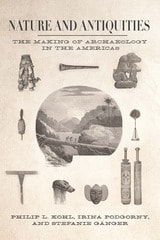
Nature and Antiquities
The Making of Archaeology in the AmericasEdited by Philip L. Kohl, Irina Podgorny, and Stefanie Gänger
University of Arizona Press, 2014
Nature and Antiquities examines the relation between the natural sciences, anthropology, and archaeology in the Americas in the nineteenth and early twentieth centuries. Taking the reader across the Americas from the Southern Cone to Canada, across the Andes, the Brazilian Amazon, Mesoamerica, and the United States, the book explores the early history of archaeology from a Pan-American perspective.
The volume breaks new ground by entreating archaeologists to acknowledge the importance of ways of knowing that resulted from the study of nature in the history of archaeology. Some of the contributions to this volume trace the part conventions, practices, and concepts from natural history and the natural sciences played in the history and making of the discipline. Others set out to uncover, reassemble, or adjust our vision of collections that research historians of archaeology have disregarded or misrepresented—because their nineteenth-century makers would refuse to comply with today’s disciplinary borders and study natural specimens and antiquities in conjunction, under the rubric of the territorial, the curious or the universal. Other contributions trace the sociopolitical implications of studying nature in conjunction with “indigenous peoples” in the Americas—inquiring into what it meant and entailed to comprehend the inhabitants of the American continent in and through a state of nature.
The volume breaks new ground by entreating archaeologists to acknowledge the importance of ways of knowing that resulted from the study of nature in the history of archaeology. Some of the contributions to this volume trace the part conventions, practices, and concepts from natural history and the natural sciences played in the history and making of the discipline. Others set out to uncover, reassemble, or adjust our vision of collections that research historians of archaeology have disregarded or misrepresented—because their nineteenth-century makers would refuse to comply with today’s disciplinary borders and study natural specimens and antiquities in conjunction, under the rubric of the territorial, the curious or the universal. Other contributions trace the sociopolitical implications of studying nature in conjunction with “indigenous peoples” in the Americas—inquiring into what it meant and entailed to comprehend the inhabitants of the American continent in and through a state of nature.
[more]
Selective Remembrances
Archaeology in the Construction, Commemoration, and Consecration of National PastsEdited by Philip L. Kohl, Mara Kozelsky, and Nachman Ben-Yehuda
University of Chicago Press, 2008
When political geography changes, how do reorganized or newly formed states justify their rule and create a sense of shared history for their people? Often, the essays in Selective Remembrances reveal, they turn to archaeology, employing the field and its findings to develop nationalistic feelings and forge legitimate distinctive national identities.
Examining such relatively new or reconfigured nation-states as Iran, Iraq, Turkey, Israel, Russia, Ukraine, India, and Thailand, Selective Remembrances shows how states invoke the remote past to extol the glories of specific peoples or prove claims to ancestral homelands. Religion has long played a key role in such efforts, and the contributors take care to demonstrate the tendency of many people, including archaeologists themselves, to view the world through a religious lens—which can be exploited by new regimes to suppress objective study of the past and justify contemporary political actions.
The wide geographic and intellectual range of the essays in Selective Remembrances will make it a seminal text for archaeologists and historians.
[more]