Results by title
5 books match the query 'Kohler, Robert E.'
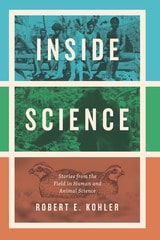
Inside Science
Stories from the Field in Human and Animal ScienceRobert E. Kohler
University of Chicago Press, 2019
Context and situation always matter in both human and animal lives. Unique insights can be gleaned from conducting scientific studies from within human communities and animal habitats. Inside Science is a novel treatment of this distinctive mode of fieldwork. Robert E. Kohler illuminates these resident practices through close analyses of classic studies: of Trobriand Islanders, Chicago hobos, corner boys in Boston’s North End, Jane Goodall’s chimpanzees of the Gombe Stream Reserve, and more. Intensive firsthand observation; a preference for generalizing from observed particulars, rather than from universal principles; and an ultimate framing of their results in narrative form characterize these inside stories from the field.
Resident observing takes place across a range of sciences, from anthropology and sociology to primatology, wildlife ecology, and beyond. What makes it special, Kohler argues, is the direct access it affords scientists to the contexts in which their subjects live and act. These scientists understand their subjects not by keeping their distance but by living among them and engaging with them in ways large and small. This approach also demonstrates how science and everyday life—often assumed to be different and separate ways of knowing—are in fact overlapping aspects of the human experience. This story-driven exploration is perfect for historians, sociologists, and philosophers who want to know how scientists go about making robust knowledge of nature and society.
Resident observing takes place across a range of sciences, from anthropology and sociology to primatology, wildlife ecology, and beyond. What makes it special, Kohler argues, is the direct access it affords scientists to the contexts in which their subjects live and act. These scientists understand their subjects not by keeping their distance but by living among them and engaging with them in ways large and small. This approach also demonstrates how science and everyday life—often assumed to be different and separate ways of knowing—are in fact overlapping aspects of the human experience. This story-driven exploration is perfect for historians, sociologists, and philosophers who want to know how scientists go about making robust knowledge of nature and society.
[more]
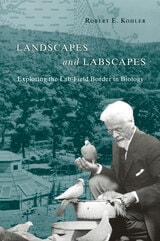
Landscapes and Labscapes
Exploring the Lab-Field Border in BiologyRobert E. Kohler
University of Chicago Press, 2002
What is it like to do field biology in a world that exalts experiments and laboratories? How have field biologists assimilated laboratory values and practices, and crafted an exact, quantitative science without losing their naturalist souls?
In Landscapes and Labscapes, Robert E. Kohler explores the people, places, and practices of field biology in the United States from the 1890s to the 1950s. He takes readers into the fields and forests where field biologists learned to count and measure nature and to read the imperfect records of "nature's experiments." He shows how field researchers use nature's particularities to develop "practices of place" that achieve in nature what laboratory researchers can only do with simplified experiments. Using historical frontiers as models, Kohler shows how biologists created vigorous new border sciences of ecology and evolutionary biology.
In Landscapes and Labscapes, Robert E. Kohler explores the people, places, and practices of field biology in the United States from the 1890s to the 1950s. He takes readers into the fields and forests where field biologists learned to count and measure nature and to read the imperfect records of "nature's experiments." He shows how field researchers use nature's particularities to develop "practices of place" that achieve in nature what laboratory researchers can only do with simplified experiments. Using historical frontiers as models, Kohler shows how biologists created vigorous new border sciences of ecology and evolutionary biology.
[more]
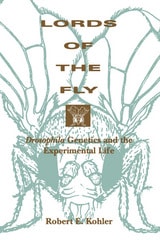
Lords of the Fly
Drosophila Genetics and the Experimental LifeRobert E. Kohler
University of Chicago Press, 1994
The common fruit fly, Drosophila, has long been one of the most productive of all laboratory animals. From 1910 to 1940, the center of Drosophila culture in America was the school of Thomas Hunt Morgan and his students Alfred Sturtevant and Calvin Bridges. They first created "standard" flies through inbreeding and by organizing a network for exchanging stocks of flies that spread their practices around the world.
In Lords of the Fly, Robert E. Kohler argues that fly laboratories are a special kind of ecological niche in which the wild fruit fly is transformed into an artificial animal with a distinctive natural history. He shows that the fly was essentially a laboratory tool whose startling productivity opened many new lines of genetic research. Kohler also explores the moral economy of the "Drosophilists": the rules for regulating access to research tools, allocating credit for achievements, and transferring authority from one generation of scientists to the next.
By closely examining the Drosophilists' culture and customs, Kohler reveals essential features of how experimental scientists do their work.
[more]

Osiris, Volume 11
Science in the FieldEdited by Henrika Kuklick and Robert E. Kohler
University of Chicago Press, 1996
Unlike many histories of scientific practices, which deal with laboratory experiments, this collection of essays focuses on scientific investigations conducted out of doors: biological, physical, and social. Case studies from varied disciplines explore the material, human, and cultural aspects of fieldwork, and the relationships between scientific activity and popular outdoor activities such as exploration and recreation.
Included are "Gender, Culture, and Astrophysical Fieldwork: Elizabeth Campbell and the Lick Observatory-Crocker Eclipse Expeditions," by Alex Soo-jung-Kim Pang; "Wallace in Other Lands," by Jane Camerini; "The Heroic Science of Glacier Motion," by Bruce Hevly; "Objectivity or Heroism: Invisibility of Women in Science," by Naomi Oreskes; "When Nature is the Zoo: Vision and Power in the Art and Science of Natural History," by Gregg Mitman; "Manly Men in Scientific Balloons: Meteorology and the Victorian Scientist as Romantic Hero," by Jennifer Tucker; "Paul du Chaillu and Construction of Authority," by Stuart McCook; "Of Sangfroid and Sphinx Moths: Cruelty, Public Relations, and Entomology, 1800-1840," by Anne Larsen Hollerbach; "The Ship as a Scientific Instrument in the 18th Century," by Richard Sorrenson; and "'A Tent with a View:' Colonial Officers, Anthropologists, and the Making of the Field in Northern Rhodesia, 1937-1960," by Lynette Schumaker.
Included are "Gender, Culture, and Astrophysical Fieldwork: Elizabeth Campbell and the Lick Observatory-Crocker Eclipse Expeditions," by Alex Soo-jung-Kim Pang; "Wallace in Other Lands," by Jane Camerini; "The Heroic Science of Glacier Motion," by Bruce Hevly; "Objectivity or Heroism: Invisibility of Women in Science," by Naomi Oreskes; "When Nature is the Zoo: Vision and Power in the Art and Science of Natural History," by Gregg Mitman; "Manly Men in Scientific Balloons: Meteorology and the Victorian Scientist as Romantic Hero," by Jennifer Tucker; "Paul du Chaillu and Construction of Authority," by Stuart McCook; "Of Sangfroid and Sphinx Moths: Cruelty, Public Relations, and Entomology, 1800-1840," by Anne Larsen Hollerbach; "The Ship as a Scientific Instrument in the 18th Century," by Richard Sorrenson; and "'A Tent with a View:' Colonial Officers, Anthropologists, and the Making of the Field in Northern Rhodesia, 1937-1960," by Lynette Schumaker.
[more]
Partners in Science
Foundations and Natural Scientists, 1900-1945Robert E. Kohler
University of Chicago Press, 1991
Robert Kohler shows exactly how entrepreneurial academic scientists became intimate "partners in science" with the officers of the large foundations created by John D. Rockefeller and Andrew Carnegie, and in so doing tells a fascinating story of how the modern system of grant-getting and grant-giving evolved, and how this funding process has changed the way laboratory scientists make their careers and do their work.
"This book is a rich historical tapestry of people, institutions and scientific ideas. It will stand for a long time as a source of precise and detailed information about an important aspect of the scientific enterprise. . .It also contains many valuable lessons for the coming years."—John Ziman, Times Higher Education Supplement
"This book is a rich historical tapestry of people, institutions and scientific ideas. It will stand for a long time as a source of precise and detailed information about an important aspect of the scientific enterprise. . .It also contains many valuable lessons for the coming years."—John Ziman, Times Higher Education Supplement
[more]