Results by title
3 books match the query 'Kontje, Todd'
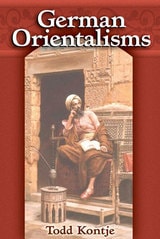
German Orientalisms
Todd Kontje
University of Michigan Press, 2004
Todd Kontje's German Orientalisms offers a fresh examination of the role of the East in the "Kontje has pulled off the amazing feat of a grand narrative: from the epic literature of the Middle Ages to very recent texts on the emerging multicultural Germany. Kontje's grand narrative, it should be noted, is not at all simplistic or reductionistic. He gets at the individual texts in complex ways, and he can tease out multidimensional features of the German texts' treatments of the 'East.' Nonetheless, he displays an enviable erudition and scholarship, tracing lines through centuries when most scholars today limit themselves to narrow specialties."
-Russell Berman, Stanford University
"Intellectually rigorous and conceptually nuanced, Todd Kontje's German Orientalisms is a valuable contribution to the debate on identity politics in German cultural history. Through an erudite and insightful analysis of the German fictions of a broadly defined 'Orient' from the Middle Ages to the present, Kontje illustrates how German literature situated itself within a 'symbolic geography,' whose coordinates are defined by both its representations of the Orient and its affiliation with the Occident. German Orientalisms offers not only an admirable synthesis of the scholarship on German linguistic and cultural nationalism but also sophisticated interpretive strategies for a better understanding of our perceptions and misconceptions of alterity."
-Azade Seyhan, Bryn Mawr College
"This is a fascinating topic, and the book opens new scholarly vistas. In an age of increased specialization, Kontje takes a macro view, looking at German literature almost
from its beginnings to the present, from Wolfram to Özdamar. He also has the courage to link his well-researched work to topics like globalization, the culture wars, and canon formation. He doesn't merely proclaim literature's importance, he shows by example how the literary imagination-creative as it is, dodging dogmatism, and able to confound ideologies-can thrive in an era of cultural studies."
-Sara Friedrichsmeyer, University of Cincinnati
Todd Kontje's German Orientalisms offers a fresh examination of the role of the East in German literary imagination, ranging from the Middle Ages to the present. In its wide historical sweep, this book offers important new insights into many of the most famous writers in the German language, from Goethe to Thomas Mann to Günter Grass.
Building on Edward Said's Orientalism-which defined Orientalism as a form of Western knowledge directly linked to imperial power-Kontje offers a more nuanced version as seen through the lens of German literature of the last thousand years.
Said's focus was on British and French Orientalists-two nations with colonial interests in the East. Germany was different in that it had no stake in the Orient. Far from diminishing an Orientalist perspective, however, the absence of a German empire in the East produced a peculiarly German brand of Orientalism, one in which German writers alternated between identification with the rest of Europe and allying themselves with parts of the East against the West.
Above all, Kontje asks how German writers conceived of their place in "the land of the center" (das Land der Mitte) and how their literary works help to create the imagined community of the German nation.
[more]
Imperial Fictions
German Literature Before and Beyond the Nation-StateTodd Kontje
University of Michigan Press, 2018
Imperial Fictions explores ways in which writers from late antiquity to the present have imagined communities before and beyond the nation-state. It takes as its point of departure challenges to the discrete nation-state posed by globalization, migration, and European integration today, but then circles back to the beginnings of European history after the fall of the Roman Empire. Unlike nationalist literary historians of the nineteenth century, who sought the tribal roots of an allegedly homogeneous people, this study finds a distant mirror of analogous processes today in the fluid mixtures and movements of peoples. Imperial Fictions argues that it is time to stop thinking about today’s multicultural present as a deviation from a culturally monolithic past. We should rather consider the various permutations of “German” identities that have been negotiated within local and imperial contexts from the early Middle Ages to the present.
[more]
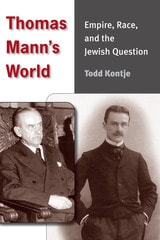
Thomas Mann's World
Empire, Race, and the Jewish QuestionTodd Kontje
University of Michigan Press, 2011
Thomas Mann's World: Empire, Race, and the Jewish Question offers a comprehensive reevaluation of one of Germany’s most celebrated literary giants by situating his life and fiction squarely within the Age of Empire. Rather than viewing Mann strictly as an idealized, cosmopolitan voice of tolerance or dismissing him entirely as a clandestine anti-Semite, Kontje presents a nuanced portrait of a deeply "worldly" author whose personal prejudices and anxieties reflected the global realities of imperial conquest, nationalism, and conflict. By tracing the evolution of Mann's work—including Buddenbrooks, The Magic Mountain, and Joseph and his Brothers—the book examines how Mann’s representations of Jews and foreign others intersected with a persistent, lifelong fascination with racial difference and his own complex identity. Ultimately, this essential text provides literary scholars with a critical framework for understanding how Mann’s highly autobiographical fiction captured not just the internal spirit of the German nation, but the broader geopolitical tensions of a rapidly globalizing world.
[more]