Results by title
3 books match the query 'Korean poetry'
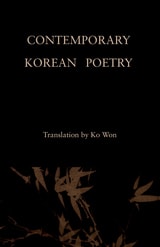
Contemporary Korean Poetry
Won Ko
University of Iowa Press, 1970
The boundaries of poetry in English are expanded with Contemporary Korean Poetry, the first major scholarly anthology introducing twentieth century Korean poetry in English. In translating 181 poems by 140 poets, Ko Won manages to capture the feeling and mood of the original work, retaining the intended simplicity for effect.
[more]
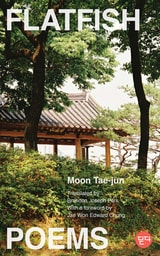
Flatfish
Poems, A Bilingual EditionMoon Tae-jun
Rutgers University Press, 2026
In his poetry collection, Flatfish, Moon Tae-jun offers an aesthetic that emphasizes the author’s exploration of the inner self. At times sparse and allusive, his poems use blank space and other stylistic considerations to convey a voice and thought that ranges from the contemplative to the surreal and absurd. Moon’s poems suggest Buddhist ideologies, natural images, and Korean temples, as the collection explores individual experiences within the context of a search for understanding a greater whole.
While Korea is certainly the setting of these poems, the works remain largely free of cultural-specific imagery and are, instead, naturalistic or universal. This first bilingual edition is a critical resource for students, poets, translators, and general readers alike.
While Korea is certainly the setting of these poems, the works remain largely free of cultural-specific imagery and are, instead, naturalistic or universal. This first bilingual edition is a critical resource for students, poets, translators, and general readers alike.
English-Korean Bilingual Edition
영-한 이중언어판
[more]
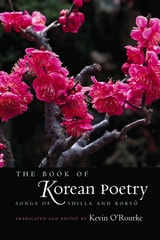
The Book of Korean Poetry
Songs of Shilla and KoryoKevin O'Rourke
University of Iowa Press, 2006
Korea’s history is divided into four periods: the Three Kingdoms of Koguryo (37 bc–ad 668), Shilla (57 bc–ad 668), and Paekche (18 bc–ad 660); Unified Shilla (668–935); Koryo (935–1392); and Choson (1392–1910). Kevin O’Rourke’s The Book of Korean Poetry traces Korean poetry from the pre-Shilla era to the end of Korea’s golden poetry period in the Koryo dynasty.There are two poetry traditions in Korea: hanshi (poems by Korean poets in Chinese characters) and vernacular poems, which are invariably songs. Hanshi is a poetry to be read and contemplated; the vernacular is a poetry to be sung and heard. Hanshi was aimed at personal cultivation, vernacular poetry primarily at entertainment. Hanshi was a much more private discipline; vernacular poetry was composed for the most part against a convivial background of wine, music, and dance.In this comprehensive treatment of the poetry of Shilla and Koryo, O’Rourke divides one hundred fifty poems into five sections: Early Songs, Shilla hanshi, Shilla hyangga, Koryo kayo, and Koryo hanshi and shijo. Only a few pre-Shilla poems are extant; O’Rourke features all five. All fourteen extant Shilla hyangga are included. Seventeen major Koryo kayo are featured; only a few short, incantatory pieces that defied translation were excluded. Fourteen of the fewer than twenty Koryo shijo with claims to authenticity are presented. From the vast number of extant hanshi, O’Rourke selected poems with the most intrinsic merit and universal appeal. In addition to introductory essays on the genres of hanshi, hyangga, Koryo kayo, and shijo, O’Rourke interleaves his graceful translations with commentary on the historical backgrounds, poetic forms, and biographical notes on the poets’ lives as well as guides to the original texts, bibliographical materials, and even anecdotes on how the poems came to be written. Along with the translations themselves, O’Rourke’s annotations of the poems make this volume a particularly interesting and important introduction to the scholarship of East Asian literature.
[more]