Results by title
2 books match the query 'Krasner, Jonathan B.'
Teaching and Learning in Jewish Day Schools
Edited by Jonathan B. Krasner, Jon A. Levisohn, and Sharon Avni
Brandeis University Press, 2025
Examines how day schools are educating diverse Jewish youth in a variety of content areas.
Teaching and Learning in Jewish Day Schools offers an important analysis of Jewish day school classrooms today. In light of difficulties initiating, evaluating, and sustaining educational innovation, this volume takes stock of what is happening among students and teachers in contemporary Jewish day school classrooms. The authors of this volume confront and question several bedrock principles of Jewish education to address how day schools intersect with broader societal issues including race and gender. They point to themes and topics that scholars and practitioners are grappling with to explore new potential pathways to evaluating student learning and learning outcomes: assessing core subject areas; understanding the ways social and environmental factors contribute to learning; and studying how race, ethnicity, class, and gender shape student learning and school culture. The chapters address topics relevant to educators working in contemporary Jewish day schools including Zionism, the outcomes of Israel education, Jewish engagement, the experience of Latinx students, community building, and more.
Teaching and Learning in Jewish Day Schools offers an important analysis of Jewish day school classrooms today. In light of difficulties initiating, evaluating, and sustaining educational innovation, this volume takes stock of what is happening among students and teachers in contemporary Jewish day school classrooms. The authors of this volume confront and question several bedrock principles of Jewish education to address how day schools intersect with broader societal issues including race and gender. They point to themes and topics that scholars and practitioners are grappling with to explore new potential pathways to evaluating student learning and learning outcomes: assessing core subject areas; understanding the ways social and environmental factors contribute to learning; and studying how race, ethnicity, class, and gender shape student learning and school culture. The chapters address topics relevant to educators working in contemporary Jewish day schools including Zionism, the outcomes of Israel education, Jewish engagement, the experience of Latinx students, community building, and more.
[more]
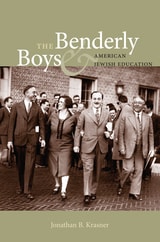
The Benderly Boys and American Jewish Education
Jonathan B. Krasner
Brandeis University Press, 2011
Samson Benderly inaugurated the first Bureau of Jewish Education in 1910 amid a hodgepodge of congregational schools, khayders, community Talmud Torahs, and private tutors. Drawing on the theories of Johann Pestalozzi, Herbert Spencer, and John Dewey, and deriving inspiration from cultural Zionism, Benderly sought to modernize Jewish education by professionalizing the field, creating an immigrant-based, progressive supplementary school model, and spreading the mantra of community responsibility for Jewish education. With philanthropist Jacob Schiff and influential laymen financing his plans, Benderly realized that his best hope for transforming the educational landscape nationwide was to train a younger generation of teachers, principals, and bureau leaders. These young men became known collectively as the “Benderly Boys,” who, from the 1920s to the 1970s, were the dominant force in Jewish education—both formal and informal—in the United States.
[more]