Results by title
2 books match the query 'Kress, W. John'
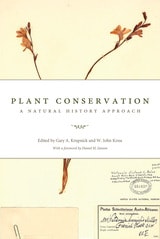
Plant Conservation
A Natural History ApproachEdited by Gary A. Krupnick and W. John Kress
University of Chicago Press, 2005
Natural history has always been the foundation of conservation biology. For centuries, botanists collected specimens in the field to understand plant diversity; now that many habitats are threatened, botanists have turned their focus to conservation, and, increasingly, they look to the collections of museums, herbaria, and botanical gardens for insight on developing informed management programs. Plant Conservation explores the value of these collections in light of contemporary biodiversity studies.
Plant Conservation opens with a broad view of plant biodiversity and then considers evolutionary and taxonomic threats and consequences of habitat alteration; specific threats to plant diversity, such as invasive species and global climate change; consequences of plant population decline at the ecological, evolutionary, and taxonomic levels; and, finally, management strategies that protect plant biodiversity from further decline. With a unique perspective on biodiversity and scientific collections, Plant Conservation ultimately emphasizes the role museums and botanical gardens will play in future conservation.
Plant Conservation opens with a broad view of plant biodiversity and then considers evolutionary and taxonomic threats and consequences of habitat alteration; specific threats to plant diversity, such as invasive species and global climate change; consequences of plant population decline at the ecological, evolutionary, and taxonomic levels; and, finally, management strategies that protect plant biodiversity from further decline. With a unique perspective on biodiversity and scientific collections, Plant Conservation ultimately emphasizes the role museums and botanical gardens will play in future conservation.
[more]
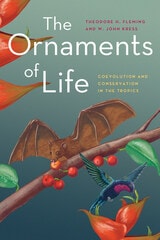
The Ornaments of Life
Coevolution and Conservation in the TropicsTheodore H. Fleming and W. John Kress
University of Chicago Press, 2013
The average kilometer of tropical rainforest is teeming with life; it contains thousands of species of plants and animals. As The Ornaments of Life reveals, many of the most colorful and eye-catching rainforest inhabitants—toucans, monkeys, leaf-nosed bats, and hummingbirds to name a few—are an important component of the infrastructure that supports life in the forest. These fruit-and-nectar eating birds and mammals pollinate the flowers and disperse the seeds of hundreds of tropical plants, and unlike temperate communities, much of this greenery relies exclusively on animals for reproduction.
Synthesizing recent research by ecologists and evolutionary biologists, Theodore H. Fleming and W. John Kress demonstrate the tremendous functional and evolutionary importance of these tropical pollinators and frugivores. They shed light on how these mutually symbiotic relationships evolved and lay out the current conservation status of these essential species. In order to illustrate the striking beauty of these “ornaments” of the rainforest, the authors have included a series of breathtaking color plates and full-color graphs and diagrams. [more]