Results by title

3 books match the query 'Ku Klux Klan'
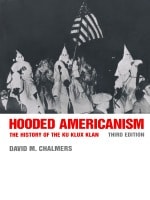
cover of Hooded Americanism: The History of the Ku Klux Klan

Hooded Americanism

The History of the Ku Klux Klan

David M. Chalmers

Duke University Press, 1987

"The only work that treats Ku Kluxism for the entire period of it's existence . . . the authoritative work on the period. Hooded Americanism is exhaustive in its rich detail and its use of primary materials to paint the picture of a century of terror. It is comprehensive, since it treats the entire period, and enjoys the perspective that the long view provides. It is timely, since it emphasizes the undeniable persistence of terrorism in American life."—John Hope Franklin
[more]
cover of The Ku Klux Klan in 1920s Arkansas: How Protestant White Nationalism Came to Rule a State

The Ku Klux Klan in 1920s Arkansas

How Protestant White Nationalism Came to Rule a State

Kenneth C. Barnes

University of Arkansas Press, 2021

Winner, 2022 J.G. Ragsdale Book Award, Arkansas Historical Association

The Ku Klux Klan established a significant foothold in Arkansas in the 1920s, boasting more than 150 state chapters and tens of thousands of members at its zenith. Propelled by the prominence of state leaders such as Grand Dragon James Comer and head of Women of the KKK Robbie Gill Comer, the Klan established Little Rock as a seat of power second only to Atlanta. In The Ku Klux Klan in 1920s Arkansas, Kenneth C. Barnes traces this explosion of white nationalism and its impact on the state’s development.

Barnes shows that the Klan seemed to wield power everywhere in 1920s Arkansas. Klansmen led businesses and held elected offices and prominent roles in legal, medical, and religious institutions, while the women of the Klan supported rallies and charitable activities and planned social gatherings where cross burnings were regular occurrences. Inside their organization, Klan members bonded during picnic barbeques and parades and over shared religious traditions. Outside of it, they united to direct armed threats, merciless physical brutality, and torrents of hateful rhetoric against individuals who did not conform to their exclusionary vision.

By the mid-1920s, internal divisions, scandals, and an overzealous attempt to dominate local and state elections caused Arkansas’s Klan to fall apart nearly as quickly as it had risen. Yet as the organization dissolved and the formal trappings of its flamboyant presence receded, the attitudes the Klan embraced never fully disappeared. In documenting this history, Barnes shows how the Klan’s early success still casts a long shadow on the state to this day.

[more]
cover of The Rise of the Ku Klux Klan: Right-Wing Movements and National Politics

The Rise of the Ku Klux Klan

Right-Wing Movements and National Politics

Rory McVeigh

University of Minnesota Press, 2009

In 1915, forty years after the original Ku Klux Klan disbanded, a former farmer, circuit preacher, and university lecturer named Colonel William Joseph Simmons revived the secret society. By the early 1920s the KKK had been transformed into a national movement with millions of dues-paying members and chapters in all of the nation’s forty-eight states. And unlike the Reconstruction-era society, the Klan in the 1920s exerted its influence far beyond the South. In The Rise of the Ku Klux Klan, Rory McVeigh provides a revealing analysis of the broad social agenda of 1920s-era KKK, showing that although the organization continued to promote white supremacy, it also addressed a surprisingly wide range of social and economic issues, targeting immigrants and, particularly, Catholics, as well as African Americans, as dangers to American society. In sharp contrast to earlier studies of the KKK, which focus on the local or regional level, McVeigh treats the Klan as it saw itself—as a national organization concerned with national issues. Drawing on extensive research into the Klan’s national publication, the Imperial Night-Hawk, he traces the ways in which Klan leaders interpreted national issues and how they attempted—and finally failed—to influence national politics. More broadly, in detailing the Klan’s expansion in the early 1920s and its collapse by the end of the decade, McVeigh ultimately sheds light on the dynamics that fuel contemporary right-wing social movements that similarly blur the line between race, religion, and values. 
[more]