Results by title
3 books match the query 'Kuklick, Bruce'
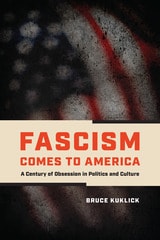
Fascism Comes to America
A Century of Obsession in Politics and CultureBruce Kuklick
University of Chicago Press, 2022
From the time Mussolini took power in Italy in 1922, Americans have been obsessed with and brooded over the meaning of fascism and how it might migrate to the United States. Fascism Comes to America examines how we have viewed fascism overseas and its implications for our own country. Bruce Kuklick explores the rhetoric of politicians, who have used the language of fascism to smear opponents, and he looks at the discussions of pundits, the analyses of academics, and the displays of fascism in popular culture, including fiction, radio, TV, theater, and film. Kuklick argues that fascism has little informational meaning in the United States, but instead, it is used to denigrate or insult. For example, every political position has been besmirched as fascist. As a result, the term does not describe a phenomenon so much as it denounces what one does not like. Finally, in displaying fascism for most Americans, entertainment—and most importantly film—has been crucial in conveying to citizens what fascism is about. Fascism Comes to America has been enhanced by many illustrations that exhibit how fascism was absorbed into the US public consciousness.
Fascism Comes to America
A Century of Obsession in Politics and CultureBruce Kuklick
University of Chicago Press, 2022
A deeply relevant look at what fascism means to Americans.
From the time Mussolini took power in Italy in 1922, Americans have been obsessed with and brooded over the meaning of fascism and how it might migrate to the United States. Fascism Comes to America examines how we have viewed fascism overseas and its implications for our own country. Bruce Kuklick explores the rhetoric of politicians, who have used the language of fascism to smear opponents, and he looks at the discussions of pundits, the analyses of academics, and the displays of fascism in popular culture, including fiction, radio, TV, theater, and film. Kuklick argues that fascism has little informational meaning in the United States, but instead, it is used to denigrate or insult. For example, every political position has been besmirched as fascist. As a result, the term does not describe a phenomenon so much as it denounces what one does not like. Finally, in displaying fascism for most Americans, entertainment—and most importantly film—has been crucial in conveying to citizens what fascism is about. Fascism Comes to America has been enhanced by many illustrations that exhibit how fascism was absorbed into the US public consciousness.

The Good Ruler
From Herbert Hoover to Richard NixonKuklick, Bruce
Rutgers University Press, 1989
Which American presidents have been good? Which have been bad? Experts on the presidency have never been able to agree on their assessments. Bruce Kuklick suggests that historians and political scientists have approached the problem of defining successful leadership without adequately considering the essential factor. Instead of trying to evaluate which presidents set consistent and worthy policies and brought them to fruition, Kuklick asks us to pay more attention to how the American people feel about their presidents. The citizenry and its emotional responses are sued as the measure of a successful president, rather than the ostensibly rational appraisals of scholars.
Applying this measure to the presidents from the Depression to Watergate, Kuklick begins by tracing the way in which Franklin Roosevelt established the parameters of the inspirational presidency and how his success shaped the study of political history. He then explores the triumphs of Eisenhower and Kennedy and contrasts these triumphs too the failures of Hoover, Truman, Johnson, and Nixon. The ability of leaders to win the respect and admiration of the citizenry is, for Kuklick, the crucial touchstone by which the success of a president is judged.
To highlight this position that is not useful for historians to justify the merits or failures of a president by pointing out what he would have done had he lived longer or in a different era, Kiklick includes and entertaining and enlightening fable, an imaginary view of historical events: Nixon is elected in 1960, giving a youthful tone to the White House until his assassination in 1967; Kennedy is elected in 1968 but resigns after he is accused of misconduct. The fable demonstrates that the specific events are less important than a president’s ability to evoke a positive emotional response from the citizenry. The Good Ruler analyzes our recent political history without partisan bias and examines the basic premises of American democratic politics.