Results by title
3 books match the query 'Kumar, Abhishek'
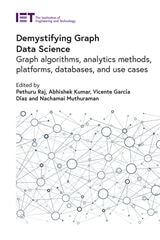
Demystifying Graph Data Science
Graph algorithms, analytics methods, platforms, databases, and use casesPethuru Raj
The Institution of Engineering and Technology, 2022
With the growing maturity and stability of digitization and edge technologies, vast numbers of digital entities, connected devices, and microservices interact purposefully to create huge sets of poly-structured digital data. Corporations are continuously seeking fresh ways to use their data to drive business innovations and disruptions to bring in real digital transformation. Data science (DS) is proving to be the one-stop solution for simplifying the process of knowledge discovery and dissemination out of massive amounts of multi-structured data.
[more]
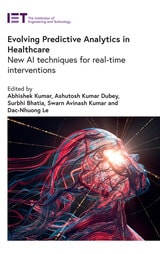
Evolving Predictive Analytics in Healthcare
New AI techniques for real-time interventionsAbhishek Kumar
The Institution of Engineering and Technology, 2022
A major use of practical predictive analytics in medicine has been in the diagnosis of current diseases, particularly through medical imaging. Now there is sufficient improvement in AI, IoT and data analytics to deal with real time problems with an increased focus on early prediction using machine learning and deep learning algorithms. With the power of artificial intelligence alongside the internet of 'medical' things, these algorithms can input the characteristics/data of their patients and get predictions of future diagnoses, classifications, treatment and costs.
[more]

Exploring Intelligent Healthcare with Quantum Computing
Abhishek Kumar
The Institution of Engineering and Technology, 2024
Classical computers encode information in binary bits that can either be 0s or 1s. In a quantum computer, the basic unit of memory is a quantum bit or qubit. These qubits play a similar role in terms of storing information, but use physical systems, such as the spin of an electron or the orientation of a photon, to do so. In situations where there are a large number of possible feature combinations, quantum computers can consider them simultaneously, speeding up the data processing time.
[more]