Results by title
2 books match the query 'Lâevinas, Emmanuel'
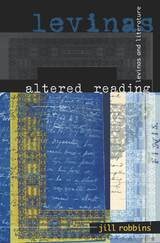
Altered Reading
Levinas and LiteratureJill Robbins
University of Chicago Press, 1999
How might the ethical philosophy of the renowned French thinker Emmanuel Levinas relate to literature? Because his philosophy addresses the very opening of ethical experience, it cannot be applied readily as a critical method to literary texts. Yet Levinas's work, studded as it is with literary sources and quotations, demands a literary account.
With an attitude at once respectful and interrogative, closely attentive to Levinas's texts while in dialogue with readings by Derrida, Blanchot, and Bataille, Altered Reading shows how the thread of the literary leads directly to the internal tensions of Levinas's ethical discourse. Jill Robbins provides a comprehensive critical account of Levinas's early and mature philosophy as well as later key transitional essays. In an invaluable appendix, she includes her own translation of an important, previously untranslated essay by Bataille on Levinas.
Altered Reading will interest philosophers, literary critics, scholars of religion, and others drawn to Levinas's work.
[more]
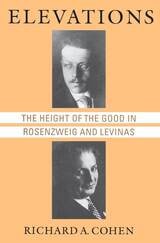
Elevations
The Height of the Good in Rosenzweig and LevinasRichard A. Cohen
University of Chicago Press, 1994
Elevations is a series of closely related essays on the ground-breaking philosophical and theological work of Emmanuel Levinas and Franz Rosenzweig, two of the twentieth century's most important Jewish philosophers. Focusing on the concept of transcendence, Richard A. Cohen shows that Rosenzweig and Levinas join the wisdom of revealed religions to the work of traditional philosophers to create a philosophy charged with the tasks of ethics and justice. He describes how they articulated a responsible humanism and a new enlightenment which would place moral obligation to the other above all other human concerns. This elevating pull of an ethics that can account for the relation of self and other without reducing either term is the central theme of these essays.
Cohen also explores the ethical philosophy of these two thinkers in relation to Nietzsche, Husserl, Heidegger, Buber, Sartre, and Derrida. The result is one of the most wide-ranging and lucid studies yet written on these crucial figures in philosophy and Jewish thought.
Cohen also explores the ethical philosophy of these two thinkers in relation to Nietzsche, Husserl, Heidegger, Buber, Sartre, and Derrida. The result is one of the most wide-ranging and lucid studies yet written on these crucial figures in philosophy and Jewish thought.
[more]