Results by title
5 books match the query 'LBJ'
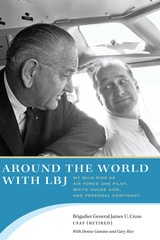
Around the World with LBJ
My Wild Ride as Air Force One Pilot, White House Aide, and Personal ConfidantBy Brigadier General James U. Cross, USAF (retired), with Denise Gamino and Gary Rice
University of Texas Press, 2008
When Lyndon Baines Johnson wanted to go somewhere, there was no stopping him. This dynamic president called for Air Force One as others summon a taxi—at a moment's notice, whatever the hour or the weather. And the man who made sure that LBJ got his ride was General James U. Cross, the president's hand-picked pilot, top military assistant, and personal confidante. One of the few Air Force One pilots to have a position, simultaneously, in the White House, General Cross is also the only member of LBJ's inner circle who has not publicly offered his recollections of the president. In this book, he goes on the record, creating a fascinating, behind-the-scenes portrait of America's complex, often contradictory, always larger-than-life thirty-sixth president.
General Cross tells an engrossing story. In addition to piloting Air Force One around the globe, he served President Johnson in multiple capacities, including directing the Military Office in the White House; managing a secret two-million-dollar presidential emergency fund; supervising the presidential retreat at Camp David, the president's entire transportation fleet, and the presidential bomb shelters; running the White House Mess; hiring White House social aides, including the president's future son-in-law, Charles Robb; and writing condolence letters to the families of soldiers killed in Vietnam. This wide-ranging, around-the-clock access to President Johnson allowed Cross to witness events and share moments that add color and depth to our understanding of America's arguably most demanding and unpredictable president.
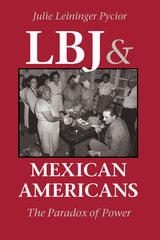
LBJ and Mexican Americans
The Paradox of PowerBy Julie Leininger Pycior
University of Texas Press, 1997
T. R. Fehrenbach Award, 1997
As he worked to build his Great Society, Lyndon Johnson often harkened back to his teaching days in the segregated "Mexican" school at Cotulla, Texas. Recalling the poverty and prejudice that blighted his students' lives, Johnson declared, "It never occurred to me in my fondest dreams that I might have the chance to help the sons and daughters of those students and to help people like them all over this country. But now I do have that chance—and I'll let you in on a secret—I mean to use it."
This book explores the complex and sometimes contradictory relations between LBJ and Mexican Americans. Julie Pycior shows that Johnson's genuine desire to help Mexican Americans—and reap the political dividends—did not prevent him from allying himself with individuals and groups intent on thwarting Mexican Americans' organizing efforts. Not surprisingly, these actions elicited a wide range of response, from grateful loyalty to, in some cases, outright opposition. Mexican Americans' complicated relationship with LBJ influenced both their political development and his career with consequences that reverberated in society at large.
LBJ and Vietnam
A Different Kind of WarBy George C. Herring
University of Texas Press, 1994
Decades later, the Vietnam War remains a divisive memory for American society. Partisans on all sides still debate why the war was fought, how it could have been better fought, and whether it could have been won at all.
In this major study, a noted expert on the war brings a needed objectivity to these debates by examining dispassionately how and why President Lyndon Johnson and his administration conducted the war as they did. Drawing on a wealth of newly released documents from the LBJ Library, including the Tom Johnson notes from the influential Tuesday Lunch Group, George Herring discusses the concept of limited war and how it affected President Johnson's decision making, Johnson's relations with his military commanders, the administration's pacification program of 1965-1967, the management of public opinion, and the "fighting while negotiating" strategy pursued after the Tet Offensive in 1968.
The author's in-depth analysis exposes numerous flaws in Johnson's management of the war. In Herring's view, the Johnson administration lacked any overall strategy for conducting the war. No change in approach was ever discussed, despite popular and even administration dissatisfaction with the progress of the war, and no oversight committee coordinated the activities of the military services and various governmental agencies, which were left to follow their own, often conflicting, agendas.
LBJ and the Presidential Management of Foreign Relations
By Paul Y. Hammond
University of Texas Press, 1993
In this insightful study, Paul Y. Hammond, an experienced analyst of bureaucratic politics, adapts and extends that approach to explain and evaluate the Johnson administration’s performance in foreign relations in terms that have implications for the post–Cold War era.
The book is structured around three case studies of Johnson’s foreign policy decision making. The first study examines economic and political development. It explores the way Johnson handled the provision of economic and food assistance to India during a crisis in India’s food policies. This analysis provides lessons not only for dealing with African famine in later years but also for assisting Eastern Europe and the former Soviet Union.
The second case study focuses on U.S. relations with Western Europe at a time that seemed to require a major change in the NATO alliance. Here, Hammond illuminates the process of policy innovation, particularly the costs of changing well-established policies that embody an elaborate network of established interests. The third case study treats the Vietnam War, with special emphasis on how Johnson decided what to do about Vietnam. Hammond critiques the rich scholarship available on Johnson’s advisory process, based on his own reading of the original sources.
These case studies are set in a larger context of applied theory that deals more generally with presidential management of foreign relations, examining a president’s potential for influence on the one hand and the constraints on his or her capacity to control and persuade on the other. It will be important reading for all scholars and policymakers interested in the limits and possibilities of presidential power in the post–Cold War era.
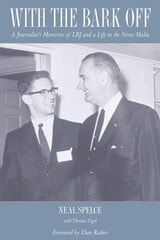
With the Bark Off
A Journalist’s Memories of LBJ and a Life in the News MediaNeal Spelce with Thomas Zigal
University of Texas Press, 2021