Results by title

10 books match the query 'LGBT activism'

cover of Between HIV Prevention and LGBTI Rights: The Political Economy of Queer Activism in Ghana

Between HIV Prevention and LGBTI Rights

The Political Economy of Queer Activism in Ghana

Ellie Gore

University of Michigan Press, 2024

Between HIV Prevention and LGBTI Rights investigates the transformative impacts of global development's sexual rights agenda on queer politics and activism in Ghana. With queer men bearing a disproportionate burden of HIV in Africa, rights-based health interventions have sought to tackle the epidemic by bringing together, educating, and ‘empowering’ queer African communities. Gore argues that queer Ghanaian men are not benefiting from development’s turn to sexual health and sexual rights. Instead, HIV and other sexual rights–based initiatives operate through neoliberal paradigms that reinforce class divides and de-politicize queer struggle. These dynamics are further shaping and shaped by the politicization of homophobia within the contemporary Ghanaian state.

Gore combines original ethnography, documentary analysis, and the examination of development and global health data to connect the struggle for queer liberation in Ghana to broader trajectories of capitalist transformation and crisis and the afterlives of colonialism. In doing so, Between HIV Prevention and LGBTI Rights offers fascinating insights into the political economy of sexuality and global development for scholars, activists, and policymakers seeking to understand and address sexual injustice and oppression, both in Africa and beyond.

The open access edition of this book was made possible through the support of the Economic and Social Research Council (UK).

[more]
cover of Blood Loss: A Love Story of AIDS, Activism, and Art

Blood Loss

A Love Story of AIDS, Activism, and Art

Keiko Lane

Duke University Press, 2024

In 1991, sixteen-year-old activist Keiko Lane joined the Los Angeles chapters of Queer Nation and ACT UP. Their members protested legislation aimed at dismantling rights for LGBTQ people, people living with HIV, and immigrants while fighting for needle-exchange programs, reproductive justice, safer-sex education, hospice funding, and the right to die with dignity. At the same time, the activists were a queer chosen family of friends and lovers who took care of one another in sickness and in health. Sometimes they helped each other die. By the time Lane turned twenty-two, most had died of AIDS. In her evocative memoir, Lane weaves together love stories and afterlives of queer resistance and survival against the landscape of the Rodney King Rebellion, the movement for queer rights, and the censorship of queer artists and sexualities. Lane interrogates the social construction of power against and in queer communities of color and the recovery of sexual agency in the midst and aftermath of violence. Luminous and powerfully moving, Blood Loss explores survival after those we love have died.
[more]
cover of Bodies on the Front Lines: Performance, Gender, and Sexuality in Latin America and the Caribbean

Bodies on the Front Lines

Performance, Gender, and Sexuality in Latin America and the Caribbean

Brenda Werth and Katherine Zien, Editors

University of Michigan Press, 2024

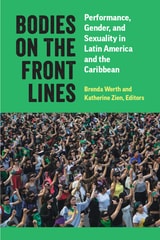
Revolutionary feminisms and queer and trans activist movements are traversing Latin America and the Caribbean. Bodies on the Front Lines situates recent performances and protest actions within legacies of homegrown gender and sexual rights activism from the South. Performances — enacted in public spaces and intimate venues, across national borders, and through circulating hashtags and digital media — play crucial roles in the elaboration, auto-theorization, translation, and reception of feminist, queer, and trans activism. Movements such as Argentina's NiUnaMenos (Not One Less) have brought together hundreds of thousands of protesters and ‘artivists’ on the streets of major cities in Latin America and beyond to denounce gender violence and demand gender, sexual, and reproductive rights. 

The volume’s contributors draw from rich legacies of theater, performance, and activism in the region, as well as decolonial and intersectional theorizing, to demonstrate the ways that performance practices enable activists to sustain their movements. The chapters engage diverse perspectives from Argentina, Brazil, Bolivia, Chile, Colombia, Cuba, the Dominican Republic, transnational Central America, Peru, Puerto Rico, and Mexico.
 
Rather than taking an approach that simplifies complexities among states, Bodies on the Front Lines takes seriously the geopolitical stakes of examining Latin America and the Caribbean as a heterogeneous site of nations and networks. In chapters covering this wide geographical area, leading scholars in the fields of theater and performance studies showcase the aesthetic, social, and political work of performance in generating and fortifying gender and sexual activism in the Americas.

[more]
cover of Brazil's Sex Wars: The Aesthetics of Queer Activism in São Paulo

Brazil's Sex Wars

The Aesthetics of Queer Activism in São Paulo

Joseph Jay Sosa

University of Texas Press, 2024

An ethnography and media analysis of LGBT+ activism in São Paulo during Brazil’s conservative turn from 2010 to 2018.

For decades, LGBT+ activists across the globe have secured victories by persuasively articulating rights to sexual autonomy. Brazilian activists, some of the world’s most energetic, have kept pace. But since 2010, a backlash has set in, as defenders of “tradition” and “family” have countered LGBT+ rights discourses using a rights-based language of their own.

To understand this shifting ground, Joseph Jay Sosa collaborated with Brazilian LGBT+ activists, who use the language of rights while knowing that rights are not what they seem. Drawing on the symbolic and affective qualities of rights, activists mobilize slogans, bodies, and media to articulate an alternative democratic sensorium. Beyond conventional notions of rights as tools for managing the obligations of states vis-à-vis citizens, activists show how rights operate aesthetically—enjoining the public to see and feel as activists do. Sosa tracks the fate of LGBT+ rights in a growing authoritarian climate that demands “human rights for the right humans.” Interpreting conflicts between advocates and opponents over LGBT+ autonomy as not just an ideological struggle but an aesthetic one, Brazil’s Sex Wars rethinks a style of politics that seems both utterly familiar and counterintuitive.

[more]
cover of Care without Pathology: How Trans- Health Activists Are Changing Medicine

Care without Pathology

How Trans- Health Activists Are Changing Medicine

Christoph Hanssmann

University of Minnesota Press, 2023

Examining trans- healthcare as a key site through which struggles for health and justice take shape


Over the past two decades, medical and therapeutic approaches to transgender patients have changed radically, from treating a supposed pathology to offering gender-affirming care. Based on ethnographic fieldwork in New York City and Buenos Aires, Care without Pathology moves across the Americas to show how trans- health activists have taken on the project of depathologization.


In New York, Christoph Hanssmann examines activist attempts to overturn bans on using public health dollars to fund trans- health care. In Argentina, he traces how trans- activists marshaled medical statistics and personal biographies to reveal state violence directed against trans- people and travestis. Hanssmann also demonstrates the importance of understanding transphobia in the broader context of gendered racism, ableism, and antipoverty, arguing for the rise of a thoroughly coalition-based mass mobilization.


Care without Pathology highlights the distributive arguments activists made to access state funding for health care, combating state arguments that funding trans- health care is too specialized, too expensive, and too controversial. Hanssmann situates trans- health as a crucible within which sweeping changes are taking place—with potentially far-reaching effects on the economic and racial barriers to accessing care.
[more]
cover of Conceptual Activism: Radical Sense-Making and the Struggle for Gender

Conceptual Activism

Radical Sense-Making and the Struggle for Gender

Davina Cooper

Duke University Press, 2026

The struggle over defining, naming, and using concepts is central to many political conflicts. In this original account of conceptual activism, Davina Cooper asks how new conceptual meanings are made, used, held, and experienced. Drawing on theoretical and empirical research, she analyzes the high-profile contemporary conflict in Britain over sex and gender. Here policymakers, regulatory bodies, community organizations, and academics fight to draw and redraw categories and their boundaries in a struggle that has spread across the census, speculative law reform, equality governance, and more. To understand the techniques and challenges that the advancement of new and controversial meanings faces, Conceptual Activism offers an innovative account of concepts and how meaning is reorganized in conditions of resistance, attentive to concepts’ materiality, plasticity, force, and unexpected encounters. As sex and gender meet economy, property, play, and activism, Cooper demonstrates how and why academic work should engage in conceptual activism.
[more]
cover of Home Is Where Your Politics Are: Queer Activism in the U.S. South and South Africa

Home Is Where Your Politics Are

Queer Activism in the U.S. South and South Africa

Jessica A. Scott

Rutgers University Press, 2024
Home Is Where Your Politics Are is a transnational consideration of queer and trans activism in the US South and South Africa. Through ethnographic exploration of queer and trans activist work in both places, Jessica Scott paints a vibrant picture of what life is like in relation to a narrative that says that queer life is harder, if not impossible, in rural areas and on the African continent. The book asks questions like, what do activists in these places care about and how do stories about where they live get in the way of the life they envision for the queer and trans people for whom they advocate? Answers to these questions provide insight that only these activists have, into the complexity of locally based advocacy strategies in a globalized world.
[more]
cover of Queer Throughlines: Spaces of Queer Activism in South Korea and the Korean Diaspora

Queer Throughlines

Spaces of Queer Activism in South Korea and the Korean Diaspora

Ju Hui Judy Han

University of Michigan Press, 2025

Queer Throughlines draws on years of direct participation, interviews, and ethnography to examine transnational Korean LGBTQ+ activism since the 1990s. Han maps the sites and routes of leftist and queer political movements, highlighting challenges posed by Christian conservatives in both South Korea and the United States. The book uses the concept of “throughlines” to weave together a web of movement stories across time and space: a coalition of Los Angeles–based LGBTQ+ activists and allies fighting an anti-gay petition campaign led by Korean immigrant churches; queer activists involved in anti-war protests in Seoul; progressive clergy embracing inclusivity and risking heresy charges and excommunication; and queer and trans activists refusing to be sidelined from visions of political change underway. These moments do not always line up in a straightforward narrative of victory or progress, yet they create powerful lines of solidarity, community, and kinship.
[more]
cover of Sideways Developments: Queer and Trans Aesthetics of Global Hong Kong

Sideways Developments

Queer and Trans Aesthetics of Global Hong Kong

Kai Hang Cheang

University of Michigan Press, 2026

Sideways Developments examines Hong Kong Anglophone and Cantophone literature and visual culture to trace the forms of queer and trans survival and flourishing in the Asian century. Contesting the cisgender, heterosexual, linear tropes that constitute developmentalist narratives deployed by superpowers—from colonial Britain to 20th-century America to a rising China—Cheang argues that sideways aesthetics define the narratives through which the LGBTQ+ community navigates personal and socioeconomic transitions. Through formalist analyses of a range of genres, Cheang reveals the affordances of queer and trans cultures for addressing the question of Hong Kong during its period of promised transition until 2047.

In this moment of multiple crises, Sideways Developments offers a timely hermeneutic and theory of solidarity and sustainability. The book tracks how sideways aesthetics have evolved from a feature of LGBTQ+ plots, performance, and nonlinear approaches to space-time to a form of togetherness that links postcolonial Hong Kong with struggles worldwide. Using what Cheang terms intersectional formalism as an analytical tool, the book provides a multilayered examination of the alternative pathways exemplified by queer and trans resilience and regeneration.
[more]
cover of The Dream of a Common Movement: Selected Writings of Urvashi Vaid

The Dream of a Common Movement

Selected Writings of Urvashi Vaid

Urvashi Vaid. Edited by Jyotsna Vaid and Amy Hoffman

Duke University Press, 2025

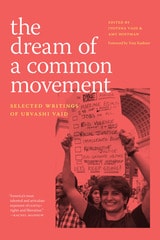
The Dream of a Common Movement collects essays, interviews, and speeches by the late feminist and civil rights activist Urvashi Vaid, whose pioneering writing and organizing over the course of four decades fundamentally shaped the LGBTQ+ movement. Vaid explores the LGBTQ+ movement’s impact on the AIDS epidemic and its challenges as it developed a national presence. She calls out movement leaders and donors for not addressing gender, race, and class issues and passionately argues that the goal of any liberation movement should be transformation, not assimilation. In personal essays, Vaid describes a double consciousness forged by the experience of immigration and a complicated relationship with her Indian-American and lesbian identities. Whether she was focused on the Donors of Color Network, the 22nd Century Initiative, the Lesbian Political Action Committee, or other initiatives she launched, Vaid was steadfast in her vision of a more just society and believed deeply in the power of people coming together to effect change. Offering a window into the breadth of her progressive vision for social change, this volume inspires readers to never stop organizing and marching.
[more]