Results by title
4 books match the query 'Labor in literature'
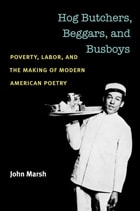
Hog Butchers, Beggars, and Busboys
Poverty, Labor, and the Making of Modern American PoetryJohn Marsh
University of Michigan Press, 2011
"Impressive—Marsh successfully rewrites the founding moment of American Modernist poetry."
---Mark Van Wienen, Northern Illinois University
"Cogently argued, instructive, and sensitive, Marsh’s revisionist reading opens new insights that will elicit lively comment and critical response."
---Douglas Wixson, University of Missouri–Rolla
Between 1909 and 1922, the genre of poetry was remade. Literary scholars have long debated why modern American poetry emerged when and how it did. While earlier poetry had rhymed, scanned, and dealt with conventional subjects such as love and nature, modern poetry looked and sounded very different and considered new areas of experience. Hog Butchers, Beggars, and Busboys: Poverty, Labor, and the Making of Modern American Poetry argues that this change was partially the result of modern poets writing into their verse what other poetry had suppressed: the gritty realities of modern life, including the problems of the poor and working class.
A closer look at the early works of the 20th century's best known poets (William Carlos Williams, T. S. Eliot, Edna St. Vincent Millay, Claude McKay, Langston Hughes, and Carl Sandburg) reveals the long-neglected role the labor problem—including sweatshops, strikes, unemployment, woman and child labor, and immigration---played in the formation of canonical modern American poetry. A revisionary history of literary modernism and exploration into how poets uniquely made the labor problem their own, this book will appeal to modernists in the fields of American and British literature as well as scholars in American studies and the growing field of working-class literature.
Human
Babylonian Reflections on LaborSophus Helle
University of Chicago Press, 2026
The Babylonian poem Atra-hasis is a forgotten masterpiece of political thought. Written in Akkadian in what is now southern Iraq during the early second millennium BCE, Atra-hasis gives us a glimpse of how ancient poets understood the society growing around them. This radical history of the world told from the perspective of the mother goddess conveys the complexity and contradictions that lie at the heart of the human experience. Atra-hasis tells how humanity was created as part of a bargain to resolve the world’s first labor strike, in which the lower gods rebelled against the excessive work imposed on them by the higher gods. It depicts humans as workers endowed with defiant intelligence. They multiply and become too loud, so the gods decide to quiet them with a cataclysmic flood.
Looking to Atra-hasis, Sophus Helle reveals an ancient story with reflections on power and history that invite comparison to topics of contemporary relevance, including labor, inequality, climate change, artificial intelligence, threats to democracy, disability, care work, sexual consent, and more. Helle considers Atra-hasis as a foundational document of “pasthumanism,” a term he uses to describe the study of how cultural conceptions of humanity have changed across centuries. He argues that ancient and non-Western texts remind us that cultural assumptions we now take for granted are neither natural nor necessary.
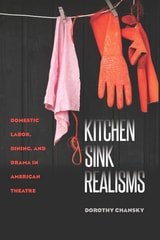
Kitchen Sink Realisms
Domestic Labor, Dining, and Drama in American TheatreDorothy Chansky
University of Iowa Press, 2015
In analyzing kitchen sink realisms, Dorothy Chansky reveals the ways that food preparation, domestic labor, dining, serving, entertaining, and cleanup saturate the lives of dramatic characters and situations even when they do not take center stage. Offering resistant readings that rely on close attention to the particular cultural and semiotic environments in which plays and their audiences operated, she sheds compelling light on the changing debates about women’s roles and the importance of their household labor across lines of class and race in the twentieth century.
The story begins just after World War I, as more households were electrified and fewer middle-class housewives could afford to hire maids. In the 1920s, popular mainstream plays staged the plight of women seeking escape from the daily grind; African American playwrights, meanwhile, argued that housework was the least of women’s worries. Plays of the 1930s recognized housework as work to a greater degree than ever before, while during the war years domestic labor was predictably recruited to the war effort—sometimes with gender-bending results. In the famously quiescent and anxious 1950s, critiques of domestic normalcy became common, and African American maids gained a complexity previously reserved for white leading ladies. These critiques proliferated with the re-emergence of feminism as a political movement from the 1960s on. After the turn of the century, the problems and comforts of domestic labor in black and white took center stage. In highlighting these shifts, Chansky brings the real home.

The Briny South
Displacement and Sentiment in the Indian Ocean WorldNienke Boer
Duke University Press, 2023