Results by title

25 books match the query 'Labor supply'
cover of A Nation at Work: The Heldrich Guide to the American Workforce

A Nation at Work

The Heldrich Guide to the American Workforce

Van Horn, Carl E

Rutgers University Press, 2003

In the United States work underlies our very concept of who we are. Changes in society and technology have influenced how and where we work, and transformations within the workplace in turn have altered our society.

A Nation at Work addresses the fundamental economic, demographic, policy, and business facts about how the workforce and workplace are changing in the early twenty-first century. Illustrated with over thirty-five graphs, Part I covers essential topics about the American workforce and workers. Part II gathers essays and speeches from the nation's outstanding journalists and workplace analysts. The book incorporates facts and data, including invaluable tables and listings for useful Internet sites, books, and organizations.

Comprehensive in scope, A Nation at Work will help readers reach a better understanding about their own work and the world of work around them.

[more]
cover of A Will for the Machine: Computerization, Automation, and the Arts in South Africa

A Will for the Machine

Computerization, Automation, and the Arts in South Africa

Mark Sanders

University of Chicago Press, 2026

This study takes up the relations among computerization, labor, and the arts in South Africa.

There are many books about the history and discourses of computerization in the United States but relatively little about these phenomena anywhere in the Global South. In A Will for the Machine, Mark Sanders outlines South Africa’s entry into the computer age in the 1960s and ’70s and explains how it coincided with the high point of apartheid. South Africa’s government viewed automation and computerization as one way of barring Black Africans from skilled work and reserving it for whites. Sanders unpacks this peculiar history, relates it to early twentieth-century struggles around mechanization in mining and telephony in South Africa, and analyzes responses to it by the writers Miriam Tlali and J. M. Coetzee, the artist William Kentridge, and Handspring Puppet Company. Showing how the arts realize ideas about the ethics and politics of automation, Sanders contributes to debates about locally divergent understandings of computer technology and human-computer interaction.

[more]
cover of Augmented Exploitation: Artificial Intelligence, Automation and Work

Augmented Exploitation

Artificial Intelligence, Automation and Work

Phoebe Moore

Pluto Press, 2021

Artificial Intelligence is a seemingly neutral technology, but it is increasingly used to manage workforces and make decisions to hire and fire employees. Its proliferation in the workplace gives the impression of a fairer, more efficient system of management. A machine can't discriminate, after all. Augmented Exploitation explores the reality of the impact of AI on workers' lives. While the consensus is that AI is a completely new way of managing a workplace, the authors show that, on the contrary, AI is used as most technologies are used under capitalism: as a smokescreen that hides the deep exploitation of workers. Going beyond platform work and the gig economy, the authors explore emerging forms of algorithmic governance and AI-augmented apps that have been developed to utilise innovative ways to collect data about workers and consumers, as well as to keep wages and worker representation under control. They also show that workers are not taking this lying down, providing case studies of new and exciting form of resistance that are springing up across the globe.
[more]
cover of Collision Course: Economic Change, Criminal Justice Reform, and Work in America

Collision Course

Economic Change, Criminal Justice Reform, and Work in America

Kathleen Auerhahn

Rutgers University Press, 2022

This book is about the convergence of trends in two American institutions – the economy and the criminal justice system. The American economy has radically transformed in the past half-century, led by advances in automation technology that have permanently altered labor market dynamics. Over the same period, the U.S. criminal justice system experienced an unprecedented expansion at great cost.  These costs include not only the $80 billion annually in direct expenditures on criminal justice, but also the devastating impacts experienced by justice-involved individuals, families, and communities. 
 
Recently, a widespread consensus has emerged that the era of “mass incarceration” is at an end, reflected in a declining prison population. Criminal justice reforms such as diversion and problem-solving courts, a renewed focus on reentry, and drug policy reform have as their goal keeping more individuals with justice system involvement out of prisons, in the community and subsequently in the labor force, which lacks the capacity to accommodate these additional would-be workers. This poses significant problems for criminal justice practice, which relies heavily on employment as a signal of offenders’ intentions to live a law-abiding lifestyle. The diminished capacity of the economy to utilize the labor of all who have historically been expected to work presents significant challenges for American society. Work, in the American ethos is the marker of success, masculinity and how one “contributes to society.” What are the consequences of ignoring these converging structural trends? This book examines these potential consequences, the meaning of work in American society, and suggests alternative redistributive and policy solutions to avert the collision course of these economic and criminal justice policy trends.
 
[more]
cover of Education, Skills, and Technical Change: Implications for Future US GDP Growth

Education, Skills, and Technical Change

Implications for Future US GDP Growth

Edited by Charles R. Hulten and Valerie A. Ramey

University of Chicago Press, 2018

Over the past few decades, US business and industry have been transformed by the advances and redundancies produced by the knowledge economy. The workplace has changed, and much of the work differs from that performed by previous generations. Can human capital accumulation in the United States keep pace with the evolving demands placed on it, and how can the workforce of tomorrow acquire the skills and competencies that are most in demand?

Education, Skills, and Technical Change explores various facets of these questions and provides an overview of educational attainment in the United States and the channels through which labor force skills and education affect GDP growth. Contributors to this volume focus on a range of educational and training institutions and bring new data to bear on how we understand the role of college and vocational education and the size and nature of the skills gap. This work links a range of research areas—such as growth accounting, skill development, higher education, and immigration—and also examines how well students are being prepared for the current and future world of work.

[more]
cover of Empirical Foundations of Household Taxation

Empirical Foundations of Household Taxation

Edited by Martin Feldstein and James M. Poterba

University of Chicago Press, 1996

Tax policy debates—and reforms—depend heavily on estimates of how alternative tax rules would affect behavior. Yet there is considerable controversy about the key empirical links among tax rates, household decisions, and revenue collections.

The nine papers in this volume exploit the substantial variation in U.S. tax policy during the last two decades to investigate how taxes affect a range of household behavior, including labor-force participation, saving behavior, choice of health insurance plan, choice of child care arrangements, portfolio choice, and tax evasion. They also present new analytical results on the effects of different types of tax policy. All of this research relies on household-level data—drawn either from public-use tax return files or from large household-level surveys—to explore various aspects of the relationship between taxes and household behavior.

As debates about the effects of proposed tax reforms continue in the 1990s, this volume will be of interest to policy makers and scholars in the field of public finance.

[more]
cover of Fifty Years of Change on the U.S.-Mexico Border: Growth, Development, and Quality of Life

Fifty Years of Change on the U.S.-Mexico Border

Growth, Development, and Quality of Life

By Joan B. Anderson and James Gerber

University of Texas Press, 2007

Winner, Book Award, Associaton for Borderland Studies, 2008

The U.S. and Mexican border regions have experienced rapid demographic and economic growth over the last fifty years. In this analysis, Joan Anderson and James Gerber offer a new perspective on the changes and tensions pulling at the border from both sides through a discussion of cross-border economic issues and thorough analytical research that examines not only the dramatic demographic and economic growth of the region, but also shifts in living standards, the changing political climate, and environmental pressures, as well as how these affect the lives of people in the border region.

Creating what they term a Border Human Development Index, the authors rank the quality of life for every U.S. county and Mexican municipio that touches the 2,000-mile border. Using data from six U.S. and Mexican censuses, the book adeptly illustrates disparities in various aspects of economic development between the two countries over the last six decades.

Anderson and Gerber make the material accessible and compelling by drawing an evocative picture of how similar the communities on either side of the border are culturally, yet how divided they are economically. The authors bring a heightened level of insight to border issues not just for academics but also for general readers. The book will be of particular value to individuals interested in how the border between the two countries shapes the debates on quality of life, industrial growth, immigration, cross-border integration, and economic and social development.
[more]
cover of Good Jobs, Bad Jobs: The Rise of Polarized and Precarious Employment Systems in the United States, 1970s-2000s

Good Jobs, Bad Jobs

The Rise of Polarized and Precarious Employment Systems in the United States, 1970s-2000s

Arne L. Kalleberg

Russell Sage Foundation, 2011

The economic boom of the 1990s veiled a grim reality: in addition to the growing gap between rich and poor, the gap between good and bad quality jobs was also expanding. The postwar prosperity of the mid-twentieth century had enabled millions of American workers to join the middle class, but as author Arne L. Kalleberg shows, by the 1970s this upward movement had slowed, in part due to the steady disappearance of secure, well-paying industrial jobs. Ever since, precarious employment has been on the rise—paying low wages, offering few benefits, and with virtually no long-term security. Today, the polarization between workers with higher skill levels and those with low skills and low wages is more entrenched than ever. Good Jobs, Bad Jobs traces this trend to large-scale transformations in the American labor market and the changing demographics of low-wage workers. Kalleberg draws on nearly four decades of survey data, as well as his own research, to evaluate trends in U.S. job quality and suggest ways to improve American labor market practices and social policies. Good Jobs, Bad Jobs provides an insightful analysis of how and why precarious employment is gaining ground in the labor market and the role these developments have played in the decline of the middle class. Kalleberg shows that by the 1970s, government deregulation, global competition, and the rise of the service sector gained traction, while institutional protections for workers—such as unions and minimum-wage legislation—weakened. Together, these forces marked the end of postwar security for American workers. The composition of the labor force also changed significantly; the number of dual-earner families increased, as did the share of the workforce comprised of women, non-white, and immigrant workers. Of these groups, blacks, Latinos, and immigrants remain concentrated in the most precarious and low-quality jobs, with educational attainment being the leading indicator of who will earn the highest wages and experience the most job security and highest levels of autonomy and control over their jobs and schedules. Kalleberg demonstrates, however, that building a better safety net—increasing government responsibility for worker health care and retirement, as well as strengthening unions—can go a long way toward redressing the effects of today’s volatile labor market. There is every reason to expect that the growth of precarious jobs—which already make up a significant share of the American job market—will continue. Good Jobs, Bad Jobs deftly shows that the decline in U.S. job quality is not the result of fluctuations in the business cycle, but rather the result of economic restructuring and the disappearance of institutional protections for workers. Only government, employers and labor working together on long-term strategies—including an expanded safety net, strengthened legal protections, and better training opportunities—can help reverse this trend. A Volume in the American Sociological Association’s Rose Series in Sociology.
[more]
cover of Human Capital in History: The American Record

Human Capital in History

The American Record

Edited by Leah Platt Boustan, Carola Frydman, and Robert A. Margo

University of Chicago Press, 2014

America’s expansion to one of the richest nations in the world was partly due to a steady increase in labor productivity, which in turn depends upon the invention and deployment of new technologies and on investments in both human and physical capital. The accumulation of human capital—the knowledge and skill of workers—has featured prominently in American economic leadership over the past two centuries.
           
Human Capital in History brings together contributions from leading researchers in economic history, labor economics, the economics of education, and related fields. Building on Claudia Goldin’s landmark research on the labor history of the United States, the authors consider the roles of education and technology in contributing to American economic growth and well-being, the experience of women in the workforce, and how trends in marriage and family affected broader economic outcomes. The volume provides important new insights on the forces that affect the accumulation of human capital.
[more]
cover of Jobless Future: Sci-Tech and the Dogma of Work

Jobless Future

Sci-Tech and the Dogma of Work

Stanley Aronowitz

University of Minnesota Press, 1995
Essential reading for those seeking solutions to the new jobless economy. This widely reviewed and highly successful book examines the job market of tomorrow. Aronowitz and DiFazio take you behind the headlines to challenge the idea that a high-tech economy will provide high-paying jobs for all who want them. Instead, they demonstrate that we're more likely to see continued layoffs and job displacement. "Imagine a Brave New Work World in which unemployment is so rampant that more than a third of the adult population can't find a job and millions of others have stopped looking. Another third works only part-time, or at temporary or dead-end jobs. Meanwhile, the number of those still holding full-time positions steadily diminishes, their wages depressed because of the premium placed simply on having a job. . . . 'People need to start thinking about a jobless future,' insist [Aronowitz and DeFazio] . . . . Tha authors attribute rising unemployment to economic stagnation coupled with revolutionary technological change that has fostered workplace trends such as downsizing, re-engineering, with part-time jobs, temporary jobs and job-sharing replacing full-time work." --Washington Post "Looks beyond the shadow play of welfare politics to the real source of that anxiety-the modern workplace. . . . Aronowitz and DiFazio are quite right to look beyond the dismal realities of today's workplace and envision a society that uses the fruits of technology to abolish-or at least diminish-what the left used to call wage slavery." --The Nation "Replete with such futuristic concepts as cybernetics, technoculture, de-skilling, and informatics, this book is as timely as today's headlines announcing the latest round of layoffs and down-sizing. . . an important and thought-provoking work." --Library Journal Stanley Aronowitz is professor of sociology at the Graduate Center of the City University of New York. William DiFazio is professor of sociology at St. John's University
[more]
cover of Jobs and the Labor Force of Tomorrow: Migration, Training, Education

Jobs and the Labor Force of Tomorrow

Migration, Training, Education

Michael Pagano

University of Illinois Press, 2017

The new volume in the Urban Agenda series addresses the challenges shaping the development of human capital in metropolitan regions. The articles, products of the 2016 Urban Forum at the University of Illinois at Chicago, engage with the overarching idea that a dynamic metropolitan economy needs a diverse, trained, and available workforce that can adapt to the needs of commerce, industry, government, and the service sector. Authors explore provocative issues like the jobless recovery, migration and immigration, K-12 education preparedness, the urban-oriented gig economy, postsecondary workforce training, and the recruitment and professional development of millennials.

Contributors: Xochitl Bada, John Bragelman, Laura Dresser, Rudy Faust, Beth Gutelius, Brad Harrington, Gregory V. Larnell, Twyla T. Blackmond Larnell, and Nik Theodore.
[more]
cover of Labor Statistics Measurement Issues

Labor Statistics Measurement Issues

Edited by John Haltiwanger, Marilyn E. Manser, and Robert H. Topel

University of Chicago Press, 1998

Rapidly changing technology, the globalization of markets, and the declining role of unions are just some of the factors that have led to dramatic changes in working conditions in the United States. Little attention has been paid to the difficult measurement problems underlying analysis of the labor market. Labor Statistics Measurement Issues helps to fill this gap by exploring key theoretical and practical issues in the measurement of employment, wages, and workplace practices.

Some of the chapters in this volume explore the conceptual issues of what is needed, what is known, or what can be learned from existing data, and what needs have not been met by available data sources. Others make innovative uses of existing data to analyze these topics. Also included are papers examining how answers to important questions are affected by alternative measures used and how these can be reconciled. This important and useful book will find a large audience among labor economists and consumers of labor statistics.
[more]
cover of Labor's End: How the Promise of Automation Degraded Work

Labor's End

How the Promise of Automation Degraded Work

Jason Resnikoff

University of Illinois Press, 2022

Labor's End traces the discourse around automation from its origins in the factory to its wide-ranging implications in political and social life. As Jason Resnikoff shows, the term automation expressed the conviction that industrial progress meant the inevitable abolition of manual labor from industry. But the real substance of the term reflected industry's desire to hide an intensification of human work--and labor's loss of power and protection--behind magnificent machinery and a starry-eyed faith in technological revolution. The rhetorical power of the automation ideology revealed and perpetuated a belief that the idea of freedom was incompatible with the activity of work. From there, political actors ruled out the workplace as a site of politics while some of labor's staunchest allies dismissed sped-up tasks, expanded workloads, and incipient deindustrialization in the name of technological progress.

A forceful intellectual history, Labor's End challenges entrenched assumptions about automation's transformation of the American workplace.

[more]
cover of Labour Statistics for a Market Economy: Challenges and Solutions in the Transition Countries of Central and Eastern Europe and the Former Soviet Union

Labour Statistics for a Market Economy

Challenges and Solutions in the Transition Countries of Central and Eastern Europe and the Former Soviet Union

Igor Chernyshev

Central European University Press, 1995

The International Labour Office is the moving force behind the adoption of the Labour Force Survey in Western countries as the only reliable means of gathering information about trends in employment and unemployment, and on pay. The countries of East-Central Europe and the former USSR have recognized their need of such statistiics and turned to the ILO to help them set up systems to provide data required by decision makers. This pioneering work shows how the old "command" economies are setting up brand new systems to classify occupations, to measure employment and unemployment, and to collect information on wages and labour costs, which will be useful to students of the area and essential for statisticians world-wide concerned with the challenge of instigating an entirely new statistical service.
[more]
cover of Social Security Programs and Retirement around the World: The Relationship to Youth Employment

Social Security Programs and Retirement around the World

The Relationship to Youth Employment

Edited by Jonathan Gruber and David A. Wise

University of Chicago Press, 2010

Many countries have social security systems that are currently financially unsustainable. Economists and policy makers have long studied this problem and identified two key causes. First, as declining birth rates raise the share of older persons in the population, the ratio of retirees to benefits-paying employees increases. Second, as falling mortality rates increase lifespans, retirees receive benefits for longer than in the past. Further exacerbating the situation, the provisions of social security programs often provide strong incentives to leave the labor force.
Social Security Programs and Retirement around the World offers comparative analysis from twelve countries and examines the issue of age in the labor force. A notable group of contributors analyzes the relationship between incentives to retire and the proportion of older persons in the workforce, the effects that reforming social security would have on the employment rates of older workers, and how extending labor force participation will affect program costs. Dispelling the myth that employing older workers takes jobs away from the young, this timely volume challenges a raft of existing assumptions about the relationship between old and young people in the workforce.
[more]
cover of Staircases or Treadmills?: Labor Market Intermediaries and Economic Opportunity in a Changing Economy

Staircases or Treadmills?

Labor Market Intermediaries and Economic Opportunity in a Changing Economy

Chris Benner

Russell Sage Foundation, 2007
Globalization, technological change, and deregulation have made the American marketplace increasingly competitive in recent decades, but for many workers this "new economy" has entailed heightened job insecurity, lower wages, and scarcer benefits. As the job market has grown more volatile, a variety of labor market intermediaries—organizations that help job seekers find employment—have sprung up, from private temporary agencies to government "One-Stop Career Centers." In Staircases or Treadmills? Chris Benner, Laura Leete, and Manuel Pastor investigate what approaches are most effective in helping workers to secure jobs with decent wages and benefits, and they provide specific policy recommendations for how job-matching organizations can better serve disadvantaged workers. Staircases or Treadmills? is the first comprehensive study documenting the prevalence of all types of labor market intermediaries and investigating how these intermediaries affect workers' employment opportunities. Benner, Leete, and Pastor draw on years of research in two distinct regional labor markets—"old economy" Milwaukee and "new economy" Silicon Valley—including a first-of-its-kind random survey of the prevalence and impacts of intermediaries, and a wide range of interviews with intermediary agencies' staff and clients. One of the main obstacles that disadvantaged workers face is that social networks of families and friends are less effective in connecting job-seekers to stable, quality employment. Intermediaries often serve as a substitute method for finding a job.  Which substitute is chosen, however, matters: The authors find that the most effective organizations—including many unions, community colleges, and local non-profits—actively foster contacts between workers and employers, tend to make long-term investments in training for career development, and seek to transform as well as satisfy market demands. But without effective social networks to help workers locate the best intermediaries, most rely on private temporary agencies and other organizations that offer fewer services and, statistical analysis shows, often channel their participants into jobs with low wages and few benefits. Staircases or Treadmills? suggests that, to become more effective, intermediary organizations of all types need to focus more on training workers, teaching networking skills, and fostering contact between workers and employers in the same industries. A generation ago, rising living standards were broadly distributed and coupled with relatively secure employment. Today, many Americans fear that heightened job insecurity is overshadowing the benefits of dynamic economic growth. Staircases or Treadmills? is a stimulating guide to how private and public job-matching institutions can empower disadvantaged workers to share in economic progress.
[more]
cover of The Fantasy Economy: Neoliberalism, Inequality, and the Education Reform Movement

The Fantasy Economy

Neoliberalism, Inequality, and the Education Reform Movement

Kraus, Neil

Temple University Press, 2023

Wage stagnation, growing inequality, and even poverty itself have resulted from decades of neoliberal decision making, not the education system, writes Neil Kraus in his urgent call to action, The Fantasy Economy. Kraus claims the idea that both the education system and labor force are chronically deficient was aggressively and incorrectly promoted starting in the Reagan era, when corporate interests and education reformers emphasized education as the exclusive mechanism providing the citizenry with economic opportunity. However, as this critical book reveals, that is a misleading articulation of the economy and education system rooted in the economic self-interests of corporations and the wealthy.

The Fantasy Economy challenges the basic assumptions of the education reform movement of the last few decades. Kraus insists that education cannot control the labor market and unreliable corporate narratives fuel this misinformation. Moreover, misguided public policies, such as accountability and school choice, along with an emphasis on workforce development and STEM over broad-based liberal arts education, have only produced greater inequality.

Ultimately, The Fantasy Economy argues that education should be understood as a social necessity, not an engine of the neoliberal agenda. Kraus’ book advocates for a change in conventional thinking about economic opportunity and the purpose of education in a democracy.

[more]
cover of The Jobless Future: Second Edition

The Jobless Future

Second Edition

Stanley Aronowitz

University of Minnesota Press, 2010

High technology will destroy more jobs than it creates. This grim prediction was first published in the 1994 edition of The Jobless Future, an eerily accurate title that could have been written for today's dismal economic climate. Fully updated and with a new introduction by Stanley Aronowitz and William DiFazio, The Jobless Future warns that jobs as we know them-long-term, with benefits-are an endangered species.
[more]
cover of The Proletarian Gamble: Korean Workers in Interwar Japan

The Proletarian Gamble

Korean Workers in Interwar Japan

Ken C. Kawashima

Duke University Press, 2009

Koreans constituted the largest colonial labor force in imperial Japan during the 1920s and 1930s. Caught between the Scylla of agricultural destitution in Korea and the Charybdis of industrial depression in Japan, migrant Korean peasants arrived on Japanese soil amid extreme instability in the labor and housing markets. In The Proletarian Gamble, Ken C. Kawashima maintains that contingent labor is a defining characteristic of capitalist commodity economies. He scrutinizes how the labor power of Korean workers in Japan was commodified, and how these workers both fought against the racist and contingent conditions of exchange and combated institutionalized racism.

Kawashima draws on previously unseen archival materials from interwar Japan as he describes how Korean migrants struggled against various recruitment practices, unfair and discriminatory wages, sudden firings, racist housing practices, and excessive bureaucratic red tape. Demonstrating that there was no single Korean “minority,” he reveals how Koreans exploited fellow Koreans and how the stratification of their communities worked to the advantage of state and capital. However, Kawashima also describes how, when migrant workers did organize—as when they became involved in Rōsō (the largest Korean communist labor union in Japan) and in Zenkyō (the Japanese communist labor union)—their diverse struggles were united toward a common goal. In The Proletarian Gamble, his analysis of the Korean migrant workers' experiences opens into a much broader rethinking of the fundamental nature of capitalist commodity economies and the analytical categories of the proletariat, surplus populations, commodification, and state power.

[more]
cover of Virtual Migration: The Programming of Globalization

Virtual Migration

The Programming of Globalization

A. Aneesh

Duke University Press, 2006

Workers in India program software applications, transcribe medical dictation online, chase credit card debtors, and sell mobile phones, diet pills, and mortgages for companies based in other countries around the world. While their skills and labor migrate abroad, these workers remain Indian citizens, living and working in India. A. Aneesh calls this phenomenon “virtual migration,” and in this groundbreaking study he examines the emerging “transnational virtual space” where labor and vast quantities of code and data cross national boundaries, but the workers themselves do not. Through an analysis of the work of computer programmers in India working for the American software industry, Aneesh argues that the programming code connecting globally dispersed workers through data servers and computer screens is the key organizing structure behind the growing phenomenon of virtual migration. This “rule of code,” he contends, is a crucial and underexplored aspect of globalization.

Aneesh draws on the sociology of science, social theory, and research on migration to illuminate the practical and theoretical ramifications of virtual migration. He combines these insights with his extensive ethnographic research in offices in three locations in India—in Delhi, Gurgaon, and Noida—and one in New Jersey. Aneesh contrasts virtual migration with “body shopping,” the more familiar practice of physically bringing programmers from other countries to work on site, in this case, bringing them from India to New Jersey. A significant contribution to the social theory of globalization, Virtual Migration maps the expanding transnational space where globalization is enacted via computer programming code.
[more]
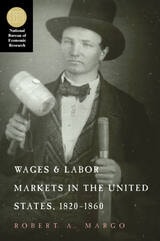
cover of Wages and Labor Markets in the United States, 1820-1860

Wages and Labor Markets in the United States, 1820-1860

Robert A. Margo

University of Chicago Press, 1999

Research by economists and economic historians has greatly expanded our knowledge of labor markets and real wages in the United States since the Civil War, but the period from 1820 to 1860 has been far less studied. Robert Margo fills this gap by collecting and analyzing the payroll records of civilians hired by the United States Army and the 1850 and 1860 manuscript federal Censuses of Social Statistics. New wage series are constructed for three occupational groups—common laborers, artisans, and white-collar workers—in each of the four major census regions—Northeast, Midwest, South Atlantic, and South Central—over the period 1820 to 1860, and also for California between 1847 and 1860. Margo uses these data, along with previously collected evidence on prices, to explore a variety of issues central to antebellum economic development.

This volume makes a significant contribution to economic history by presenting a vast amount of previously unexamined data to advance the understanding of the history of wages and labor markets in the antebellum economy.
[more]
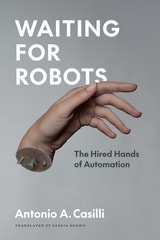
cover of Waiting for Robots: The Hired Hands of Automation

Waiting for Robots

The Hired Hands of Automation

Antonio A. Casilli

University of Chicago Press, 2025

An essential investigation that pulls back the curtain on automation, like AI, to show human workers’ hidden labor.
 
Artificial Intelligence fuels both enthusiasm and panic. Technologists are inclined to give their creations leeway, pretend they’re animated beings, and consider them efficient. As users, we may complain when these technologies don’t obey, or worry about their influence on our choices and our livelihoods. And yet, we also yearn for their convenience, see ourselves reflected in them, and treat them as something entirely new. But when we overestimate the automation of these tools, award-winning author Antonio A. Casilli argues, we fail to recognize how our fellow humans are essential to their efficiency. The danger is not that robots will take our jobs, but that humans will have to do theirs.
 
In this bracing and powerful book, Casilli uses up-to-the-minute research to show how today’s technologies, including AI, continue to exploit human labor—even ours. He connects the diverse activities of today’s tech laborers: platform workers, like Uber drivers and Airbnb hosts; “micro workers,” including those performing atomized tasks like data entry on Amazon Mechanical Turk; and the rest of us, as we evaluate text or images to show we’re not robots, react to Facebook posts, or approve or improve the output of generative AI. As Casilli shows us, algorithms, search engines, and voice assistants wouldn’t function without unpaid or underpaid human contributions. Further, he warns that if we fail to recognize this human work, we risk a dark future for all human labor.
 
Waiting for Robots urges us to move beyond the simplistic notion that machines are intelligent and autonomous. As the proverbial Godot, robots are the bearers of a messianic promise that is always postponed. Instead of bringing prosperity for all, they discipline the workforce, so we don’t dream of a world without drudgery and exploitation. Casilli’s eye-opening book makes clear that most “automation” requires human labor—and likely always will—shedding new light on today’s consequences and tomorrow’s threats of failing to recognize and compensate the “click workers” of today.
[more]
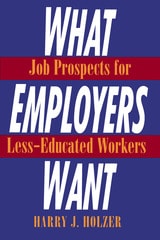
cover of What Employers Want: Job Prospects for Less-Educated Workers

What Employers Want

Job Prospects for Less-Educated Workers

Harry J. Holzer

Russell Sage Foundation, 1996

A very important contribution to the field of labor economics, and in particular to the understanding of the labor market forworkers with relatively low skill levels. I think we have the sense that the market looks bad, but haven't been clear on how bad it is, or how it got that way. What Employers Want provides some of the answers and identifies the important questions. It is essential reading. —Jeffrey S. Zax, University of Colorado at Boulder The substantial deterioration in employment and earnings among the nation's less-educated workers, especially minorities and younger males in the nation's big cities, has been tentatively ascribed to a variety of causes: an increase in required job skills, the movement of companies from the cities to the suburbs, and a rising unwillingness to hire minority job seekers. What Employers Want is the first book to replace conjecture about today's job market with first-hand information gleaned from employers about who gets hired. Drawn from asurvey of over 3,000 employers in four major metropolitan areas—Los Angeles, Boston, Atlanta, and Detroit—this volume provides a wealth of data on what jobs are available to the less-educated, in what industries, what skills they require, where they are located, what they pay, and how they are filled. The evidence points to a dramatic surge in suburban, white-collar jobs. The manufacturing industry—once a steady employer of blue-collar workers—has been eclipsed by the expanding retail trade and service industries, where the vast majority of jobs are in clerical, managerial, or sales positions. Since manufacturing establishments have been the most likely employers to move from the central cities to the suburbs, the shortage of jobs for low-skill urban workers is particularly acute. In the central cities, the problem is compounded and available jobs remain vacant because employers increasingly require greater cognitive and social skills as well as specific job-related experience. Holzer reveals the extent to which minorities are routinely excluded by employer recruitment and screening practices that rely heavily on testing, informal referrals, and stable work histories. The inaccessible location and discriminatory hiring patterns of suburban employers further limit the hiring of black males in particular, while earnings, especially for minority females, remain low. Proponents of welfare reform often assume that stricter work requirements and shorter eligibility periods will effectively channel welfare recipients toward steady employment and off federal subsidies. What Employers Want directly challenges this premise and demonstrates that only concerted efforts to close the gap between urban employers and inner city residents can produce healthy levels of employment in the nation's cities. Professor Holzer outlines the measures that will benecessary—targeted education and training programs, improved transportation and job placement, heightened enforcement of antidiscrimination laws, and aggressive job creation strategies. Repairing urban labor markets will not be easy. This book shows why. A Volume in the Multi-City Study of Urban Inequality
[more]
cover of Will We Be Smart Enough?: A Cognitive Analysis of the Coming Workforce

Will We Be Smart Enough?

A Cognitive Analysis of the Coming Workforce

Earl Hunt

Russell Sage Foundation, 1995

The American workforce and the American workplace are rapidly changing—in ways that make them increasingly incompatible. Advances in automation and telecommunications have eliminated many jobs based on routine tasks and muscle power and fueled the demand for employees who can understand and apply new technologies. But, as Earl Hunt convincingly demonstrates in Will We Be Smart Enough?, such "smart" employees will be in dangerously short supply unless fundamental changes are made to our educational and vocational systems. Will We Be Smart Enough? combines cognitive theory, demographic projections, and psychometric research to measure the capabilities of tomorrow's workforce against the needs of tomorrow's workplace. Characterized by sophisticated machinery, instant global communication, and continuous reorganization, the workplace will call for people to fuse multiple responsibilities, adapt quickly to new trends, and take a creative approach to problem solving. Will Americans be able to meet the difficult and unprecedented challenges brought about by these innovations? Hunt examines data from demographic sources and a broad array of intelligence tests, whose fairness and validity he judiciously assesses. He shows that the U.S. labor force will be increasingly populated by older workers, who frequently lack the cognitive flexibility required by rapid change, and by racial and ethnic minorities, who have so far not fully benefitted from the nation's schools to develop the cognitive skills necessary in a technologically advanced workplace. At the heart of Will We Be Smart Enough? lies the premise that this forecast can be altered, and that cognitive skills can be widely and successfully taught. Hunt applies psychological principles of learning and cognitive science to a variety of experimental teaching programs, and shows how the information revolution, which has created such rapid change in the workplace, can also be used to transform the educational process and nurture the skills that the workplace of the future will require. Will We Be Smart Enough? answers naysayers who pronounce so many people "cognitively disadvantaged" by suggesting that new forms of education can provide workers with enhanced skills and productive employment in the twenty-first century.   "Hunt's book provides succinct, lucid presentations of our best scientific understandings of thinking, intelligence, job performance, and how to measure them. Only by comprehending and applying these understandings to develop sound educational and instructional strategies can we create a capable workforce for the digital age." —John T. Bruer, President, James S. McDonnell Foundation< "Earl Hunt applies keys insights from cognitive psychology and from the psychology of measurement to issues of workers and the workplace. His book constitutes a valuable contribution to, and synthesis of, an important area of study. "—Howard Gardner, Harvard Project Zero   Will We Be Smart Enough? and The Bell Curve Controversy What about [The Bell Curve by Herrnstein and Murray] caused The New York Times to refer to it as the most controversial book of 1994, and to Murray as the most dangerous conservative in America? The answer is that they took an extreme position on a number of controversial issues [regarding intelligence and genetics]....My conclusion is that we have to do something to increase the amount of cognitive skills in the coming workforce and that, in many cases, we know what to do. Herrnstein and Murray claim that nothing can be done. I disagree....When it comes to improving the cognitive skills of the workforce, this is an area where everyone, whites and blacks, Latinos and Anglos, government programs and private enterprise, has got to get their act togeth
[more]
cover of Working for Democracy: American Workers from the Revolution to the Present

Working for Democracy

American Workers from the Revolution to the Present

Edited by Paul Buhle and Alan Dawley

University of Illinois Press, 1985

Written by some of our nation's top historians, Working for Democracy is the first book to examine the politics of American workers from the revolution to the present in terms of broad struggles for power in society at large. In more than a dozen chapters, the topics range from the committees of artisan "republicans" at the time of the American Revolution to the League of Revolutionary Black Workers. Whether the subject is the anti-slavery movement, the New Deal coalition, the Wobblies, or women workers, Working For Democracy is a testament to the struggles of workers everywhere in America.
 
[more]