Results by title

6 books match the query 'Labyrinth'

cover of Captive of the Labyrinth: Sarah L. Winchester, Heiress to the Rifle Fortune

Captive of the Labyrinth

Sarah L. Winchester, Heiress to the Rifle Fortune

Mary Jo Ignoffo

University of Missouri Press, 2010
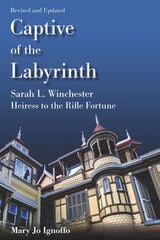
Since her death in 1922, Sarah Winchester has been perceived as a mysterious, haunted figure. After inheriting a vast fortune upon the death of her husband in 1881, Sarah purchased a simple farmhouse in San José, California. She began building additions to the house and continued construction on it for the next twenty years. A hostile press cast Sarah as the conscience of the Winchester Repeating Arms Company—a widow shouldering responsibility for the many deaths caused by the rifle that brought her riches. She was accused of being a ghost-obsessed spiritualist, and to this day it is largely believed that the extensive construction she executed on her San José house was done to appease the ghouls around her.
But was she really as guilt-ridden and superstitious as history remembers her? When Winchester’s home was purchased after her death, it was transformed into a tourist attraction. The bizarre, sprawling mansion and the enigmatic nature of Winchester’s life were exaggerated by the new owners to generate publicity for their business. But as the mansion has become more widely known, the person of Winchester has receded from reality, and she is only remembered for squandering her riches to ward off disturbed spirits.
Captive of the Labyrinth: Sarah L. Winchester, Heiress to the Rifle Fortune demystifies the life of this unique American. In the first full-length biography of Winchester, author and historian Mary Jo Ignoffo unearths the truth about this notorious eccentric, revealing that she was not a maddened spiritualist driven by remorse but an intelligent, articulate woman who sought to protect her private life amidst the chaos of her public existence. The author takes readers through Winchester’s several homes, explores her private life, and, by excerpting from personal correspondence, gives the heiress a voice for the first time since her death. Ignoffo’s research reveals that Winchester’s true financial priority was not dissipating her fortune on the mansion in San José but investing it for a philanthropic legacy.
For too long Sarah Winchester has existed as a ghost herself—a woman whose existence lies somewhere between the facts of her life and a set of sensationalized recollections of who she may have been. Captive of the Labyrinth finally puts to rest the myths about this remarkable woman, and, in the process, uncovers the legacy she intended to leave behind.
[more]
cover of Captive of the Labyrinth: Sarah L. Winchester, Heiress to the Rifle Fortune,  Revised and Updated Edition

Captive of the Labyrinth

Sarah L. Winchester, Heiress to the Rifle Fortune, Revised and Updated Edition

Mary Jo Ignoffo

University of Missouri Press, 2022

Captive of the Labyrinth is reissued here to commemorate the 100th anniversary of the death of rifle heiress Sarah L. Winchester in 1922. After inheriting a vast fortune upon the death of her husband in 1881, Winchester purchased a simple farmhouse in San José, California. She built additions to the house and continued construction for the next twenty years. When neighbors and the local press could not imagine her motivations, they invented fanciful ones of their own. She was accused of being a ghost-obsessed spiritualist, and to this day it is largely believed that the extensive construction she executed on her San José house was done to thwart death and appease the spirits of those killed by the Winchester rifle.

Author and historian Mary Jo Ignoffo’s definitive biography unearths the truth about this reclusive eccentric, revealing that she was not a maddened spiritualist driven by remorse but an intelligent, articulate woman who sought to protect her private life amidst the chaos of her public existence and the social mores of the time. The author takes readers through Winchester’s several homes, explores her private life, and, by excerpting from personal correspondence, one learns the widow’s true priority was not dissipating her fortune on the mansion in San José but endowing a hospital to eradicate a dread disease.

Sarah Winchester has been exploited for profit for over a century, but Captive of the Labyrinth finally puts to rest the myths about this American heiress, and, in the process, uncovers her true legacies.

 
[more]
cover of Lost in a Labyrinth of Red Tape: The Story of an Immigration that Failed

Lost in a Labyrinth of Red Tape

The Story of an Immigration that Failed

Armin Schmid and Renate Schmid

Northwestern University Press, 1996

Lost in a Labyrinth of Red Tape is the story of one family's desperate attempts to emigrate from Nazi Germany. The Frühaufs faced enormous obstacles with the German and foreign authorities when they attempted to take advantage of matriarch Hilde Frühauf's U.S. citizenship. At the mercy of various agencies and shippers, they became more and more entangled in the red tape of the title. The daughter went into hiding and fled to Belgium, where she was hidden by the Resistance and survived the war. Tragically, the remaining members of her family failed to emigrate, and were killed by the Nazis.
[more]
cover of Morocco: In the Labyrinth of Dreams and Bazaars

Morocco

In the Labyrinth of Dreams and Bazaars

Walter M. Weiss

Haus Publishing, 2016

While much of the Middle East is now engulfed in conflict and repression, Morocco remains a curious anomaly: peaceful and open to the West, it has provided refuge for artists and writers for generations, and it remains an exotic destination for many curious travelers. The country has been influenced by an incredible variety of peoples—Phoenicians, Romans, Arabs, Berbers, Muslims, Jews, and most of Europe’s colonizers have played a role—and modern Moroccan society is no less rich and varied.

In Morocco, Walter M. Weiss brings extensive knowledge of the region to bear as he travels the breadth and depth of the country’s social and geographical contrasts. Berber villagers of the mountains are for the most part still illiterate and consider their king to be divinely chosen, while businessmen in Casablanca’s towering offices dream of closer ties to the European Union. Weiss visits the settings of modern legends, such as Tangier, as well as the two medieval centres Fès and Meknès, and sees earthen kasbahs and Marrakech’s bazaar. On the way, he meets acrobats, Sufi musicians, pilgrims, craftsmen, beatniks, rabbis, and Berber farmers—a kaleidoscope of variety and cultural influence.
[more]
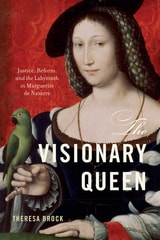
cover of The Visionary Queen: Justice, Reform, and the Labyrinth in Marguerite de Navarre

The Visionary Queen

Justice, Reform, and the Labyrinth in Marguerite de Navarre

Theresa Brock

University of Delaware Press, 2024

The Visionary Queen affirms Marguerite de Navarre’s status not only as a political figure, author, or proponent of nonschismatic reform but also as a visionary. In her life and writings, the queen of Navarre dissected the injustices that her society and its institutions perpetuated against women. We also see evidence that she used her literary texts, especially the Heptaméron, as an exploratory space in which to generate a creative vision for institutional reform. The Heptaméron’s approach to reform emerges from statistical analysis of the text’s seventy-two tales, which reveals new insights into trends within the work, including the different categories of wrongdoing by male, institutional representatives from the Church and aristocracy, as well as the varying responses to injustice that characters in the tales employ as they pursue reform. Throughout its chapters, The Visionary Queen foregrounds the trope of the labyrinth, a potent symbol in early modern Europe that encapsulated both the fallen world and redemption, two themes that underlie Marguerite's project of reform.
[more]
cover of Year of the Labyrinth

Year of the Labyrinth

Brian Sneeden

Carnegie Mellon University Press, 2026

In this folk-horror pastoral, poet Brian Sneeden threads paths of myth and ritual, fatherhood and climate collapse, ghost stories and grief.

Described by Kiki Petrosino as “a beautiful invasion,” Year of the Labyrinth draws upon Sneeden’s experiences as a translator and multilingual writer working in language preservation to explore boundaries between speech and ritual, myth and ecology. “In these fiercely imagined poems,” Petrosino writes, “our speaker passes between seemingly fixed physical and conceptual worlds—human/animal, past/present, forest/field. This voice finds lyric power in liminal spaces—in ‘the pollen line’ and ‘a change of wind.’ With the speaker, we travel through mirrors to places where you might grasp an animal if only ‘by the curve of its name,’ and where ‘a bird that ha[s]n’t yet been invented’ may sing. This poet’s imagination makes porous the landscapes we thought were familiar.” Kelly Link, in her judge’s citation for the Barthelme Prize, writes: “How wonderful it is, the marriage of economy and the arcane, as if a story could be a kind of lozenge that, slipped under the tongue, estranges us from our idea of how both life and language work. Every sentence has the effect of an acupuncturist’s needle, small pricks that let in strange energy.”

[more]