Results by title
6 books match the query 'Lacan'
Egocracy
Marx, Freud and LacanSonia Arribas and Howard Rouse
Diaphanes, 2011
Lacan To The Letter
Reading Ecrits CloselyBruce Fink
University of Minnesota Press, 2004
An analysis of Lacan’s thought by way of a close, authoritative reading of his Écrits
To read Lacan closely is to follow him to the letter, to take him literally, making the wager that he comes right out and says what he means in many cases, though much of his argument must be reconstructed through a line-by-line examination. And this is precisely what Bruce Fink does in this ambitious book, a fine analysis of Lacan’s work on language and psychoanalytic treatment conducted on the basis of a very close reading of texts in his Écrits: A Selection.
As a translator and renowned proponent of Lacan’s works, Fink is an especially adept and congenial guide through the complexities of Lacanian literature and concepts. He devotes considerable space to notions that have been particularly prone to misunderstanding, notions such as “the sliding of the signified under the signifier,” or that have gone seemingly unnoticed, such as “the ego is the metonymy of desire.” Fink also pays special attention to psychoanalytic concepts, like affect, that Lacan is sometimes thought to neglect, and to controversial concepts, like the phallus. From a parsing of Lacan’s claim that “commenting on a text is like doing an analysis,” to sustained readings of “The Instance of the Letter in the Unconscious,” “The Direction of the Treatment,” and “Subversion of the Subject” (with particular attention given to the Graph of Desire), Fink’s book is a work of unmatched subtlety, depth, and detail, providing a valuable new perspective on one of the twentieth century’s most important thinkers.
Lacan in Public
Psychoanalysis and the Science of RhetoricChristian Lundberg
University of Alabama Press, 2012
Lacan in Public argues that Lacan’s contributions to the theory of rhetoric are substantial and revolutionary and that rhetoric is, in fact, the central concern of Lacan’s entire body of work.
Lacan’s conception of rhetoric, Christian Lundberg argues in Lacan in Public, upsets and extends the received wisdom of American rhetorical studies—that rhetoric is a science, rather than an art; that rhetoric is predicated not on the reciprocal exchange of meanings, but rather on the impossibility of such an exchange; and that rhetoric never achieves a correspondence with the real-world circumstances it attempts to describe.
As Lundberg shows, Lacan’s work speaks directly to conversations at the center of current rhetorical scholarship, including debates regarding the nature of the public and public discourses, the materiality of rhetoric and agency, and the contours of a theory of persuasion.
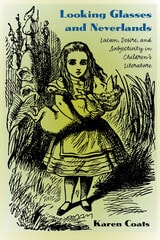
Looking Glasses and Neverlands
Lacan, Desire, and Subjectivity in Children's LiteratueKaren Coats
University of Iowa Press, 2004
This groundbreaking study introduces and explores Lacan’s complex theories of subjectivity and desire through close readings of canonical children’s books such as Charlotte’s Web, Stellaluna, Holes, Tangerine, and The Chocolate War, providing an introduction to an increasingly influential body of difficult work while making the claim that children’s textual encounters are as significant as their existential ones in constituting their subjectivities and giving shape to their desires.
Postmodern Spiritual Practices
The Construction of the Subject and the Reception of Plato in Lacan, Derrida, and FoucaultPaul Allen Miller
The Ohio State University Press, 2007
On the other hand, blindness to the merits of postmodern thought is also due to Anglo-American philology’s own parochial instincts. Ensconced within a nineteenth-century model of Alterumswissenschaft, only a minority of classicists have made forays into philosophical, psychoanalytic, and other speculative modes of inquiry. The result has been that postmodern French thought has largely been the province of scholars of modern languages.
A situation thus emerges in which most classicists do not know theory, and so cannot appreciate the scope of these thinkers’ contribution to our understanding of the genealogy of Western thought, while most theorists do not know the Platonic texts and their contexts that ground them. This book bridges this gap, offering detailed and theoretically informed readings of French postmodernism’s chief thinkers’ debts to Plato and the ancient world.
Subject Lessons
Hegel, Lacan, and the Future of MaterialismEdited by Russell Sbriglia and Slavoj Zizek
Northwestern University Press, 2020
Responding to the ongoing “objectal turn” in contemporary humanities and social sciences, the essays in Subject Lessons present a sustained case for the continued importance— indeed, the indispensability—of the category of the subject for the future of materialist thought.
Approaching matters through the frame of Hegel and Lacan, the contributors to this volume, including the editors, as well as Andrew Cole, Mladen Dolar, Nathan Gorelick, Adrian Johnston, Todd McGowan, Borna Radnik, Molly Anne Rothenberg, Kathryn Van Wert, and Alenka Zupančič—many of whom stand at the forefront of contemporary Hegel and Lacan scholarship—agree with neovitalist thinkers that material reality is ontologically incomplete, in a state of perpetual becoming, yet they maintain that this is the case not in spite of but, rather, because of the subject.
Incorporating elements of philosophy, psychoanalysis, and literary and cultural studies, Subject Lessons contests the movement to dismiss the subject, arguing that there can be no truly robust materialism without accounting for the little piece of the Real that is the subject.