Results by title

3 books match the query 'Laity'
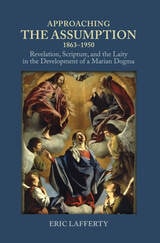
cover of Approaching the Assumption, 1863-1950: Revelation, Scripture, and the Laity in the Development of a Marian Dogma

Approaching the Assumption, 1863-1950

Revelation, Scripture, and the Laity in the Development of a Marian Dogma

Eric Lafferty

Catholic University of America Press, 2026
The Assumption of Mary refers to the ancient Christian belief that the Mother of God was taken up into Heaven, body and soul, at the end of her earthly life. For centuries, Catholics and other Christians celebrated the Assumption as a liturgical feast and meditated on the miraculous event in the Rosary. Nevertheless, its relationship to Revelation remained undefined. This changed in 1950 when Pope Pius XII declared the Assumption of Mary a dogma of the Catholic Church. In this rare exercise of papal authority, Pius XII infallibly and irrevocably taught that the Assumption was a truth revealed by God. This book explores how the definition of this Marian dogma came to fruition. After a brief history of the prior three Marian dogmas — Mother of God, Ever-Virgin, and the Immaculate Conception — this book narrates the major moments in the effort to obtain a dogmatic definition of the Assumption. The beginning of this “Assumptionist movement” can be dated to 1863 when Queen Isabel II of Spain petitioned the pope to declare the Assumption a dogma. Subsequently, petitionary efforts and scholarly inquiry increased and spread throughout the world. In addition to the narrative of this movement, this book gives special consideration to three vital aspects: debate over the Assumption’s definability as a dogma, if and how Scripture reveals the Assumption, and the contribution of the laity on a matter of doctrine. Collectively, the Assumptionist movement emerges as a critical event in the nineteenth- and twentieth-century Catholic Church. Culminating in a dogmatic definition shortly before the opening of Vatican II, it also serves as a key point of inquiry for continuity and development of doctrine. A final chapter argues that the operative beliefs pertaining to Revelation, Scripture, and the laity during the Assumptionist movement stand in continuity with the teachings of Vatican II.
[more]
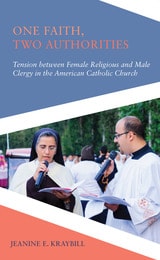
cover of One Faith, Two Authorities: Tension between Female Religious and Male Clergy in the American Catholic Church

One Faith, Two Authorities

Tension between Female Religious and Male Clergy in the American Catholic Church

Jeanine E. Kraybill

Temple University Press, 2019

While female religious have grown to possess a sense of personal authority in issues impacting the laity, and have come to engage in social-issue-oriented activities, religious institutions have traditionally viewed men as the decision-makers. One Faith, Two Authorities examines the tensions of policy and authority within the gendered nature of the Catholic Church. 

Jeanine Kraybilllooks at the influence of Catholic elites—specifically within the U.S. Conference of Catholic Bishops and the Leadership Conference of Women Religious—and their opinions on public policy and relevant gender dynamics with regard to healthcare, homosexuality, immigration, and other issues. She considers the female religious’ inclusive positions as well as their opposition to ACA for bills that would be rooted in institutional positions on procreation, contraception, or abortion. Kraybill also systematically examines the claims of the 2012 Doctrinal Assessment against the Leadership Conference of Women Religious.

One Faith, Two Authorities considerswhether the sisters and the male clergy are in fact in disagreement about social justice and healthcare issues and/or if women religious have influence.

[more]
cover of The Heavenly Contract: Ideology and Organization in Pre-Revolutionary Puritanism

The Heavenly Contract

Ideology and Organization in Pre-Revolutionary Puritanism

David Zaret

University of Chicago Press, 1985

The idea of a heavenly contract, uniting God and humanity in a bargain of salvation, emerged as the keystone of Puritan theology in early modern England. Yet this concept, with its connotations of exchange and reciprocity, runs counter to other tenets of Calvinism, such as predestination, that were also central to Puritan thought. With bold analytic intelligence, David Zaret explores this puzzling conflict between covenant theology and pure Calvinism. In the process he demonstrates that popular beliefs and activities had tremendous influence on Puritan religion.
[more]