Results by title
7 books match the query 'Lamarre, Thomas'
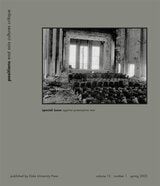
Against Preemptive War, Volume 13
Tani E. Barlow, Yukiko Hanawa, Thomas LaMarre, and Donald Lowe, eds.
Duke University Press, 0
Gathering material from politically active scholars, artists, and authors from Europe, Asia, and North America, this collection reflects on the likely fallout from the corruptive U.S. strategy of preemption. In the introduction, the editors criticize the American press for being, with few exceptions, easily if not willingly deceived by the Bush administration’s propaganda regarding weapons of mass destruction. One contributor redefines fascism as a situation in which contradictions are evident but blatantly ignored, one which creates a false sense of cohesion between events. Another argues that U.S. military bases around the world are now maintained not for military defense and quick mobilization but to create a culture of American militarism, noting that troops were sent from the U.S. for the invasion of Iraq rather than from closer bases around the world. Finally, the issue raises a formidable question: how do we end war waged against what might come to pass rather than what actually is?
Contributors. Tani Barlow, Jim Bonk, Josh Brown, Bei Dao, Carolyn Eisenberg, Lawrence Ferlinghetti, Matthew Fryslie, Sue Golding (as johnny de philo), Freda Guttman, Yukiko Hanawa, Harry Harootunian, Sharon Hayashi, Reynaldo C. Ileto, Joy Kogawa, Thomas LaMarre, The Liberal Islam Network, Sumit K. Mandal, Edoarda Masi, Brian Massumi, Anne McKnight, Carel Moiseiwitsch, Alberto Moreiras, Claudia Pozzana, Alessandro Russo, Ukai Satoshi, Laurie Sears, Kuang Xinnian, Marilyn Young
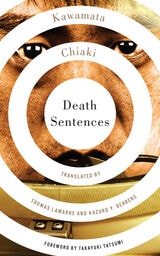
Death Sentences
Kawamata Chiaki
University of Minnesota Press, 2012
Japan, 1980s: A special police squad is tracking down one of the “afflicted” to recover the “stuff.” Although the operation seems like a drug bust, the “stuff” is actually some kind of text. Death Sentences—a work of science fiction that shares its conceit with the major motion picture The Ring—tells the story of a mysterious surrealist poem, penned in the 1940s, which, through low-tech circulation across time, kills its readers, including Arshile Gorky and Antonin Artaud, before sparking a wave of suicides after its publication in 1980s Japan. Mixing elements of Japanese hard-boiled detective story, horror, and science fiction, the novel ranges across time and space, from the Left Bank of Paris to the planet Mars.
Paris, 1948: André Breton anxiously awaits a young poet, Who May. He recalls their earlier encounter in New York City and the mysterious effects of reading Who May’s poem “Other World.” Upon meeting, Who May gives Breton another poem, “Mirror,” an even more unsettling work. Breton shares it with his fellow surrealists. Before Breton can discuss the poem with him, Who May vanishes. Who May contacts Breton about a third poem, “The Gold of Time,” and then slips into a coma and dies (or enters another dimension). Copies of the poem are mailed to all of Who May’s friends—Breton, Gorky, Paul Éluard, Marcel Duchamp, and other famous surrealists and dadaists. Thus begins the “magic poem plague.”
Death Sentences is the first novel by the popular and critically acclaimed science fiction author Kawamata Chiaki to be published in English. Released in Japan in 1984 as Genshi-gari (Hunting the magic poems), Death Sentences was a best seller and won the Japan Science Fiction Grand Prize. With echoes of such classic sci-fi works as George Orwell’s 1984, Ray Bradbury’s Fahrenheit 451, William Gibson’s Neuromancer, and Philip K. Dick’s Martian Time-Slip, Death Sentences is a fascinating mind-bender with a style all its own.
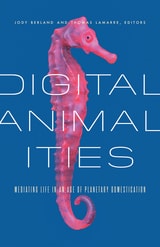
Digital Animalities
Mediating Life in an Age of Planetary DomesticationJody Berland
University of Minnesota Press, 2026
Exploring where animality meets digital media in the shadow of climate crisis
Digital Animalities is a groundbreaking investigation into the entanglements of animal life, media infrastructures, and digital technologies in a time of environmental precarity and digital saturation. Revealing the digital as a dynamic site where animal agency and technological systems collide, the contributors eschew simplistic binaries to emphasize complex mediations between animals and digital media.
From wildlife camera traps and virtual zoos to gaming environments and animation tools, these essays explore how animals are captured, played with, and consumed through digital technologies, elaborating their agency in these mediations of ecological and biopolitical processes. Rethinking animality as a fluid and contested terrain shaped by climate change, extinction pressures, and emerging ecopolitical paradigms, Digital Animalities shifts how we consider the impact of the digital on sentient lives and their futures.
Contributors: Giovanni Aloi, Art Institute of Chicago; Etienne S. Benson, Max Planck Institute for the History of Science, Berlin; Sarah Bezan, U College Cork; Michael Fisch, U of Chicago; Kate Galloway, Rensselaer Polytechnic Institute; Christine L. Marran, U of Minnesota; Brian McCormack; Jonathan Osborn; Hannah Tollefson, U of Toronto Scarborough; Tom Tyler, U of Leeds; Paul Wells, Loughborough U; Hang Wu.
Retail e-book files for this title are screen-reader friendly with images accompanied by short alt text and/or extended descriptions.
Making Sense in Common
A Reading of Whitehead in Times of CollapseIsabelle Stengers
University of Minnesota Press, 2023
A leading philosopher seeks to recover “common sense” as a meeting place to reconcile science and philosophy
With her previous books on Alfred North Whitehead, Isabelle Stengers not only secured a reputation as one of the premier philosophers of our times but also inspired a rethinking of critical theory, political thought, and radical philosophy across a range of disciplines. Here, Stengers unveils what might well be seen as her definitive reading of Whitehead.
Making Sense in Common will be greeted eagerly by the growing group of scholars who use Stengers’s work on Whitehead as a model for how to think with conceptual precision through diverse domains of inquiry: environmentalism and ecology, animal studies, media and technology studies, the history and philosophy of science, feminism, and capitalism. On the other hand, the significance of this new book extends beyond Whitehead. Instead, it lies in Stengers’s recovery of the idea of “common sense” as a meeting place—a commons—where opposed ideas of science and humanistic inquiry can engage one another and help to move society forward. Her reconciliation of science and philosophy is especially urgent today—when climate disaster looms all around us, when the values of what we thought of as civilization and modernity are discredited, and when expertise of any kind is under attack.
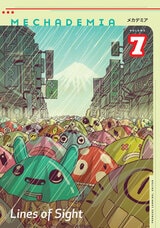
Mechademia 7
Lines of SightFrenchy Lunning
University of Minnesota Press, 2012
Lines of Sight—the seventh volume in the Mechademia series, an annual forum devoted to Japanese anime and manga—explores the various ways in which anime, manga, digital media, fan culture, and Japanese art—from scroll paintings to superflat—challenge, undermine, or disregard the concept of Cartesian (or one-point) perspective, the dominant mode of visual culture in the West since the seventeenth century. More than just a visual mode or geometric system, Cartesianism has shaped nearly every aspect of modern rational thought, from mathematics and science to philosophy and history.
Framed by Thomas Lamarre’s introduction, “Radical Perspectivalism,” the essays here approach Japanese popular culture as a visual mode that employs non-Cartesian formations, which by extension make possible new configurations of perception and knowledge. Whether by shattering the illusion of visual or narrative seamlessness through the use of multiple layers or irregular layouts, blurring the divide between viewer and creator, providing diverse perspectives within a single work of art, or rejecting dualism, causality, and other hallmarks of Cartesianism, anime and manga offer in their radicalization of perspective the potential for aesthetic and even political transformation.
Contributors: David Beynon, Deakin U; Fujimoto Yukari, Meiji U; Yuriko Furuhata, McGill U; Craig Jackson, Ohio Wesleyan U; Reginald Jackson, U of Chicago; Thomas Lamarre, McGill U; Jinying Li; Waiyee Loh; Livia Monnet, U of Montreal; Sharalyn Orbaugh, U of British Columbia; Stefan Riekeles; Atsuko Sakaki, U of Toronto; Miryam Sas, U of California, Berkeley; Timon Screech, U of London; Emily Somers; Marc Steinberg, Concordia U.
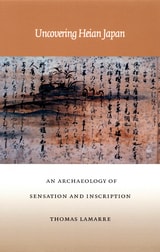
Uncovering Heian Japan
An Archaeology of Sensation and InscriptionThomas LaMarre
Duke University Press, 2000
Combining a pathbreaking visual analysis of the calligraphy with which this poetry was transcribed, a more traditional textual analysis, and a review of the politics of the period, LaMarre presents a dramatically new view of Heian poetry and culture. He challenges the assumption of a cohesive “national imagination,” seeing instead an early Japan that is ethnically diverse, territorially porous, and indifferent to linguistic boundaries. Working through the problems posed by institutionalized notions of nationalism, nativism, and modernism, LaMarre rethinks the theories of scholars such as Suzuki Hideo, Yoshimoto Takaaki, and Komatsu Shigemi, in conjunction with theorists such as Derrida, Karatani, Foucault, and Deleuze. Contesting the notion that speech is central to the formation of community, Uncovering Heian Japan focuses instead on the potential centrality of the more figural operations of poetic practice.
Specialists in Japanese history and culture as well as scholars working in other areas of cultural criticism will find that this book enriches their understanding of an early Japan that has exerted so much influence on later concepts of what it means to be Japanese.
William James
Empiricism and PragmatismDavid Lapoujade
Duke University Press, 2020