Results by title
4 books match the query 'Lambert, Gregg'
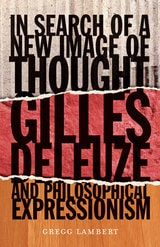
In Search of a New Image of Thought
Gilles Deleuze and Philosophical ExpressionismGregg Lambert
University of Minnesota Press, 2012
Gregg Lambert demonstrates that since the publication of Proust and Signs in 1964 Gilles Deleuze’s search for a new means of philosophical expression became a central theme of all of his oeuvre, including those written with psychoanalyst Félix Guattari. Lambert, like Deleuze, calls this “the image of thought.”
Lambert’s exploration begins with Deleuze’s earliest exposition of the Proustian image of thought and then follows the “tangled history” of the image that runs through subsequent works, such as Kafka: Toward a Minor Literature, The Rhizome (which serves as an introduction to Deleuze’s A Thousand Plateaus), and several later writings from the 1980s collected in Essays Critical and Clinical. Lambert shows how this topic underlies Deleuze’s studies of modern cinema, where the image of thought is predominant in the analysis of the cinematic image—particularly in The Time-Image. Lambert finds it to be the fundamental concern of the brain proposed by Deleuze in the conclusion of What Is Philosophy?
By connecting the various appearances of the image of thought that permeate Deleuze’s entire corpus, Lambert reveals how thinking first assumes an image, how the images of thought become identified with the problem of expression early in the works, and how this issue turns into a primary motive for the more experimental works of philosophy written with Guattari. The study traces a distinctly modern relationship between philosophy and non-philosophy (literature and cinema especially) that has developed into a hallmark of the term “Deleuzian.” However, Lambert argues, this aspect of the philosopher’s vision has not been fully appreciated in terms of its significance for philosophy: “not only ‘for today’ but, to quote Nietzsche, meaning also ‘for tomorrow, and for the day after tomorrow.’”

The Elements of Foucault
Gregg Lambert
University of Minnesota Press, 2020
A new conceptual diagram of Foucault’s original vision of the biopolitical order
The history around the critical reception of Michel Foucault’s published writings is troubled, according to Gregg Lambert, especially in light of the controversy surrounding his late lectures on biopolitics and neoliberal governmentality. In this book, Lambert’s unique approach distills Foucault’s thought into its most basic components in order to more fully understand its method and its own immanent rules of construction.
The Elements of Foucault presents a critical study of Foucault’s concept of method from the earlier History of Sexuality, Volume 1, to his later lectures. Lambert breaks down Foucault’s post-1975 analysis of the idea of biopower into four elements: the method, the conceptual device (i.e., dispositif), the grid of intelligibility, and the notion of “milieu.” Taken together, these elements compose the diagram of Foucault’s early analysis and the emergence of the neoliberal political economy. Lambert further delves into how Foucault’s works have been used and misused over time, challenging the periodization of Foucault’s later thought in scholarship as well as the major and most influential readings of Foucault by other contemporary philosophers—in particular Gilles Deleuze and Giorgio Agamben.
The Elements of Foucault is the first generally accessible, yet rigorous and comprehensive, discussion of lectures and major published works of Foucault’s post-1975 theory of biopower and of the major innovation of the concept of dispositif. It is also the first critical work to address the important influence of French philosopher Georges Canghuilhem on Foucault’s thought.

The Immanence of a Crisis
Gregg Lambert
University of Minnesota Press, 2027
A radical reconsideration of what crisis means in an age of continual global upheavals
The very notion of crisis in the wake of the Covid-19 pandemic, widespread social unrest, economic instability, and worsening climate change seems almost mundane. Combining rigorous philosophical analysis with literary expressionism, The Immanence of a Crisis rethinks the idea of calamity to explore how human beings collectively resist and adapt to the external conditions imposed on them.
Challenging the conventional pathological standpoint that views crises as singular episodes, each with a locatable and decisive cause, The Immanence of a Crisis frames its subject as a multiplicity of overlapping events that are shaped by both natural and artificial forces. Drawing on a diverse range of thinkers such as Jean-Baptiste Lamarck, Alfred North Whitehead, Gilles Deleuze, and Michel Foucault, Gregg Lambert offers timely philosophical reflections on how to contend with the many existential challenges we face in a rapidly changing world.
Concluding what the author calls a “four-part trilogy” on Foucault’s concept of biopolitics, this work demonstrates how modern governance seeks to justify its power by embedding populations in a state of perpetual emergency. By refusing the idea of a return to normal, The Immanence of a Crisis instead theorizes how we might redeem the present moment and develop new forms of resilience amidst what is now a permanent and pervasive condition of crisis.
Retail e-book files for this title are screen-reader friendly.
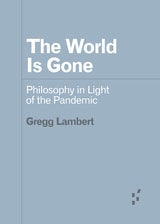
The World Is Gone
Philosophy in Light of the PandemicGregg Lambert
University of Minnesota Press, 2021
Part personal memoir, part philosophical reflection and written in the midst of the pandemic in 2021, The World Is Gone employs the Robinson Crusoe fable to launch an existential investigation of the effects of extreme isolation, profound boredom, nightly insomnia, and the fear of madness associated with the loss of a world populated by others.
Forerunners: Ideas First is a thought-in-process series of breakthrough digital publications. Written between fresh ideas and finished books, Forerunners draws on scholarly work initiated in notable blogs, social media, conference plenaries, journal articles, and the synergy of academic exchange. This is gray literature publishing: where intense thinking, change, and speculation take place in scholarship.