Results by title
4 books match the query 'Lamont, Michèle'
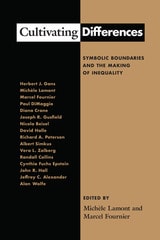
Cultivating Differences
Symbolic Boundaries and the Making of InequalityEdited by Michèle Lamont and Marcel Fournier
University of Chicago Press, 1992
How are boundaries created between groups in society? And what do these boundaries have to do with social inequality?
In this pioneering collection of original essays, a group of leading scholars helps set the agenda for the sociology of culture by exploring the factors that push us to segregate and integrate and the institutional arrangements that shape classification systems. Each examines the power of culture to shape our everyday lives as clearly as does economics, and studies the dimensions along which boundaries are frequently drawn.
The essays cover four topic areas: the institutionalization of cultural categories, from morality to popular culture; the exclusionary effects of high culture, from musical tastes to the role of art museums; the role of ethnicity and gender in shaping symbolic boundaries; and the role of democracy in creating inclusion and exclusion.
The contributors are Jeffrey Alexander, Nicola Beisel, Randall Collins, Diana Crane, Paul DiMaggio, Cynthia Fuchs Epstein, Joseph Gusfield, John R. Hall, David Halle, Richard A. Peterson, Albert Simkus, Alan Wolfe, and Vera Zolberg.
[more]
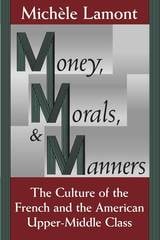
Money, Morals, and Manners
The Culture of the French and the American Upper-Middle ClassMichèle Lamont
University of Chicago Press, 1992
Drawing on remarkably frank, in-depth interviews with 160 successful men in the United States and France, Michèle Lamont provides a rare and revealing collective portrait of the upper-middle class—the managers, professionals, entrepreneurs, and experts at the center of power in society. Her book is a subtle, textured description of how these men define the values and attitudes they consider essential in separating themselves—and their class—from everyone else.
Money, Morals, and Manners is an ambitious and sophisticated attempt to illuminate the nature of social class in modern society. For all those who downplay the importance of unequal social groups, it will be a revelation.
"A powerful, cogent study that will provide an elevated basis for debates in the sociology of culture for years to come."—David Gartman, American Journal of Sociology
"A major accomplishment! Combining cultural analysis and comparative approach with a splendid literary style, this book significantly broadens the understanding of stratification and inequality. . . . This book will provoke debate, inspire research, and serve as a model for many years to come."—R. Granfield, Choice
"This is an exceptionally fine piece of work, a splendid example of the sociologist's craft."—Lewis Coser, Boston College
[more]
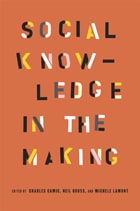
Social Knowledge in the Making
Edited by Charles Camic, Neil Gross, and Michèle Lamont
University of Chicago Press, 2011
Over the past quarter century, researchers have successfully explored the inner workings of the physical and biological sciences using a variety of social and historical lenses. Inspired by these advances, the contributors to Social Knowledge in the Making turn their attention to the social sciences, broadly construed. The result is the first comprehensive effort to study and understand the day-to-day activities involved in the creation of social-scientific and related forms of knowledge about the social world.
The essays collected here tackle a range of previously unexplored questions about the practices involved in the production, assessment, and use of diverse forms of social knowledge. A stellar cast of multidisciplinary scholars addresses topics such as the changing practices of historical research, anthropological data collection, library usage, peer review, and institutional review boards. Turning to the world beyond the academy, other essays focus on global banks, survey research organizations, and national security and economic policy makers. Social Knowledge in the Making is a landmark volume for a new field of inquiry, and the bold new research agenda it proposes will be welcomed in the social science, the humanities, and a broad range of nonacademic settings.
[more]
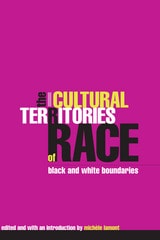
The Cultural Territories of Race
Black and White BoundariesEdited by Michèle Lamont
University of Chicago Press, 1999
Even as America becomes more multiracial, the black-white divide remains central to understanding many patterns and tensions in contemporary society. Since the 1960s, however, social scientists concerned with this topic have been reluctant to discuss the cultural dimensions of racial inequality—not wanting to "blame the victim" for having "wrong values." The Cultural Territories of Race redirects this research tendency, employing today's more sophisticated methods of cultural analysis toward a new understanding of how cultural structures articulate the black/white problem.
These essays examine the cultural territories of race through topics such as blacks' strategies for dealing with racism, public categories for definition of race, and definitions of rules for cultural memberships. Empirically grounded, these studies analyze divisions among blacks according to their relationships with whites or with alternative black culture; differences among whites regarding their attitudes toward blacks; and differences both among blacks and between blacks and whites, in their cultural understandings of various aspects of social life ranging from material success to marital life and to ideas about feminism. The essays teach us about the largely underexamined cultural universes of black executives, upwardly mobile college students, fast-food industry workers, so-called deadbeat dads, and proponents of Afrocentric curricula.
The Cultural Territories of Race makes an important contribution to current policy debates by amplifying muted voices that have too often been ignored by other social scientists.
Contributors are: Elijah Anderson, Amy Binder, Bethany Bryson, Michael C. Dawson, Catherine Ellis, Herbert J. Gans, Jennifer L. Hochschild, Michèle Lamont, Jane J. Mansbridge, Katherine S. Newman, Maureen R. Waller, Pamela Barnhouse Walters, Mary C. Waters, Julia Wrigley, Alford A. Young Jr.
[more]