Results by title
4 books match the query 'Lamoreaux, Naomi R.'
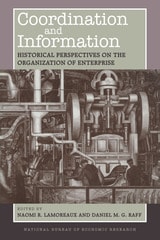
Coordination and Information
Historical Perspectives on the Organization of EnterpriseEdited by Naomi R. Lamoreaux and Daniel M. G. Raff
University of Chicago Press, 1995
In an ideal world, the market would be the optimal provider of coordination, but in the real world of incomplete information, some activities are better coordinated in other ways. Divided into three parts, this book addresses coordination within firms, at the borders of firms, and outside firms, providing a picture of the overall incidence and logic of economic coordination. The case studies—drawn from the late nineteenth and early twentieth century, when the modern business enterprise was evolving, address such issues as the relationship between coordination mechanisms and production techniques, the logic of coordination in industrial districts, and the consequences of regulation for coordination.
Continuing the work on information and organization presented in the influential Inside the Business Enterprise, this book provides material for business historians and economists who want to study the development of the dissemination of information and the coordination of economic activity within and between firms.
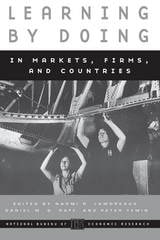
Learning by Doing in Markets, Firms, and Countries
Edited by Naomi R. Lamoreaux, Daniel M. G. Raff, and Peter Temin
University of Chicago Press, 1998
The first three essays in this volume explore techniques firms have used to both manage information to create valuable asymmetries and to otherwise suppress unwelcome competition. The next three focus on the ways in which firms have built special capabilities over time, capabilities that have been both sources of competitive advantage and resistance to new opportunities. The last two extend the notion of learning from the level of firms to that of nations. The collection as a whole builds on the previous two volumes to make the connection between information structure and product market outcomes in business history.
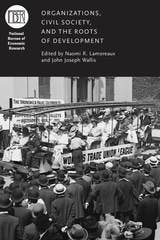
Organizations, Civil Society, and the Roots of Development
Edited by Naomi R. Lamoreaux and John Joseph Wallis
University of Chicago Press, 2017
The contributions to Organizations, Civil Society, and the Roots of Development seek to answer this question through an exploration of how developing nations throughout the eighteenth and nineteenth centuries, including the United States, United Kingdom, France, and Germany, made the transition to allowing their citizens the right to form organizations. The transition, contributors show, was not an easy one. Neither political changes brought about by revolution nor subsequent economic growth led directly to open access. In fact, initial patterns of change were in the opposite direction, as political coalitions restricted access to specific organizations for the purpose of maintaining political control. Ultimately, however, it became clear that these restrictions threatened the foundation of social and political order. Tracing the path of these modern civil societies, Organizations, Civil Society, and the Roots of Development is an invaluable contribution to all interested in today’s developing countries and the challenges they face in developing this organizational capacity.
Understanding Long-Run Economic Growth
Geography, Institutions, and the Knowledge EconomyEdited by Dora L. Costa and Naomi R. Lamoreaux
University of Chicago Press, 2011
The conditions for sustainable growth and development are among the most debated topics in economics, and the consensus is that institutions matter greatly in explaining why some economies are more successful than others over time. Probing the long-term effects of early colonial differences on immigration policy, land distribution, and financial development in a variety of settings, Understanding Long-Run Economic Growth explores the relationship between economic conditions, growth, and inequality, with a focus on how the monopolization of resources by the political elite limits incentives for ordinary people to invest in human capital or technological discovery. Among the topics discussed are the development of credit markets in France, the evolution of transportation companies in the United Kingdom and the United States, and the organization of innovation in the United States.