Results by title
118 books match the query 'Land tenure' and 16 start with a
A Greater Ireland
The Land League and Transatlantic Nationalism in Gilded Age AmericaEly M. Janis
University of Wisconsin Press, 2014
As this "Greater Ireland" flourished, new opportunities arose for women and working-class men to contribute within Irish-American society. Exploring the complex interplay of ethnicity, class, and gender, Janis demonstrates the broad range of ideological, social, and political opinion held by Irish Americans in the 1880s. Participation in the Land League deeply influenced a generation that replaced their old county and class allegiances with a common cause, shaping the future of Irish-American nationalism.

A Land Not Forgotten
Indigenous Food Security and Land-Based Practices in Northern OntarioMichael A. Robidoux
University of Manitoba Press, 2017

A Rule of Property for Bengal
An Essay on the Idea of Permanent SettlementRanajit Guha
Duke University Press, 1996
By proclaiming the Permanent Settlement in 1793, the British hoped to promote a prosperous capitalist agriculture of the kind that had developed in England. The act renounced for all time the state’s right to raise the assessment already made upon landowners and thus sought to establish a system of property that was, in the British view, necessary for the creation of a stable government. Guha traces the origins of the Permanent Settlement to the anti-feudal ideas of Phillip Francis and the critique of feudalism provided by physiocratic thought, the precursor of political economy. The central question the book asks is how the Permanent Settlement, founded in anti-feudalism and grafted onto India by the most advanced capitalist power of the day became instrumental in the development of a neo-feudal organization of landed property and in the absorption and reproduction of precapitalist elements in a colonial regime.
Guha’s examination of the British attempt to mold Bengal to the contours of its own society without an understanding of the traditions and obligations upon which the Indian agrarian system was based is a truly pioneering work. The implications of A Rule of Property for Bengal remain rich for the current discussions from the postcolonialist perspective on the meaning of modernity and enlightenment.
A Thousand Pieces of Paradise
Landscape and Property in the Kickapoo ValleyLynne Heasley
University of Wisconsin Press, 2012
A Thousand Pieces of Paradise is an ecological history of property and a cultural history of rural ecosystems set in one of the Midwest’s most historically significant regions, the Kickapoo River Valley. Whether examining the national war on soil erosion, Amish migration, a Corps of Engineers dam project, or Native American land claims, Lynne Heasley traces the history of modern American property debates. Her book holds powerful lessons for rural communities seeking to reconcile competing values about land and their place in it.
A Tortilla Is Like Life
Food and Culture in the San Luis Valley of ColoradoBy Carole M. Counihan
University of Texas Press, 2009
Located in the southern San Luis Valley of Colorado, the remote and relatively unknown town of Antonito is home to an overwhelmingly Hispanic population struggling not only to exist in an economically depressed and politically marginalized area, but also to preserve their culture and their lifeways. Between 1996 and 2006, anthropologist Carole Counihan collected food-centered life histories from nineteen Mexicanas—Hispanic American women—who had long-standing roots in the Upper Rio Grande region. The interviews in this groundbreaking study focused on southern Colorado Hispanic foodways—beliefs and behaviors surrounding food production, distribution, preparation, and consumption.
In this book, Counihan features extensive excerpts from these interviews to give voice to the women of Antonito and highlight their perspectives. Three lines of inquiry are framed: feminist ethnography, Latino cultural citizenship, and Chicano environmentalism. Counihan documents how Antonito's Mexicanas establish a sense of place and belonging through their knowledge of land and water and use this knowledge to sustain their families and communities. Women play an important role by gardening, canning, and drying vegetables; earning money to buy food; cooking; and feeding family, friends, and neighbors on ordinary and festive occasions. They use food to solder or break relationships and to express contrasting feelings of harmony and generosity, or enmity and envy. The interviews in this book reveal that these Mexicanas are resourceful providers whose food work contributes to cultural survival.
Above the Clearwater
Living on Stolen LandBette Lynch Husted
Oregon State University Press, 2004
Like her father before her, Bette Husted grew up on stolen land. The bench land above the Clearwater River in north-central Idaho had been a home for the Nez Perce Indians until the Dawes Act opened their reservation to settlement in 1895. As a child on the family homestead, Husted felt the presence of the Nez Perce: "But they were always just out of sight, like a smoky shadow behind me that I couldn't quite turn around quickly enough to catch."
Above the Clearwater chronicles her family's history on the land, revealing their joys and sorrows, their triumphs and tragedies. In a series of graceful and moving essays, Husted traces this intimate history, from her Cold War childhood to her struggles as a parent and finally to her life as a woman and teacher in the rural West. Her family's stories echo those of countless other families in the American West: the conflicts with guns, the struggles over land ownership and water rights, the isolation of women, the separations by race and class, the family secrets of mental illness and suicide.
With a powerful, poetic voice, Husted illuminates the tangled relationship between the history of a particular place and the history of the families who inhabit that place over time. As Above the Clearwater explores one family's search for a home on land taken from its original inhabitants, it quietly asks all readers to examine their own homes in the same light.
Agrarian Crisis in India
The Case of BiharBy F. Tomasson Jannuzi
University of Texas Press, 1974
Although much has been written on agrarian reforms in India, there are few in-depth studies of specific states and none concerning the relevance of agrarian reforms to the economic development and political stability of Bihar— a state containing one-tenth of the people of India, a population comparable in magnitude to that of the United Kingdom or France. F. Tomasson Jannuzi's field research in Bihar, beginning with village-level surveys and interviews in 1956 and extending through repeated visits through August 1970, has enabled him to provide a unique perspective on events and issues associated with the continuing struggle to transform Bihar's agrarian structure.
Agrarian Crisis in India is at once a history of post-independence agrarian reforms in an important state of India, a detailed critique of the statutory loopholes that have frustrated successive land-reform measures, and a penetrating analysis of the economic, political, and social implications of the failure of agrarian reforms to be implemented in twentieth-century Bihar. The author's analysis of the case of Bihar provides insights not only into the agrarian crisis in Bihar but also into other agrarian societies in the midst of social and economic transformation.
Experts in the field of economic development traditionally have held that the goals of increased production and distributive justice must be approached in sequence. It has been considered almost axiomatic that economic growth will result initially in growing inequalities among classes within a region and among regions within a country. Professor Jannuzi suggests that in Bihar a compelling alternative to this conventional wisdom is an economic-development strategy based on the recognition that the agricultural-production and distributive-justice goals are inseparable and must be addressed simultaneously. He suggests that economic growth in rural Bihar may become impossible if distributive justice continues to be denied to significant sections of the peasantry and, conversely, that distributive justice will prove an illusory target unless economic growth can be assured. Professor Jannuzi recommends the implementation of specified agrarian reforms in Bihar as the prerequisite for meeting the agricultural-production and distributive-justice goals.
Agrarian Environments
Resources, Representations, and Rule in IndiaArun Agrawal, ed.
Duke University Press, 2000
Editors Arun Agrawal and K. Sivaramakrishnan claim that rural social change in India cannot be understood without exploring how environmental changes articulate major aspects of agrarian transformations—technological, cultural, and political—in the last two centuries. In order to examine these issues, they have reached beyond the confines of single disciplinary allegiances or methodological loyalties to bring together anthropologists, historians, political scientists, geographers, and environmental scientists who are significantly informed by interdisciplinary research. Drawing on extensive field and archival research, the contributors demonstrate the powerful political implications of blurring the boundaries between dichotomous cultural representations, combine conceptual analyses with specific case studies, and look at why competing powers chose to emphasize particular representations of land use or social relations. By providing a more textured analysis of how categories emerge and change, this work offers the possibility of creating crucial alliances across populations that have historically been assumed to lack mutual goals.
Agrarian Environments will be valuable to those in political science, Asian studies, and environmental studies.
Contributors. Arun Agrawal, Mark Baker, Molly Chattopadhyaya, Vinay Gidwani, Sumit Guha, Shubhra Gururani, Cecile Jackson, David Ludden, Haripriya Rangan, Paul Robbins, Vasant Saberwal, James C. Scott, K. Sivaramakrishnan, Ajay Skaria, Jennifer Springer, Darren Zook
Alaska Native Cultures and Issues
Responses to Frequently Asked QuestionsEdited by Libby Roderick
University of Alaska Press, 2010
Allotment Stories
Indigenous Land Relations under Settler SiegeDaniel Heath Justice
University of Minnesota Press, 2021
More than two dozen stories of Indigenous resistance to the privatization and allotment of Indigenous lands
Land privatization has been a longstanding and ongoing settler colonial process separating Indigenous peoples from their traditional homelands, with devastating consequences. Allotment Stories delves into this conflict, creating a complex conversation out of narratives of Indigenous communities resisting allotment and other dispossessive land schemes.
From the use of homesteading by nineteenth-century Anishinaabe women to maintain their independence to the role that roads have played in expropriating Guam’s Indigenous heritage to the links between land loss and genocide in California, Allotment Stories collects more than two dozen chronicles of white imperialism and Indigenous resistance. Ranging from the historical to the contemporary and grappling with Indigenous land struggles around the globe, these narratives showcase both scholarly and creative forms of expression, constructing a multifaceted book of diverse disciplinary perspectives. Allotment Stories highlights how Indigenous peoples have consistently used creativity to sustain collective ties, kinship relations, and cultural commitments in the face of privatization. At once informing readers while provoking them toward further research into Indigenous resilience, this collection pieces back together some of what the forces of allotment have tried to tear apart.
Contributors: Jennifer Adese, U of Toronto Mississauga; Megan Baker, U of California, Los Angeles; William Bauer Jr., U of Nevada, Las Vegas; Christine Taitano DeLisle, U of Minnesota–Twin Cities; Vicente M. Diaz, U of Minnesota–Twin Cities; Sarah Biscarra Dilley, U of California, Davis; Marilyn Dumont, U of Alberta; Munir Fakher Eldin, Birzeit U, Palestine; Nick Estes, U of New Mexico; Pauliina Feodoroff; Susan E. Gray, Arizona State U; J. Kēhaulani Kauanui, Wesleyan U; Rauna Kuokkanen, U of Lapland and U of Toronto; Sheryl R. Lightfoot, U of British Columbia; Kelly McDonough, U of Texas at Austin; Ruby Hansen Murray; Tero Mustonen, U of Eastern Finland; Darren O’Toole, U of Ottawa; Shiri Pasternak, Ryerson U; Dione Payne, Te Whare Wānaka o Aoraki–Lincoln U; Joseph M. Pierce, Stony Brook U; Khal Schneider, California State U, Sacramento; Argelia Segovia Liga, Colegio de Michoacán; Leanne Betasamosake Simpson; Jameson R. Sweet, Rutgers U; Michael P. Taylor, Brigham Young U; Candessa Tehee, Northeastern State U; Benjamin Hugh Velaise, Google American Indian Network.
American Indian History on Trial
Historical Expertise in Tribal LitigationE. Richard Hart
University of Utah Press, 2017
Hart, a historian who has testified in cases that have resulted in roughly a billion dollars in judgments, uses specific cases to explain at length what kind of historical research and documentation is necessary for tribes seeking to protect and claim their rights under United States law. He demonstrates the legal questions that Native Americans face by exploring the cultural history and legal struggles of six Indian nations. He recounts how these were addressed by expert testimony grounded in thorough historical understanding, research, and argumentation. The case studies focus on the Wenatchi, Coeur d’Alene, Hualapai, Amah Mutsun, Klamath, and Zuni peoples but address issues relevant to many American tribes.

American Pentimento
The Invention of Indians and the Pursuit of RichesPatricia Seed
University of Minnesota Press, 2001
Americans and Their Land
The House Built on AbundanceAnne Mackin
University of Michigan Press, 2006
—James Carroll, author of House of War and An American Requiem, winner of the National Book Award
“Anne Mackin has taken a fresh and provocative look at that most fascinating of relationships: the one between the American people and the American land.”
—Michael Pollan, Knight Professor of Journalism and Director of the Knight Program in Science and Environmental Journalism at University of California Berkeley, contributing writer to the New York Times Magazine, and author of The Omnivore's Dilemma and The Botany of Desire
“Anne Mackin has given us a valuable and less-used lens to view the development of our neighborhoods, towns and cities: the land itself. Our relationship to the earth beneath our feet—how we dig it, buy it, sell it, zone it, pave it, spoil it or pamper it—helps explain what is produced on top of the land in our nation, from farms to homes to skyscrapers. All in all, Mackin takes us on a novel and erudite journey, from one coast to the other, and from Colonial times to the present. This valuable book marks a significant and lasting contribution to the way we see and understand our landscape and ourselves.”
—Alex Marshall, author of How Cities Work: Suburbs, Sprawl, and the Roads Not Taken
“To really understand the origins of the range war now raging between smart growth and property rights advocates over the future of the American land, you need to read this exceptional book.”
—Robert D. Yaro, President Regional Plan Association and Professor in Practice, University of Pennsylvania
Thomas Malthus once said, “The happiness of the Americans depended much less upon their peculiar degree of civilization than . . . upon their having a great plenty of fertile uncultivated land.”
Malthus knew. Lord MacCaulay knew. Albert Gallatin knew. America and its people would change as a growing population whittled away the supply of land.
Nothing has shaped the American character like the abundance of land that met the colonist, the pioneer, and the early suburbanite. With today’s political and economic institutions shaped by the largesse of yesteryear, how will Americans fare in the new landscape of water wars, expensive housing, rising fuel prices, environmental and property rights battles, and powerful industrial lobbies?
Why is land the key to American democracy? How can we protect our democracy as more people and industries compete more intensively for our remaining resources? Americans and Their Land begins an important, overdue discussion of these questions. Anne Mackin takes the reader story by story from frontier history to the present and shows how land shaped the American political landscape. She shows how our evolving traditions of apportioning resources have allowed diminished supplies to create our present, increasingly unequal society, and she asks how 300 million Americans living in the new American landscape of growing competition can better share those resources.
Ancestral Landscapes of the Pueblo World
James E. Snead
University of Arizona Press, 2008
Arrernte Present, Arrernte Past
Invasion, Violence, and Imagination in Indigenous Central AustraliaDiane J. Austin-Broos
University of Chicago Press, 2008
Employing ethnographic and archival research, Diane Austin-Broos traces the history of the Arrernte as they have transitioned from a society of hunter-gatherers to members of the Hermannsburg Mission community to their present, marginalized position in the modern Australian economy. While she concludes that these wrenching structural shifts led to the violence that now marks Arrernte communities, she also brings to light the powerful acts of imagination that have sustained a continuing sense of Arrernte identity.
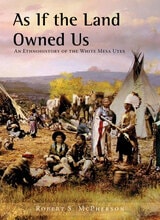
As If the Land Owned Us
An Ethnohistory of the White Mesa UtesRobert S. McPherson
University of Utah Press, 2011
The Ute people of White Mesa have a long, colorful, but neglected history in the Four Corners region. Although they ranged into the Great Basin, Southwest, and parts of the Rocky Mountains as hunters, gatherers, and warriors, southeastern Utah was home. There they adapted culturally and physically to the austere environment while participating in many of the well-known events of their times.
In As If the Land Owned Us, Robert McPherson has gathered the wisdom of White Mesa elders as they imparted knowledge about their land—place names, uses, teachings, and historic events tied to specific sites—providing a fresh insight into the lives of these little-known people. While there have been few published studies about the Southern Utes, this ethnohistory is the first to mix cultural and historic events. The book illustrates the life and times of the White Mesa Utes as they faced multiple changes to their lifeways. It is time for their history to be told in their terms.