Results by title
3 books match the query 'Landscape painting, American'

George Inness and the Science of Landscape
Rachael Ziady DeLue
University of Chicago Press, 2005
Throughout his career, Inness struggled to make visible what was invisible to the human eye by combining a deep interest in nineteenth-century scientific inquiry—including optics, psychology, physiology, and mathematics—with an idiosyncratic brand of mysticism. Rachael Ziady DeLue's George Inness and the Science of Landscape—the first in-depth examination of Inness's career to appear in several decades—demonstrates how the artistic, spiritual, and scientific aspects of Inness's art found expression in his masterful landscapes. In fact, Inness's practice was not merely shaped by his preoccupation with the nature and limits of human perception; he conceived of his labor as a science in its own right.
This lavishly illustrated work reveals Inness as profoundly invested in the science and philosophy of his time and illuminates the complex manner in which the fields of art and science intersected in nineteenth-century America. Long-awaited, this reevaluation of one of the major figures of nineteenth-century American art will prove to be a seminal text in the fields of art history and American studies.
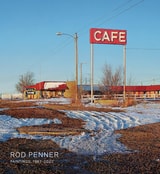
Rod Penner
Paintings, 1987–2022Rod Penner
The Artist Book Foundation, 2022
Rod Penner infuses his photorealistic paintings of the American southwest with a cinematic quality in the first major monograph on this contemporary realist artist.
The abandoned and forgotten landscapes of rural southwestern towns are the favored subjects of Rod Penner's paintings. His deft use of contrasts in his images—despondency and hope, isolation and nostalgia—evokes memories of The Last Picture Show and elicits complex responses from viewers. "I'm interested in the look of things and the quality of being there," he says. "A moment that is completely frozen with all the variety of textures; rust on poles, crumbling asphalt, light hitting the grass."
Penner's works are based on his photographs, digital video stills, and his experience of the rural landscapes of Texas and New Mexico. He depicts desolate, often deserted locations, the character of old houses and abandoned buildings, weather, and unique geography. His chosen scenes are infused with a cinematic quality that is the result of the exquisite light that he captures with his meticulous process. "The finished paintings should evoke contrasting responses of melancholy and warmth, desolation and serenity," he says.
Penner's hyperrealistic technique meticulously records both the iconic imagery and the beauty in the ashes of these once-prosperous streets and nighborhoods that still endure. The incredible poignant scenes evoke a universalism, a collective experience seen through the lens of Americana. "You won't find any hidden or overt socio-political meaning in my work and at the same time I hope that by utilizing what I find in the American landscape I'm able to connect to viewers on a deeper psychological level."
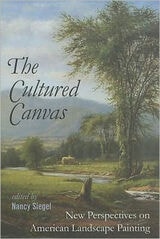
The Cultured Canvas
New Perspectives on American Landscape PaintingNancy Siegel
University of New Hampshire Press, 2012
Written from aesthetic, sociopolitical, cultural, and literary perspectives, The Cultured Canvas explores myriad ways in which American visual culture can be evaluated through newly conceived thematic and ideological approaches. This book moves beyond our accepted notion of the oil painting on canvas to consider the term as both a literal and figurative surface upon which artists construct or construe the landscape as an intellectual, cultural, or physical entity. It provides an innovative reevaluation of traditional thought concerning the Hudson River School, Luminism, and artists of the Civil War era.
As interdisciplinary emphases are employed with increasing frequency in arts and humanities courses, the breadth and depth of topics covered in this collection will provide a much-needed text for scholars in American art history, nineteenth-century American studies, and landscape studies, in addition to serving as a complement to courses in American literature and culture.
Hardcover is un-jacketed.