Results by title
7 books match the query 'Landscapes in art'
Capturing Troy
The Narrative Functions of Landscape in Archaic and Early Classical Greek ArtGuy Hedreen
University of Michigan Press, 2002
Guy Michael Hedreen is Professor of Art, Williams College.
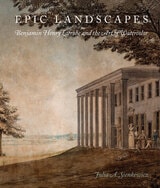
Epic Landscapes
Benjamin Henry Latrobe and the Art of WatercolorJulia Sienkewicz
University of Delaware Press, 2011
Published by University of Delaware Press. Distributed worldwide by Rutgers University Press.
Landscape and Power, Second Edition
Edited by W. J. T. Mitchell
University of Chicago Press, 2002
The first edition of this book, published in 1994, reshaped the direction of landscape studies by considering landscape not simply as an object to be seen or a text to be read, but as an instrument of cultural force, a central tool in the creation of national and social identities. This second edition adds not only a new preface, but five new essays—from Edward Said, W. J. T. Mitchell, Jonathan Bordo, Michael Taussig, and Robert Pogue Harrison—extending the scope of the book in remarkable ways.
Landscape and Power continues to be a central text for students and scholars who want to understand the importance of landscape to the making of our social, political, and cultural world.
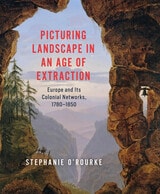
Picturing Landscape in an Age of Extraction
Europe and Its Colonial Networks, 1780–1850Stephanie O'Rourke
University of Chicago Press, 2025
In the late eighteenth and early nineteenth centuries, European artists confronted the emergence of a new way of thinking about and treating the Earth and its resources. Centered on extraction, this new paradigm was characterized by large-scale efforts to transform and monetize the physical environment across the globe. With this book, Stephanie O’Rourke considers such practices, looking at what was at stake in visual representations of the natural world during the first decades of Europe’s industrial revolutions.
O’Rourke argues that key developments in the European landscape painting tradition were profoundly shaped by industries including mining and timber harvesting, as well as by interlinked ideas about race, climate, and waste. Focusing on developments in Britain, France, Germany, and across Europe’s colonial networks, she explores how artworks and technical illustrations portrayed landscapes in ways that promoted—or pushed against—the logic of resource extraction.
Shaping Roman Landscape
Ecocritical Approaches to Architecture and Wall Painting in Early Imperial ItalyMantha Zarmakoupi
J. Paul Getty Trust, The, 0
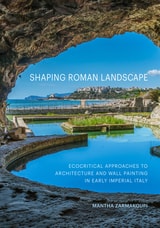
Landscape emerged as a significant theme in the Roman Late Republican and Early Imperial periods. Writers described landscape in texts and treatises, its qualities were praised and sought out in everyday life, and contemporary perceptions of the natural and built environment, as well as ideas about nature and art, were intertwined with architectural and decorative trends.
This illustrated volume examines how representations of real and depicted landscapes, and the merging of both in visual space, contributed to the creation of novel languages of art and architecture. Drawing on a diverse body of archaeological, art historical, and literary evidence, this study applies an ecocritical lens that moves beyond the limits of traditional iconography. Chapters consider, for example, how garden designs and paintings appropriated the cultures and ecosystems brought under Roman control and the ways miniature landscape paintings chronicled the transformation of the Italian shoreline with colonnaded villas, pointing to the changing relationship of humans with nature. Making a timely and original contribution to current discourses on ecology and art and architectural history, Shaping Roman Landscape reveals how Roman ideas of landscape, and the decorative strategies at imperial domus and villa complexes that gave these ideas shape, were richly embedded with meanings of nature, culture, and labor.
The Cultured Canvas
New Perspectives on American Landscape PaintingNancy Siegel
University of New Hampshire Press, 2012
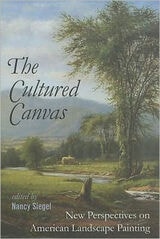
Written from aesthetic, sociopolitical, cultural, and literary perspectives, The Cultured Canvas explores myriad ways in which American visual culture can be evaluated through newly conceived thematic and ideological approaches. This book moves beyond our accepted notion of the oil painting on canvas to consider the term as both a literal and figurative surface upon which artists construct or construe the landscape as an intellectual, cultural, or physical entity. It provides an innovative reevaluation of traditional thought concerning the Hudson River School, Luminism, and artists of the Civil War era.
As interdisciplinary emphases are employed with increasing frequency in arts and humanities courses, the breadth and depth of topics covered in this collection will provide a much-needed text for scholars in American art history, nineteenth-century American studies, and landscape studies, in addition to serving as a complement to courses in American literature and culture.
Hardcover is un-jacketed.
This Ecstatic Nation
The American Landscape and the Aesthetics of PatriotismTerre Ryan
University of Massachusetts Press, 2011
Terre Ryan examines this phenomenon by exploring the overlapping trails of national mythology, landscape aesthetics, patriotic discourse, and public policy. Tracing her journeys around bombing grounds in Nevada, logging sites in Oregon, and energy fields in Wyoming, she argues that business and government agencies often frame commercial projects and national myths according to nineteenth-century beliefs about landscape and bounty. Advertisements and political promotional materials following this aesthetic framework perpetuate frontier-era ideas about the environment as commodity, scenery, and cultural trashlands. Transmitted through all types of media, nineteenth-century perspectives on landscape continue to inform mainstream perceptions of the environment, environmental policies, and representations of American patriotism.
Combining personal narrative with factual reportage, political and cultural critique, and historical analysis, Ryan reframes the images we see every day and places them into a larger national narrative.