Results by title
12 books match the query 'Landscapes in literature'
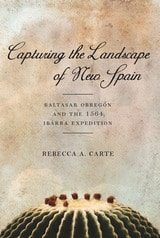
Capturing the Landscape of New Spain
Baltasar Obregón and the 1564 Ibarra ExpeditionRebecca A. Carte
University of Arizona Press, 2015
Although Obregón’s role in the Ibarra expedition was that of soldier-explorer, and despite his lacking an advanced education, he would go on to compose Historia de los descubrimientos de Nueva España twenty years later, expanding his narrative to include the years before and after his own firsthand experiences with Ibarra. Obregón depicts the storied landscape of the northern borderlands with vivid imagery, fusing setting and situation, constructing a new reality of what was, is, and should be, and presenting it as truth.
In Capturing the Landscape of New Spain, Rebecca A. Carte explains how landscape performs a primary role in Obregón’s retelling, emerging at times as protagonist and others as antagonist. Carte argues that Obregón’s textualization offers one of the first renderings of the region through the Occidental cultural lens, offering insight into Spanish cultural perceptions of landscape during a period of important social and political shifts.
By examining mapping and landscape discourse, Carte shows how history and geography, past and present, people and land, come together to fashion the landscape of northern New Spain.
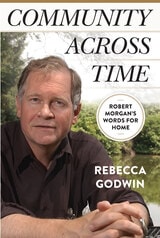
Community across Time
Robert Morgan’s Words for HomeRebecca Godwin
West Virginia University Press, 2023
One of the first book-length considerations of the Appalachian writer Robert Morgan.
One of the first book-length studies of Robert Morgan, Community across Time considers the Appalachian writer’s explorations of memory, family history, and landscape. It provides a study of all of Morgan’s fiction to date, as well as a chapter on his poetry and some reference, where appropriate, to his nonfiction. Rebecca Godwin examines the family history that informs much of this body of work, offering an extended biographical essay that ties characters and plot details to Morgan’s ancestors’ lives and to his own experiences growing up in the Blue Ridge Mountains.
Religious rifts, economic hardships, class conflicts, the place of women and Indigenous peoples, and the failure of humans to recognize the divinity of the natural world are among the motifs centering Morgan’s writing. Community across Time explores those themes as it looks to Morgan’s relationship to the Appalachian South.
Land/Scape/Theater
Elinor Fuchs and Una Chaudhuri, Editors
University of Michigan Press, 2002
Embracing subjects as diverse as the "landscape dramaturgy" of Suzan-Lori Parks, Artaud's trip to the Sierra Madre,Gertrude Stein's landscape theory and practice, Guillermo Gomez-Peña's "border subjects," and Bayreuth and Disneyland as cultic sites, Land/Scape/Theater draws on a broad range of theory, dramatic texts, and performance. All aspects of modern theater, these essays suggest, including the bedrock Aristotelian constituents of plot and character, have a landscape dimension that often goes unrecognized.
With its broad theoretical range and cross-disciplinary reach, Land/Scape/Theater will interest theater theorists and practitioners and cultural studies specialists, including historians of landscape. Theater students, scholars, teachers, directors, designers, and actors will find here a new framework and a new vocabulary for understanding both theater and the larger culture.
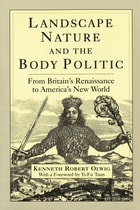
Landscape, Nature, and the Body Politic
From Britain's Renaissance to America's New WorldKenneth Robert Olwig
University of Wisconsin Press, 2002
Landscape, Nature, and the Body Politic explores the origins and lasting influences of two contesting but intertwined discourses that persist today when we use the words landscape, country, scenery, nature, national. In the first sense, the land is a physical and bounded body of terrain upon which the nation state is constructed (e.g., the purple mountain majesties above the fruited plain, from sea to shining sea). In the second, the country is constituted through its people and established through time and precedence (e.g., land where our fathers died, land of the Pilgrims’ pride). Kenneth Robert Olwig’s extended exploration of these discourses is a masterful work of scholarship both broad and deep, which opens up new avenues of thinking in the areas of geography, literature, theater, history, political science, law, and environmental studies.
Olwig tracks these ideas though Anglo-American history, starting with seventeenth-century conflicts between the Stuart kings and the English Parliament, and the Stuart dream of uniting Scotland with England and Wales into one nation on the island of Britain. He uses a royal production of a Ben Jonson masque, with stage sets by architect Inigo Jones, as a touchstone for exploring how the notion of "landscape" expands from artful stage scenery to a geopolitical ideal. Olwig pursues these contested concepts of the body politic from Europe to America and to global politics, illuminating a host of topics, from national parks and environmental planning to theories of polity and virulent nationalistic movements.
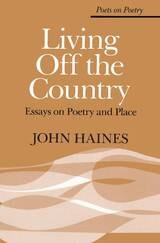
Living Off the Country
Essays on Poetry and PlaceJohn Haines
University of Michigan Press, 1981
We live on the surface, he discovered. It is the land that makes people. If a poet will see, will feel, will interpret his place and then relate that experience to what he knows of the world at large, he will have a life in imagination, a vitality beyond appearances.
John Haines is author of At the End of Summer: Poems 1948-1954; Fables and Distances: New and Selected Essays; and The Owl in the Mask of the Dreamer. He received the Lenore Marshall Poetry Prize in 1991.
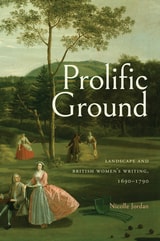
Prolific Ground
Landscape and British Women's Writing, 1690–1790Nicolle Jordan
Bucknell University Press, 2025
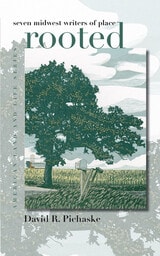
Rooted
Seven Midwest Writers of PlaceDavid R. Pichaske
University of Iowa Press, 2006
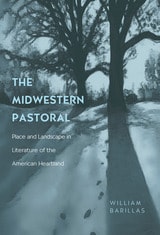
The Midwestern Pastoral
Place and Landscape in Literature of the American HeartlandWilliam Barillas
Ohio University Press, 2006
The Nature of Trauma in American Novels
Michelle Balaev
Northwestern University Press, 2012
In The Nature of Trauma in the American Novel, Michelle Balaev undertakes an ambitious rethinking of the foundations, implementations, and new possibilities of literary trauma theory.
This Vast Book of Nature
Writing the Landscape of New Hampshire’s White Mountains, 1784–1911Pavel Cenkl
University of Iowa Press, 2006
Starting with an exploration of Jeremy Belknap’s 1784 expedition to Mount Washington, which Cenkl links to the origins of tourism in the White Mountains, to the transformation of touristic and residential relationships to landscape, This Vast Book of Nature explores the ways competing visions of the landscape have transformed the White Mountains culturally and physically, through settlement, development, and—most recently—preservation, a process that continues today.
Translating Southwestern Landscapes
The Making of an Anglo Literary RegionAudrey Goodman
University of Arizona Press, 2002
Whether as tourist's paradise, countercultural destination, or site of native resistance, the American Southwest has functioned as an Anglo cultural fantasy for more than a century. In Translating Southwestern Landscapes, Audrey Goodman excavates this fantasy to show how the Southwest emerged as a symbolic space from 1880 through the early decades of the twentieth century.
Drawing on sources as diverse as regional magazines and modernist novels, Pueblo portraits and New York exhibits, Goodman has crafted a wide-ranging history that explores the invention, translation, and representation of the Southwest. Its principal players include amateur ethnographer Charles Lummis, who conflated the critical work of cultural translation; pulp novelist Zane Grey, whose bestselling novels defined the social meanings of the modern West; fashionable translator Mary Austin, whose "re-expressions" of Indian song are contrasted with recent examples of ethnopoetics; and modernist author Willa Cather, who demonstrated an immaterial feeling for landscape from the Nebraska Plains to Acoma Pueblo.
Goodman shows how these writers—as well as photographers such as Paul Strand, Ansel Adams, and Alex Harris—exhibit different phases of the struggle between an Anglo calling to document Native and Hispanic difference and America's larger drive toward imperial mastery. In critiquing photographic representations of the Southwest, she argues that commercial interests and eastern prejudices boiled down the experimental images of the late nineteenth century to a few visual myths: the persistence of wilderness, the innocence of early portraiture, and the purity of empty space.
An ambitious synthesis of criticism and anthropology, art history and geopolitical theory, Translating Southwestern Landscapes names the defining contradictions of America's most recently invented cultural space. It shows us that the Southwest of these early visitors is the only Southwest most of us have ever known.
Writing on the Soil
Land and Landscape in Literature from Eastern and Southern AfricaNg’ang’a Wahu-Muchiri
University of Michigan Press, 2023
Across contiguous nation-states in Eastern Africa, the geographic proximity disguises an ideological complexity. Land has meant something fundamental in the sociocultural history of each country. Those concerns, however, have manifested into varied political events, and the range of struggles over land has spawned a multiplicity of literary interventions. While Kenya and Uganda were both British colonies, Kenya's experience of settler land alienation made for a much more violent response against efforts at political independence. Uganda's relatively calm unyoking from the colonial burden, however, led to a tumultuous post-independence. Tanzania, too, like Kenya and Uganda, resisted British colonial administration—after Germany's defeat in World War 1.
In Writing on the Soil, author Ng’ang’a Wahu-Mũchiriargues that representations of land and landscape perform significant metaphorical labor in African literatures, and this argument evolves across several geographical spaces. Each chapter's analysis is grounded in a particular locale: western Kenya, colonial Tanganyika, post-independence Tanzania, Zimbabwe, Nairobi, Dar es Salaam, Anam Ka'alakol (Lake Turkana), Kampala, and Kitgum in Northern Uganda. Moreover, each section contributes to a deeper understanding of the aesthetic choices that authors make when deploying tropes revolving around land, landscape, and the environment. Mũchiri disentangles the numerous connections between geography and geopolitical space on the one hand, and ideology and cultural analysis on the other. This book embodies a multi-layered argument in the sphere of African critical scholarship, while adding to the growing field of African land rights scholarship—an approach that foregrounds the close reading of Africa’s literary canon.