Results by title
3 books match the query 'Langston, Richard'
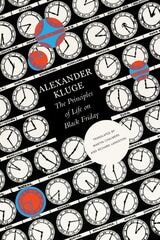
The Principles of Life on Black Friday
Chronicle of Emotions, Notebook 1Alexander Kluge
Seagull Books, 2023
This volume concerns itself with the question of time, from the description of a brief fragment passing by in a matter of minutes to stories of the unexpected stock-market crash of 1929, a once-in-a-century event that Europeans call ‘Black Friday’ because Wall Street’s collapse reached the Old World one day later. Through this exploration of time, Kluge ponders some fundamental questions not altered by the passing of time: What can I trust? How can I protect myself? What should I be afraid of? Our age today has achieved a new kind of obscurity. We’ve encountered a pandemic. We’ve witnessed the Capitol riots. We see before us inflation, war, and a burning planet. We gaze at the world with suspense. What we need in our lives is orientation—just like ships that navigate the high seas. We might just find that in Kluge’s vignettes and stories.
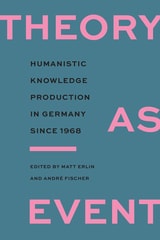
Theory as Event
Humanistic Knowledge Production in Germany Since 1968Matt Erlin, André Fischer
Northwestern University Press, 2027
Shedding new light on the actors, infrastructures, and events that shaped the development of literary and cultural theory
While theory aspires by its very nature to timeless validity, the ascendency of particular intellectual paradigms at specific historical moments depends on a complex assemblage of institutional, historical, political, material, and medial factors. Theory as Event: Humanistic Knowledge Production in Germany Since 1968 reconsiders the so-called age of theory as it took shape in the German-speaking world after 1968. In invoking the term “event,” this volume draws attention to the myriad incidents and accidents that enable the creation, diffusion, and canonization of humanistic knowledge, from public controversies and debates to the circulation of various forms of print media.
By conceptualizing theory as an event, the volume also sheds new light on the quotidian, praxeological forms of knowledge production—inconspicuous but no less important acts of research, teaching, and even administration that have shaped the intellectual landscape of the humanities, from visiting professorships and habilitation defenses to the founding of new working groups. In shifting attention from the explication of individual works to these seemingly paratextual phenomena, the contributors to this collection not only offer a fresh perspective on key moments in German intellectual history; they also model a new approach to the history of ideas.

Visions of Violence
German Avant-Gardes After FascismRichard Langston
Northwestern University Press, 2007
An extreme faction of aesthetic modernity intent on bulldozing contemporary life, the avant-garde has regularly employed visions of violence in their push for societal and cultural renewal. But in the shadow of unparalleled war and genocide, such aesthetic violence lost its force. This book explores the reconfiguration of the avant-garde in response to the violent transformation of European reality. Citing the emergence of independent avant-garde practitioners in the place of the previous collective, Richard Langston considers six individual exemplars of Germany’s post-fascist avant-garde—works that span the last six decades: painter, writer, and filmmaker Peter Weiss’s appropriation of French surrealism in the fifties; writer Dieter Wellershoff’s coterie of “new realists”; artist Wolf Vostell’s mediation and conflation of the experiences of the Auschwitz trials and the Vietnam War; poet and novelist Dieter Brinkmann’s collages from the seventies; the multimedia displacements of Alexander Kluge; and the performative engagements of dramatists Christoph Schlingensief and Rene Pollesch.
Taking stock of the evolution of Germany’s post-fascist avant-gardes, Langston’s book shows how the movement from Weiss to Pollesch exhibits the problems that both modernity and postmodernity pose for an aesthetic engagement of Germany’s violent past.