Results by title
5 books match the query 'Langston Hughes'
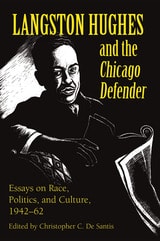
Langston Hughes and the *Chicago Defender*
Essays on Race, Politics, and Culture, 1942-62Langston Hughes. Edited by Christopher C. De Santis
University of Illinois Press, 1995
But it was as a columnist for the famous African-American newspaper the Chicago Defender that Hughes chronicled the hopes and despair of his people. For twenty years, he wrote forcefully about international race relations, Jim Crow, the South, white supremacy, imperialism and fascism, segregation in the armed forces, the Soviet Union and communism, and African-American art and culture. None of the racial hypocrisies of American life escaped his searing, ironic prose.
This is the first collection of Hughes's nonfiction journalistic writings. For readers new to Hughes, it is an excellent introduction; for those familiar with him, it gives new insights into his poems and fiction.
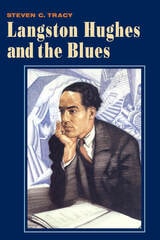
Langston Hughes and the Blues
Steven C. Tracy
University of Illinois Press, 2024
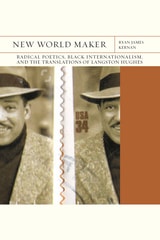
New World Maker
Radical Poetics, Black Internationalism, and the Translations of Langston HughesRyan James Kernan, foreword by Robin D. G. Kelley
Northwestern University Press, 2022
Through original research and close readings alert to the foreign prosody underlying Hughes’s work, New World Maker recuperates his political writing, which had been widely maligned by Cold War detractors and adherents of New Criticism, and affirms his place as a progenitor of African diasporic literature and within the pantheon of US modernists. Demonstrating the integral part translation played in Hughes’s creative process, this book challenges a number of common assumptions about this canonical thinker and offers important insights for scholars of African diasporic literature, comparative literature, and American, Caribbean, and translation studies.
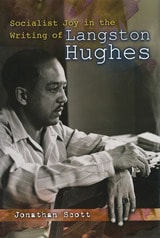
Socialist Joy in the Writing of Langston Hughes
Jonathan Scott
University of Missouri Press, 2007
Jonathan Scott has written the first book-length study to analyze the extraordinary range of Hughes’s creative output, showing that his unassailable reputation as one of America’s finest “folk poets” barely scratches the surface of his oeuvre. Scott offers a robust account of the relations between Hughes and political activism to show that Hughes’s direct involvement with the U.S. socialist movement of the 1920s and 1930s was largely responsible for the variety of his writing. Scott also contends that the goal of overthrowing white oppression produced a “socialist joy” that would express itself repeatedly in Hughes’s work during the anticommunist crusades of the 1950s and 1960s.
In his provocative study, Scott explores four areas of Hughes’s intellectual work: his relationship with Afro-Caribbean arts, Soviet Russia, and the Harlem Renaissance; his postwar newspaper writing for the African American press; his extensive cultural work as an anthologist; and his writings for young people. Through these analyses, Scott proposes the concept of “red, white, and black” as an alternative paradigm for appreciating Hughes in particular and the American scene in general.
Scott views Hughes not simply as a great author but as an American working-class intellectual trickster whose eccentric projects require a redefinition of the very concept of authorship. By focusing on Hughes’s intellectual method, Scott also contests the notion of reducing all African Americans to one undifferentiated social status beneath that of any class within the white oppressing group—a hallmark of racial oppression that has diminished, in the U.S. academy, Hughes’s international status.
As Scott persuasively argues, it is only through an understanding of Hughes’s literary method that we can undertake a thorough account of his prolific production during the cold war era. His book situates Hughes’s life and work in their proper contexts, both reconfirming Hughes’s reputation as an intellectual of the American Left and establishing his long-denied place in American studies as the most well-rounded writer of his time.
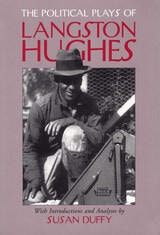
The Political Plays of Langston Hughes
Introductions and Analyses by Susan Duffy
Southern Illinois University Press, 2000
Among the most influential poets of the Harlem Renaissance, Langston Hughes is perhaps best remembered for the innovative use of jazz rhythms in his writing. While his poetry and essays received much public acclaim and scholarly attention, Hughes’ dramas are relatively unknown. Only five of the sixty-three plays Hughes scripted alone or collaboratively have been published (in 1963).
Published here, for the first time, are four of Hughes’ most poignant, poetic, and political dramas, Scottsboro Limited, Harvest (also known as Blood on the Fields), Angelo Herndon Jones, and De Organizer. Each play reflects Hughes’ remarkable professionalism as a playwright as well as his desire to dramatize the social history of the African American experience, especially in the context of the labor movements of the 1930s and their attempts to attract African American workers. Hughes himself counted prominent members of these leftist groups among his close friends and patrons; he formed a theater group with Whittaker Chambers, prompting an FBI investigation of Hughes and his writing in the 1930s. These plays, while easily read as idealistic propaganda pieces for the left, are nonetheless reflective of Hughes’ other more influential and studied works.
The first scholar to offer a systematic study of Hughes’ plays, Susan Duffy provides an informed introduction as well as a detailed analysis of each of the four plays. Duffy also establishes that De Organizer, a collaboration with noted jazz pianist and composer James P. Johnson (who also wrote its score) was indeed performed by the Labor Stage.
By making these forgotten texts available, and by presenting them within a scholarly discussion of 1930s leftist political movements, Duffy seeks to spark a renewed interest in Langston Hughes as an American playwright and political figure.