Results by title
4030 books match the query 'Language Arts & Disciplines' and 351 start with a
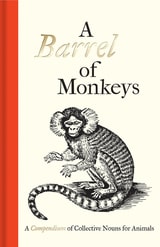
A Barrel of Monkeys
A Compendium of Collective Nouns for AnimalsCompiled by Samuel Fanous
Bodleian Library Publishing, 2015
A Barrel of Monkeys brings together more than one hundred collective nouns for animals, from a bloat of hippopotamuses to a caravan of camels, a tower of giraffes, and a leap of leopards. The rivalry between male rhinoceroses becomes especially apt when the rowdy ungulates are characterized as a crash of rhinos. An ambush of tigers is an apt characterization of the skillful hunters that silently stalk their prey. A blend of wordplay, puns, and alliteration, some of the terms collected here are now commonplace, like a pride of lions. Others aren’t heard much these days, but many—like a dazzle of zebras or a prickle of porcupines—richly deserve a comeback.
With charming illustrations by the eighteenth-century artist and naturalist Thomas Bewick, A Barrel of Monkeys is the perfect follow-up to A Conspiracy of Ravens, the Bodleian Library’s book of bird words. Not even a crash of rhinos can stop readers from smiling at this second collection.

A Basic Music Library
Essential Scores and Sound Recordings, Volume 1: Popular MusicAmerican Library Association, 2022
A Belfast Girl
A 1960s American folk music legend weaves stories of a girlhood on “the singing streets” of Ireland, marriage in Scotland, and arrival in AmericaMaggi Kerr Peirce
Parkhurst Brothers, Inc., 2013
A 1960s American folk music legend weaves stories of a girlhood on “the singing streets” of Ireland, marriage in Scotland, and arrival in America
A Book Sale How-To Guide
More Money, Less StressPat Ditzler
American Library Association, 2012
A Box Full of Tales
Kathy MacMillan
American Library Association, 2008
A Braided Heart
Essays on Writing and FormBrenda Miller
University of Michigan Press, 2021
A Braided Heart provides a friendly, personal, and smart guide to the writing life. It also offers clear and original instruction on craft elements at the forefront of today’s emerging forms in creative nonfiction: from the short-short, to the braided form, to the hermit crab essay. An acknowledged expert in these forms, Brenda Miller gives writers practical advice on how to sustain and invigorate their writing practice, while also encouraging readers to explore their own writing lives.
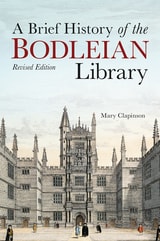
A Brief History of the Bodleian Library
Mary Clapinson
Bodleian Library Publishing, 2020
How did a library founded over four hundred years ago grow to become the world-renowned institution it is today, home to over thirteen million items? From its foundation by Sir Thomas Bodley in 1598 to the opening of the Weston Library in 2015, this illustrated account shows how the Library’s history has been involved with the British monarchy and political events throughout the centuries. The history of the Library is also a history of collectors and collections, and this book traces the story of major donations and purchases, making use of the Library’s own substantial archives to show how it came to house key items such as early confirmations of the Magna Carta, Shakespeare’s First Folio, and the manuscript of Jane Austen’s earliest writings, among many others.
This revised edition brings the history of the Bodleian Library up to the present moment. Beautifully illustrated with prints, portraits, manuscripts, and archival material, this book is essential reading for anyone interested in the history of libraries and collections.
A Brief History of the Spanish Language
David A. Pharies
University of Chicago Press, 2007
After introductory chapters on what it means to study the history of a language, the concept of linguistic change, and the nature of language families, Pharies traces the development of Spanish from its Latin roots, all with the minimum amount of technical language possible. In the core sections of the book, readers are treated to an engaging and remarkably succinct presentation of the genealogy and development of the language, including accounts of the structures and peculiarities of Latin, the historical and cultural events that deeply influenced the shaping of the language, the nature of Medieval Spanish, the language myths that have become attached to Spanish, and the development of the language beyond the Iberian Peninsula, especially in the Americas. Focusing on the most important facets of the language’s evolution, this compact work makes the history of Spanish accessible to anyone with a knowledge of Spanish and a readiness to grasp basic linguistic concepts.
Available in both English and Spanish editions, A Brief History of the Spanish Language provides a truly outstanding introduction to the exciting story of one of the world’s great languages.
A Century of Repression
The Espionage Act and Freedom of the PressRalph Engelman and Carey Shenkman
University of Illinois Press, 2022
A Century of Travels in China
Critical Essays on Travel Writing from the 1840s to the 1940sEdited by Douglas Kerr and Julia Kuehn
Hong Kong University Press, 2007
A Communion of Friendship
Literacy, Spiritual Practice, and Women in RecoveryBeth Daniell
Southern Illinois University Press, 2003
Drawing on interviews and an array of scholarly work, Beth Daniell maps out the relations of literacy and spirituality in A Communion of Friendship: Literacy, Spiritual Practice, and Women in Recovery. Daniell tells the story of a group of women in “Mountain City” who use reading and writing in their search for spiritual growth. Diverse in socioeconomic status, the Mountain City women are, or have been, married to alcoholics. In Al-Anon, they use literacy to practice the Twelve Steps of Alcoholics Anonymous in order to find spiritual solutions to their problems.
In addition, Daniell demonstrates that in the lives of these women, reading, writing, and speaking are intertwined, embedded in one another in rich and complex ways. For the women, private literate practice is of the utmost importance because it aids the development and empowerment of the self. These women engage in literate practices in order to grow spiritually and emotionally, to live more self-aware lives, to attain personal power, to find or make meaning for themselves, and to create community. By looking at the changes in the women’s reading, Daniell shows that Al-Anon doctrine, particularly its oral instruction, serves as an interpretive tool. This discussion points out the subtle but profound transformations in these women’s lives in order to call for an inclusive notion of politics.
Foregrounding the women’s voices, A Communion of Friendship addresses a number of issues important in composition studies and reading instruction. This study examines the meaning of literacy within one specific community, with implications both for pedagogy and for empirical research in composition inside and outside the academy.
A Community of Writers
Paul Engle and the Iowa Writers' WorkshopDana, Robert
University of Iowa Press, 1999
With these words, written long before his Iowa Writers' Workshop became world famous, much imitated, and academically rich, Paul Engle captured the spirit behind his beloved workshop. Now, in this collection of essays by and about those writers who shared the energetic early years, Robert Dana presents a dynamic, informative tribute to Engle and his world.
The book's three sections mingle myth and history with style and grace and no small amount of humor. The beginning essays are given over to memories of Paul Engle in his heyday. The second group focuses particularly on those teachers—Robert Lowell, John Berryman, Kurt Vonnegut, for example—who made the workshop hum on a day-to-day basis. Finally, the third section is devoted to storytelling: tall tales, vignettes, surprises, sober and not-so-sober moments. Engle's own essay, "The Writer and the Place," describes his "simple, and yet how reckless" conviction that "the creative imagination in all of the arts is as important, as congenial, and as necessary, as the historical study of all the arts."
Today, of course, there are hundreds of writers' workshops, many of them founded and directed by graduates of the original Iowa workshop. But when Paul Engle arrived in Iowa there were exactly two. His indomitable nature and great persuasive powers, combined with his distinguished reputation as a poet, loomed large behind the enhancement of the Iowa Writers' Workshop. This volume of fine and witty essays reveals the enthusiasm and drive and sheer pleasure that went into Iowa's renowned workshop.
A Computational Introduction to Linguistics
Describing Language in Plain PrologAlmerindo E. Ojeda
CSLI, 2013
A Concise Introduction to Syntactic Theory
The Government-Binding ApproachElizabeth A. Cowper
University of Chicago Press, 1992
"Cowper exhibits the analytical devices of current principles-and-parameters approaches, takes readers carefully through the central elements of grammatical theory (including very recent work), and ushers them selectively into the technical literature. . . . A serious introduction for those who want to know the nuts and bolts of syntactic theory and to see why linguists are so excited these days."—David Lightfoot, University of Maryland
"An excellent short introduction to the Government and Binding model of syntactic theory. . . . Cowper's work succeeds in teaching syntactic argumentation and in showing the conceptual reasons behind specific proposals in modern syntactic theory."—Jaklin Kornfilt, Syracuse University
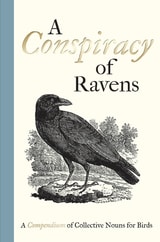
A Conspiracy of Ravens
A Compendium of Collective Nouns for BirdsCompiled by Samuel Fanous
Bodleian Library Publishing, 2014
A Conspiracy of Ravens presents readers with a compendium of collective bird nouns from the distant and not-so-distant past. Some of the nouns are portentous, like a tiding of magpies. Others, like a murmuration of starlings or a chattering of choughs, convey sound. Still more reflect with literary flourish the beauty of the bird: what could be more celebratory than a crown of kingfishers or an exaltation of larks? Featuring songbirds, aquatic birds, garden favorites, and birds of prey, this book collects more than one hundred of the best and most imaginative expressions and illustrates them with charming woodcuts by the eighteenth-century artist and naturalist Thomas Bewick.
A beautiful and entertaining read, A Conspiracy of Ravens will delight bird-lovers and word-lovers in equal measure.
A Constructing Experience
Charles Bazerman
Southern Illinois University Press, 1994
Charles Bazerman’s newest book, a selection of both his published and unpublished essays from recent years, ranges from pedagogy to research to theory, exploring how all three levels are motivated by common concerns and how they are integrated through similar concepts and approaches. From this integrative perspective, Bazerman reveals his life-long inquiry into the nature of language—why it exists and what place it holds in the social world.
Presenting a powerful, action-oriented view of language that finds meaning in local circumstances and local uses, Bazerman divides his essays into four parts, beginning with an examination of the classroom experience. In describing the dynamics of the classroom and the relationship of the classroom to surrounding social arrangements, Bazerman notes how reading relates to writing, how interpersonal relations influence and structure acts of reading and writing, and how reading and writing are themselves forms of social action.
Bazerman, in parts 2 and 3, explains how larger forms of social structure are in dialectic with local acts of literacy, how experience of the world influences both everyday writing and empirically driven research, and how individuals conceive of social situations and actions to think about and plan activities. As he admittedly puzzles through conceptual obstacles, Bazerman explores many of the terms and theories evoked in rhetorical studies and provides a critical examination of the theories of James Kinneavy as well as more general thoughts on the nature of rhetorical study.
In part 4, Bazerman reinterprets the classical rhetorical concept of kairos in the light of theory and research in the social sciences, analyzes intertextuality in a scientific text, and offers a rereading of the writings of Adam Smith.
Throughout this book, Bazerman maintains that research into writing is the examination of what people do and have done, what influences what they do, and what texts do to people who write and read them. In addition, he reiterates the importance of literacy as a connecting device, essential to survival, growth, and change. Lack of literacy cuts people off from the institutions and means of life in a society.
A Constructional Approach to Resultatives
Hans C. Boas
CSLI, 2003
A Contested Caribbean Indigeneity
Language, Social Practice, and Identity within Puerto Rican Taíno ActivismSherina Feliciano-Santos
Rutgers University Press, 2021
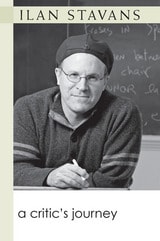
A Critic's Journey
Ilan Stavans
University of Michigan Press, 2009
Ilan Stavans has been a lightning rod for cultural discussion and criticism his entire career. In A Critic's Journey, he takes on his own Jewish and Hispanic upbringing with an autobiographical focus and his typical flair with words, exploring the relationship between the two cultures from his own and also from others' experiences.
Stavans has been hailed as a voice for Latino culture thanks to his Hispanic upbringing, but as a Jew and a Caucasian, he's also an outsider to that culture---something that's sharpened his perspective (and some of his critics' swords). In this book of essays, he looks at the creative process from that point of view, exploring everything from the translation of Don Quixote to the Hispanic anti-Semitism and the Holocaust in Latin America.
Ilan Stavans is Lewis-Sebring Professor in Latin American and Latino Culture and Five College Fortieth Anniversary Professor at Amherst College. A native of Mexico, he received his doctorate in Latin American Literature from Columbia University. Stavans's books include The Hispanic Condition, On Borrowed Words, Spanglish, Dictionary Days, The Disappearance, Love & Language (with Verónica Albin), Resurrecting Hebrew, and Mr. Spic Goes to Washington, and he has edited books including The Oxford Book of Jewish Stories and the upcoming Norton Anthology of Latino Literature. His story "Morirse está en Hebreo" was made into the award-winning movie My Mexican Shivah.
Stavans has received numerous awards, among them a Guggenheim Fellowship, the National Jewish Book Award, an Emmy nomination, the Latino Book Award, Chile's Presidential Medal, the Rubén Darío Distinction, and the Cátedra Roberto Bolaño. His work has been translated into a dozen languages.
A Descriptive Approach to Language-Theoretic Complexity
James Rogers
CSLI, 1998
A Dictionary of Ch'orti' Mayan-Spanish-English
Kerry Hull
University of Utah Press, 2016
Each entry contains examples of Ch’orti’ sentences along with their translations. Each term is defined grammatically and linked to a grammatical index. Variations due to age and region are noted. Additionally, extensive cultural and linguistic annotations accompany many entries, providing detailed looks into Ch’orti’ daily life, mythology, flora and fauna, healing, ritual, and food. Hull worked closely with native speakers, including traditional ritual specialists, and presents that work here in a way that is easily accessible to scholars and laypersons alike.
A Dictionary of Language
David Crystal
University of Chicago Press, 2001
A Dictionary of Selected Synonyms in the Principal Indo-European Languages
Carl Darling Buck
University of Chicago Press, 1988
A Different Kind of Web
New Connections Between Archives and Our UsersKate Theimer
American Library Association, 2011
A Feminist Legacy
The Rhetoric and Pedagogy of Gertrude BuckSuzanne Bordelon
Southern Illinois University Press, 2007
The first book-length investigation of a pioneering English professor and theorist at Vassar College, A Feminist Legacy: The Rhetoric and Pedagogy of Gertrude Buck explores Buck’s contribution to the fields of education and rhetoric during the Progressive Era. By contextualizing Buck’s academic and theoretical work within the rise of women’s educational institutions like Vassar College, the social and political movement toward suffrage, and Buck’s own egalitarian political and social ideals, Suzanne Bordelon offers a scholarly and well-informed treatment of Buck’s achievements that elucidates the historical and contemporary impact of her work and life.
Bordelon argues that while Buck did not call herself a feminist, she embodied feminist ideals by demanding the full participation of her female students and by challenging power imbalances at every academic, social, and political level.
A Feminist Legacy reveals that Vassar College is an undervalued but significant site in the history of women’s argumentation and pedagogy. Drawing on a rich variety of archival sources, including previously unexamined primary material, A Feminist Legacy traces the beginnings of feminist theories of argumentation and pedagogy and their lasting legacy within the fields of education and rhetoric.
A Few Good Books
Stephanie L. Maatta
American Library Association, 2010
A Gateway to Sindarin
A Grammar of an Elvish Language from JRR Tolkien's Lord of the RingsDavid Salo
University of Utah Press, 2004
From the 1910s to the 1970s, author and linguist J. R. R. Tolkien worked at creating plausibly realistic languages to be used by the creatures and characters in his novels. Like his other languages, Sindarin was a new invention, not based on any existing or artificial language. By the time of his death, he had established fairly complete descriptions of two languages, the "elvish" tongues Quenya and Sindarin. He was able to compose poetic and prose texts in both, and he also constructed a lengthy sequence of changes for both from an ancestral "proto-language," comparable to the development of historical languages and capable of analysis with the techniques of historical linguistics.
In A Gateway to Sindarin, David Salo has created a volume that is a serious look at an entertaining topic. Salo covers the grammar, morphology, and history of the language. Supplemental material includes a vocabulary, Sindarin names, a glossary of terms, and an annotated list of works relevant to Sindarin. What emerges is an homage to Tolkien's scholarly philological efforts.
A Gift of Meaning
Bill Tammeus
University of Missouri Press, 2001
Because of the peculiar momentary nature of journalism, not every column can stand the test of time. But many—even those about events nearly gone from the public consciousness--contain lasting truths. A Gift of Meaning is a collection of those lasting truths from Bill Tammeus, a columnist for the Kansas City Star.
Each piece reveals Tammeus's attempt to wrestle eternal meaning from the events and experiences that sweep us along day by day.
I stopped by a homeless shelter the other day to see someone I know. As I waited, I felt rather conspicuous in my suit and tie. In fact, the friendly man at the information desk asked me if I was a pastor. I chuckled.
But as I sat in the lobby waiting to see the man I came to check on, I was struck again by what may be the most difficult of all human tasks: empathy. That is, the challenge of really putting ourselves in the shoes of others.
In the end, A Gift of Meaning is not just a presentation of found meaning, but also a call to readers to stop and think for themselves. This book is an invitation to breathe deeply and seek out the meaning of what the world heaves at us each day. It is an offering of insights that will provide fresh ways of comprehending things readers thought they already understood.
A Glossary of Words and Phrases in the Oral Performing and Dramatic Literatures of the Jin, Yuan, and Ming
Dale R. Johnson
University of Michigan Press, 2002
A Grammar Writer's Cookbook
Edited by Miriam Butt, Tracy Holloway King, María-Eugenia Niño, and Frédérique S
CSLI, 1999
A Grammar and Dictionary of the Timucua Language
Julian Granberry
University of Alabama Press, 1993
Preserving the voice of a vanished people through language, history, and scholarship.
Taken from the surviving contemporary documentary sources, Julian Granberry's volume describes the grammar and lexicon for the extinct 17th-century Timucua language of Central and North Florida and traces the origins of the 17th-century Timucua speakers and their language. Originally privately published in 1987, with limited circulation, this is the only available publication on the Timucuan language. It provides full grammatical analysis and complete lexical data, and it synthesizes both linguistic and archaeological data in order to provide a coherent picture of the Timucua peoples. Granberry traces the probable historical origins of Timucua speakers to a central Amazonian homeland at approximately 2,500 B.C. and proposes that Timucua speakers were responsible for introducing ceramic wares into North America.
A Grammar of Akajeru
Fragments of a Traditional North Andamanese DialectRaoul Zamponi and Bernard Comrie
University College London, 2021
Originally spoken across the northern Andamanese Islands in the Bay of Bengal, the Akajeru language is spoken today by only three people. A Grammar of Akajeru describes this unique grammatical system as it was reported at the turn of the twentieth century. Based primarily on research conducted by Victorian anthropologists Alfred R. Radcliffe-Brown and Edward Horace Man, this book offers a linguistic analysis of all extant Akajeru material as well as the scant documentation of adjacent dialects Akabo and Akakhora. This volume includes a grammatical sketch of Akajeru, an English-Akajeru lexicon, and a comparison between Akajeru and present-day Andamanese.
A Grammar of Elfdalian
Yair Sapir and Olof Lundgren
University College London, 2024
Elfdalian is the language traditionally spoken in Älvdalen, central Sweden. Due to its linguistic difference from Swedish, several attempts have been made in Sweden to acquire official recognition of it as a minority language. However, despite the growing interest in documenting and revitalizing Elfdalian, it is still regarded as a dialect.
As one of the best-preserved members of a larger but lesser-known sub-branch of the Scandinavian languages called Dalecarlian (or Dalmål), Elfdalian is a unique language to study. The purpose of this grammar is to account for Late Classical, or Preserved Elfdalian from linguistic, historical, and sociolinguistic angles, and to make the language, including both its archaic and innovative features, accessible to a wider audience.
Grammar of Elfdalian serves as a valuable resource for Ölvdan locals who wish to revitalize or retake their language, for those who wish to transmit the language to others through preschool, school, or adult instruction, and for people who wish to study a North Germanic language for the first time. Linguists may find Elfdalian interesting from the angle of its language structure, as well as from the perspectives of sociolinguistics and language policy.
A Grammar of Gaddi
Preeti Kumari, Shreya Mehta, Anjali Nair, Anusuya Nayak, Yangchen Roy, and Vyom Sharma
University College London, 2026
The first comprehensive descriptive grammar of the understudied Indo-Aryan Pahari language, Gaddi.
A Grammar of Gaddi is the first long-form descriptive grammar of the Pahari Indo-Aryan language, Gaddi (also called Bharmauri), spoken by the Gaddi people, a traditionally pastoral community in India. The volume presents a meticulous linguistic analysis of Gaddi, showcasing its phonemic inventory, phonotactics, syllable structure, and its phonological and morpho-phonological processes.
A Grammar of Khowar
Descriptive and Comparative AnalysisElena Bashir
University College London, 2025
Grammar of Khowar is the first comprehensive English-language study of Khowar, a unique Indo-Aryan language spoken in northern Pakistan. Drawing on over thirty years of field research, Elena Bashir provides a detailed snapshot of the language at a critical moment in its evolution, as increasing cultural and economic pressures accelerate linguistic change.
The book presents Khowar’s phonology, morphology, and syntax, alongside an in-depth analysis of how its grammatical structures shape the way speakers conceptualize the world. Rife with original example sentences—many sourced from oral texts recorded in multiple villages—this work preserves linguistic data that might otherwise be lost. A special appendix includes a thirty-page sample text in Khowar’s Perso-Arabic script, followed by a romanized transcription and English translation, offering an invaluable resource for scholars.
A critical contribution to South Asian linguistics, this book underscores the urgency of studying and preserving endangered mountain languages before they fade from use.
A Grammar of Mam, A Mayan Language
By Nora C. England
University of Texas Press, 1983
This is the first full-length reference grammar of Mam, a Mayan language spoken today by over 400,000 people in the western highlands of Guatemala and the state of Chiapas, Mexico. The result of over three years of extensive fieldwork in Guatemala, A Grammar of Mam, a Mayan Language is based on the dialect of Mam spoken by 12,000 people in San Ildefonso Ixtahuacan in the department of Huehuetenango, Guatemala.
England organizes A Grammar of Mam according to two complementary principles: to analyze Mam following basically traditional levels of grammatical description and to present material in such a way that the background information necessary for understanding each topic of discussion shall have been previously provided. Accordingly, England's analysis of the sound system and morphophonemic processes of Mam is followed by a description of the characteristics of root, inflectional, and derivational morphology. Chapters on phrase structure precede two chapters on sentence-level syntax.
A Grammar of Mam is of particular interest in analyzing a Mayan language that is both syntactically and morphologically ergative and that is innovative in the direction of strengthening the ergative system. Indeed at all levels of linguistic organization Mam is innovative, and for this reason it is uniquely interesting both historically and theoretically.
A Grammar of Paraguayan Guarani,
Bruno Estigarribia
University College London, 2020

A Grammar of Spoken Brazilian Portuguese
Earl W. Thomas
Vanderbilt University Press, 1987
A Historical Grammar of the Maya Language of Yucatan
1557-2000Victoria R. Bricker
University of Utah Press, 2018
A Historical and Etymological Dictionary of American Sign Language
The Origin and Evolution of More Than 500 SignsEmily Shaw
Gallaudet University Press, 2014
Through rigorous study of historical texts, field research in communities throughout France and the U.S., and an in-depth analysis of the cultural groups responsible for the lexicon, authors Emily Shaw and Yves Delaporte present a compelling and detailed account of the origins of over 500 ASL signs, including regional variations. Organized alphabetically by equivalent English glosses, each sign is accompanied by a succinct description of its origin and an LSF sign where appropriate. Featuring an introductory chapter on the history of the development of ASL and the etymological methodology used by the authors, this reference resource breaks new ground in the study of America’s sign language.
A History of ALA Policy on Intellectual Freedom
A Supplement to the Intellectual Freedom ManualTrina Magi
American Library Association, 2015
Collecting several key documents and policy statements, this supplement to the tenth edition of the Intellectual Freedom Manual traces a history of ALA's commitment to fighting censorship. Beginning with an introductory essay that chronicles ALA policy making on intellectual freedom, this important resource includes sections discussing such foundational issues as
- library advocacy on social and political issues, from post-World War I disarmament, to Vietnam-era protests, to the call to revisit the field’s rhetoric concerning neutrality;
- the evolution of the Library Bill of Rights, such as the 1978 revision that eliminated its use of sex-linked pronouns and ALA Council actions rescinding the 2018 interpretation on meeting rooms;
- protecting the freedom to read;
- diverse collections and equity, diversity, and inclusion, new to this edition;
- ALA’s complicated history on race, including a 1936 statement opposing discrimination, inaction amidst litigation to desegregate libraries in the 1950s and 1960s, and protests over Florida’s Stand Your Ground Law;
- ALA's Code of Ethics;
- how to respond to challenges and concerns about library resources;
- internet filtering, minors and online activity, and education and information literacy;
- programs and displays;
- policy on governmental intimidation;
- copyright; and
- privacy and confidentiality, including the retention of library usage records.
A History of American Literary Journalism
The Emergence of a Modern Narrative FormJohn C. Hartsock
University of Massachusetts Press, 2000
During the 1960s, such works as Truman Capote's In Cold Blood and Joan Didion's Slouching Towards Bethlehem were cited as examples of the “new journalism.” True stories that read like novels, they combined the journalist's task of factual reporting with the art of fictional narration.
Yet as John C. Hartsock shows in this revealing study, the roots of this distinctive form of writing—whether called new journalism, literary journalism, or creative nonfiction—can be traced at least as far back as the late nineteenth century. In the decades following the American Civil War, Stephen Crane, Lafcadio Hearn, and other journalists challenged the notion, then just emerging, that the reporter's job was to offer a concise statement of the “objective truth.” Drawing on the techniques of the realistic novel, these writers developed a new narrative style of reporting aimed at lessening the distance between observer and observed, subject and object.
By the 1890s, Hartsock argues, literary journalism had achieved critical recognition as a new form of writing, different not only from “objective” reporting but also from the sensationalistic “yellow press” and at times the socially engaged “muckrakers.” In the twentieth century, the form has continued to evolve and maintain its vitality, despite being marginalized by the academic establishment.
A former journalist who covered Capitol Hill for UPI and reported on the collapse of the Soviet Union for the San Francisco Examiner, Hartsock brings a fresh and informed perspective to the issues he examines. The result is a concise introduction to the genesis and development of a significant literary genre.
A History of Language
Steven Roger Fischer
Reaktion Books, 2018
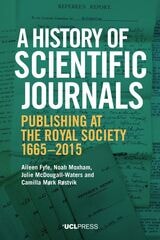
A History of Scientific Journals
Publishing at the Royal Society, 1665–2015Aileen Fyfe, Noah Moxham, Julie Mcdougall-Waters, and Camilla Mørk Røstvik
University College London, 2022
Modern scientific research has changed significantly since the days of Isaac Newton, with professionalized, collaborative, and international networks that engage a more diverse community of researchers. Yet, the long history of scientific publishing reveals a deep mutual relationship between how academic discourse develops and what (and how) research is published. With unique insights from the Royal Society of London’s comprehensive archives spanning 350 years of scientific journal publishing, A History of Scientific Journals illustrates the entangled histories of scientific publishing and professional discourses. This volume provides insights into the editorial management, business practices, and financial difficulties of journals such as Philosophical Transactions, which was first published in 1665 and has published papers by Newton, Darwin, Dorothy Hodgkin, and Stephen Hawking. Highly illustrated with photographs of historic archived documents, including early publications and editorial annotations, this history extends to the present day and includes a look at digital journal publication and the open-access movement, making the book's publication through UCL Press both appropriate and symbiotic.
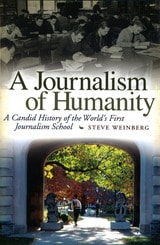
A Journalism of Humanity
A Candid History of the World's First Journalism SchoolSteve Weinberg
University of Missouri Press, 2008
It might seem unlikely that a midwestern university located far from national media centers would be home to the world’s first journalism school, but the University of Missouri holds that distinction. Now celebrating its centennial, the School of Journalism, founded by a newsman who lacked a college education, is regarded as one of the highest-rated in the world.
Steve Weinberg, an alumnus and investigative reporter who returned to teach at Missouri, now covers—and uncovers—the many-faceted history of its School of Journalism, from the days of Walter Williams through the Dean Mills era. A Journalism of Humanity balances the dynamics of the university that set the school’s course with the external forces that shaped journalism and society. True to journalism, it reveals the school’s flaws as well as its virtues.
Bringing his investigative expertise to bear, Weinberg tells the school’s complex story through thematic chapters. He draws on internal documents and correspondence to uncover the politics of the school from its founding to the present—the struggles over resources as well as the constant battle to balance scholarly ambitions with professional mission. In the course of his chronicle, he depicts an institution ahead of its time in professional education but often lagging in dealing with social issues such as race and gender.
Weinberg’s account embraces faculty and staff members, students and alumni, supporters and detractors, as it covers all professional sequences taught at the school. It captures the freewheeling debate that has been a hallmark of the school and includes the perspectives of women, blacks, and gays, who all too often were marginalized. It also incorporates a wealth of insider detail, from a typical day at the school during the Williams era to tales of the “Missouri Mafia.”
Key players, significant programs, legal and ethical battles—all are covered in a candid history that makes captivating reading for those associated with the school or for anyone interested in the development of journalism education. A Journalism of Humanity is a story as big as its subject that looks back on a trailblazing century and forward toward a continuing dedication to journalistic excellence.
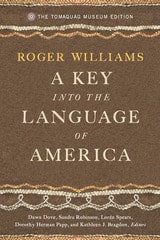
A Key into the Language of America
The Tomaquag Museum EditionRoger Williams
Westholme Publishing, 2019
Roger Williams’s Key into the Language of America, first published in 1643, is one of the most important artifacts of early Indigenous American culture. In it, Williams recorded the day-to-day experience of the Narragansett people of Rhode Island in their own words, the first documentation of an American Indian language in English. Williams’s Key can be read at many levels because of its historical, literary, political, and religious significance. Its greatest value, though, is its intimate portrait of the Narragansett and their linguistic neighbors in the early years of European colonial settlement, before disease, dislocation, warfare—in particular, King Philip’s War—and colonial interference had diminished their population and power in the region. An extraordinary achievement, Williams’s Key gives us a contemporary account of Narragansett family life, of their sociability and skill in business, their dress, foodways, and the farming, fishing, and hunting that formed the basis of their sustenance practices.
This new Tomaquag Museum edition includes for the first time cultural commentary provided by the Narragansett Tribe as well as modern linguistic information provided by a leading authority in the study of American Indian languages.
The Tomaquag Museum, located in Exeter, Rhode Island, is an Indigenous nonprofit organization dedicated to sharing the culture, arts, and history of the Narragansett and other tribal communities of southern New England.
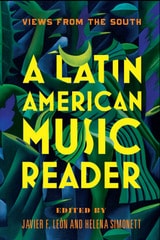
A Latin American Music Reader
Views from the SouthJavier F Leon
University of Illinois Press, 2016
Contributors include Marina Alonso Bolaños, Gonzalo Camacho Díaz, José Jorge de Carvalho, Claudio F. Díaz, Rodrigo Cantos Savelli Gomes, Juan Pablo González, Rubén López-Cano, Angela Lühning, Jorge Martínez Ulloa, Maria Ignêz Cruz Mello, Julio Mendívil, Carlos Miñana Blasco, Raúl R. Romero, Iñigo Sánchez Fuarros, Carlos Sandroni, Carolina Santamaría-Delgado, Rodrigo Torres Alvarado, and Alejandro Vera.
A Leonard Bloomfield Anthology
Leonard Bloomfield
University of Chicago Press, 1987
"Hockett has achieved his purpose—to reveal Bloomfield's way of working, the general principles that guided his work, and last, but by no means least, to indicate how Bloomfield's interests and attitudes changed with the passing years."—Harry Hoijer, Language
A Lexical Approach to Italian Cliticization
Paola Monachesi
CSLI, 1999
A Librarian's Guide to an Uncertain Job Market
Jeannette American Library Association
American Library Association, 2011