Results by title
2 books match the query 'Language Literature'

Franz Kafka and His Prague Contexts
Studies on Language and LiteratureMarek Nekula
Karolinum Press, 2015
Franz Kafka is by far the Prague author most widely read and admired internationally. However, his reception in Czechoslovakia, launched by the Liblice conference in 1963, has been conflicted. While rescuing Kafka from years of censorship and neglect, Czech critics of the 1960s “overwrote” his German and Jewish literary and cultural contexts in order to focus on his Czech cultural connections. Seeking to rediscover Kafka’s multiple backgrounds, in Franz Kafka and His Prague Contexts Marek Nekula focuses on Kafka’s Jewish social and literary networks in Prague, his German and Czech bilingualism, and his knowledge of Yiddish and Hebrew. Kafka’s bilingualism is discussed in the context of contemporary essentialist views of a writer’s “organic” language and identity. Nekula also pays particular attention to Kafka’s education, examining his studies of Czech language and literature as well as its role in his intellectual life. The book concludes by asking how Kafka “read” his urban environment, looking at the readings of Prague encoded in his fictional and non-fictional texts.
[more]
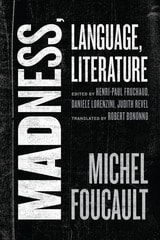
Madness, Language, Literature
Michel Foucault
University of Chicago Press, 2023
Newly published lectures by Foucault on madness, literature, and structuralism.
Perceiving an enigmatic relationship between madness, language, and literature, French philosopher Michel Foucault developed ideas during the 1960s that are less explicit in his later, more well-known writings. Collected here, these previously unpublished texts reveal a Foucault who undertakes an analysis of language and experience detached from their historical constraints. Three issues predominate: the experience of madness across societies; madness and language in Artaud, Roussel, and Baroque theater; and structuralist literary criticism. Not only do these texts pursue concepts unique to this period such as the “extra-linguistic,” but they also reveal a far more complex relationship between structuralism and Foucault than has typically been acknowledged.
Perceiving an enigmatic relationship between madness, language, and literature, French philosopher Michel Foucault developed ideas during the 1960s that are less explicit in his later, more well-known writings. Collected here, these previously unpublished texts reveal a Foucault who undertakes an analysis of language and experience detached from their historical constraints. Three issues predominate: the experience of madness across societies; madness and language in Artaud, Roussel, and Baroque theater; and structuralist literary criticism. Not only do these texts pursue concepts unique to this period such as the “extra-linguistic,” but they also reveal a far more complex relationship between structuralism and Foucault than has typically been acknowledged.
[more]