Results by title
14 books match the query 'Laos'
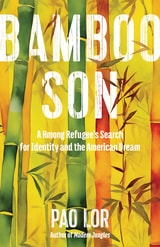
Bamboo Son
A Hmong Refugee’s Search for Identity and the American DreamPao Lor
Wisconsin Historical Society Press, 2026
“In Hmong, the word bamboo or ntsuag has two meanings. It refers to the bamboo plant, which has many significant cultural and practical uses in Hmong life. The word also means orphan. Therefore, bamboo son, in Hmong, means tub ntsuag or orphan son. To survive and succeed as a Hmong orphan, like bamboo, one must be resilient and adaptable, bend without breaking, and stand tall against enormous odds.”
In this follow-up to his acclaimed memoir, Modern Jungles, Pao Lor picks up his story as a young Hmong immigrant building a new life in a new home and shares the narrative of his ensuing journey into adulthood. Lor emerged from war and tragedies in the jungles of Laos and refugee camps of Thailand in the 1970s to pursue a vision of the American dream in Green Bay, Wisconsin, in the 1980s. The distance between his humble beginnings and that dream life was littered with challenges as well as possibilities.
Lor’s transformation from an insecure but determined high school student to a husband, father, teacher, administrator, and author is marked by triumph and defeat, trauma and joy, and always hope and optimism. As he navigates school, first loves, family relationships, and a career, Lor must contend with language barriers, discrimination, and his own inner demons stemming from feelings of inferiority. Threads of his identity—Hmong, American, and Wisconsinite—intersect and occasionally come into conflict.
Lor’s search for belonging comes full circle when he travels to Laos and Thailand with his wife, Maya, in 2022. Seeing his birthplace for the first time in forty-five years, he revisits the isolated mountain villages where he spent his early childhood; the places where his parents and sister died as the family fled the region in the violent aftermath of the Vietnam War; and the two refugee camps where Pao and his siblings lived before being relocated to the United States when he was seven. As he reexamines these memories and reconciles his past, Lor finds peace and the freedom to move forward with his soul renewed.
Lor’s story is an uplifting journey of resilience, adaptation, love, and forgiveness, inspiring readers to reflect on the meaning and accessibility of the American dream.
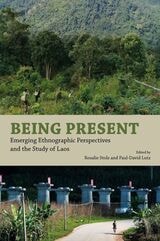
Being Present
Emerging Ethnographic Perspectives and the Study of LaosEdited by Rosalie Stolz and Paul-David Lutz
National University of Singapore Press, 2026
Ethnography has long called on researchers to immerse themselves in the worlds they study—but what does it mean to “be present” in the field today? Being Present investigates this question through innovative research on Laos, a country rapidly changing at the crossroads of Southeast Asia and China. This volume brings together a new generation of scholars to explore Chinese-built railways, shifting farmlands, urban mourning rituals, and changing aspirations in Laos.
Covering infrastructure, health, trade, and spirituality, these studies challenge assumptions about ethnography. They show how immersion and reflexivity remain essential in a connected world. Being Present offers a fresh look at contemporary Laos and a timely reflection on ethnographic practice.
Bomb Children
Life in the Former Battlefields of LaosLeah Zani
Duke University Press, 2019
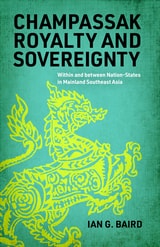
Champassak Royalty and Sovereignty
Within and between Nation-States in Mainland Southeast AsiaIan G. Baird
University of Wisconsin Press, 2024
In re-creating this story, Baird draws not only on a dazzling variety of primary sources in English, French, Lao, and Thai but also on many years spent in conversation with members of the Na Champassak family, who are now spread across a wide geographical area, from Laos and Thailand to France and the United States. Each chapter treats one historical period, identifying the Champassak approach to sovereignty during that time. Through this deep history, Baird shows how sovereign power, even within one case, takes a wide range of forms, always contingent, contested, and uneven across space and time.
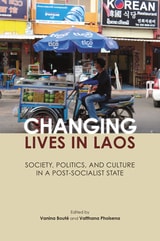
Changing Lives in Laos
Society, Politics, and Culture in a Post-Socialist StateEdited by Vanina Bouté and Vatthana Pholsena
National University of Singapore Press, 2017
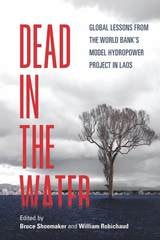
Dead in the Water
Global Lessons from the World Bank's Model Hydropower Project in LaosEdited by Bruce Shoemaker and William Robichaud; foreword by Yos Santasombat; afterword by Philip Hirsch
University of Wisconsin Press, 2019
In the 2000s, as the World Bank was reeling from revelations of past hydropower failures, it nonetheless promoted the enormous Nam Theun 2 project. NT2, the Bank believed, offered a new, wiser model of dam development that would alleviate poverty, protect the environment, engage locally affected people in a transparent fashion, and stimulate political transformation. This was a tall order. For the first time, this book shows in detail why, despite assertions of success from the World Bank and other agencies involved in the project, the dam's true story has been one of substantial loss for affected villagers and the regional environment. Nam Theun 2 is an important case study that illustrates much broader problems of global development policy.
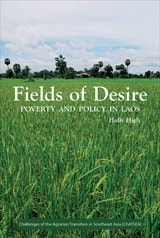
Fields of Desire
Poverty and Policy in LaosHolly High
National University of Singapore Press, 2014
Based on long-term fieldwork in a Lao village that has been the subject of multiple poverty reduction and development programs, High’s account looks at implementation on the ground. While these efforts were laudable in their aims of reducing poverty, they often failed to achieve their objectives. Local people received them with suspicion and disillusionment. Nevertheless, poverty reduction policies continued to be renewed by planners and even desired locally. High relates this to the force of aspirations among rural Lao, ambivalent understandings of power and the “post-rebellious” moment in contemporary Laos.
Forsaken Causes
Liberal Democracy and Anticommunism in Cold War LaosRyan Wolfson-Ford
University of Wisconsin Press, 2024
Forsaken Causes offers a groundbreaking intellectual history of the Royal Lao Government (RLG) from 1945 to 1975. In Ryan Wolfson-Ford’s account, the Lao people emerge as not merely pawns of the superpowers but agents in their own right, with the Lao elite wielding particular influence over the nation’s trajectory. Their prevailing ideologies—liberal democracy and anticommunism—were not imposed from outside, but rather established by Lao themselves in the fight against French colonialism. These ideologies were rooted in Lao culture, which prized its traditional monarchy, Buddhist faith, French learning, and nationalist conception of a Lao race. Against histories that have dismissed Lao elites as instruments of foreign powers, Wolfson-Ford shows that the RLG charted its own course, guided by complex motivations, rationales, and beliefs. During this time Lao enjoyed unprecedented democratic freedoms, many of which have not been seen since the government fell to communist takeover in 1975.
By recentering the Lao in their own history, Wolfson-Ford restores our understanding of this robust but often forgotten liberal democracy, recovers lost voices, and broadens our understanding of postcolonial and Cold War Southeast Asia as a whole.
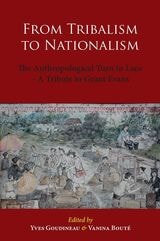
From Tribalism to Nationalism
The Anthropological Turn in Laos – A Tribute to Grant EvansEdited by Yves Goudineau and Vanina Bouté
National University of Singapore Press, 2022
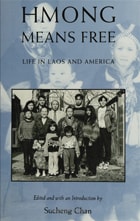
Hmong Means Free
Life in Laos and AmericaSucheng Chan
Temple University Press, 1994
This collection of evocative personal testimonies by three generations of Hmong refugees is the first to describe their lives in Laos as slash-and-burn farmers, as refugees after a Communist government came to power in 1975, and as immigrants in the United States. Reflecting on the homes left behind, their narratives chronicle the difficulties of forging a new identity.
From Jou Yee Xiong's Life Story:
"I stopped teaching my sons many of the Hmong ways because I felt my ancestors and I had suffered enough already. I thought that teaching my children the old ways would only place a burden on them."
From Ka Pao Xiong's (Jou Yee Xiong's son) Life Story:
"It has been very difficult for us to adapt because we had no professions or trades and we suffered from culture shock. Here in America, both the husband and wife must work simultaneously to earn enough money to live on. Many of our children are ignorant of the Hmong way of life…. Even the old people are forgetting about their life in Laos, as they enjoy the prosperity and good life in America."
From Xang Mao Xiong's Life Story:
"When the Communists took over Laos and General Vang Pao fled with his family, we, too, decided to leave. Not only my family, but thousands of Hmong tried to flee. I rented a car for thirty thousand Laotian dollars, and it took us to Nasu…. We felt compelled to leave because many of us had been connected to the CIA…. Thousands of Hmong were traveling on foot. Along the way, many of them were shot and killed by Communist soldiers. We witnessed a bloody massacre of civilians."
From Vue Vang's Life Story:
"Life was so hard in the [Thai refugee] camp that when we found out we could go to the United States, we did not hesitate to grasp the chance. We knew that were we to remain in the camp, there would be no hope for a better future. We would not be able to offer our children anything better than a life of perpetual poverty and anguish."
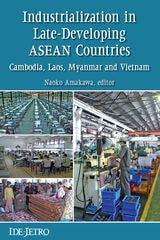
Industrialization in Late-Developing ASEAN Countries
Cambodia, Laos, Myanmar and VietnamNaoko Amakawa
National University of Singapore Press, 2010
The outcomes differed significantly owing to geographical location, government policies, and internal economic conditions. Industrialization in Late-Developing ASEAN Countries explores these differences through case studies based on an extended research program conducted by the Institute of Developing Economies in Tokyo, which offered insights into models of economic growth, and into the trajectories followed by the four countries examined.
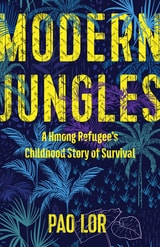
Modern Jungles
A Hmong Refugee’s Childhood Story of SurvivalPao Lor
Wisconsin Historical Society Press, 2021
Born in a small farming village, Pao was destined to be a Hmong clan leader, wedding negotiator, or shaman. But the course of his life changed dramatically in the 1970s, when the Hmong faced persecution for their role in helping US forces fighting communism in the region. After more than two years in Thai refugee camps, Pao and his surviving family members boarded the belly of an “iron eagle” bound for the United States, where he pictured a new life of comfort and happiness. Instead, Pao found himself navigating a frightening and unfamiliar world, adjusting to a string of new schools and living situations while struggling to fulfill the hopes his parents had once held for his future. Now in Modern Jungles, Pao Lor shares his inspiring coming-of-age tale about perseverance, grit, and hope.
Included are discussion questions for use by book clubs, in classrooms, or around the dinner table.
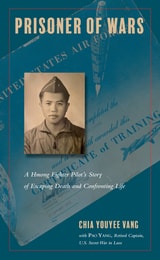
Prisoner of Wars
A Hmong Fighter Pilot's Story of Escaping Death and Confronting LifeChia Youyee Vang
Temple University Press, 2021
Retired Captain Pao Yang was a Hmong airman trained by the U.S. Air Force and CIA to fly T-28D aircraft for the U.S. Secret War in Laos. However, his plane was shot down during a mission in June 1972. Yang survived, but enemy forces captured him and sent him to a POW camp in northeastern Laos. He remained imprisoned for four years after the United States withdrew from Vietnam because he fought on the American side of the war.
Prisoner of Wars shows the impact the U.S Secret War in Laos had on Hmong combatants and their families. Chia Vang uses oral histories thatpoignantly recount Yang’s story and the deeply personal struggles his loved ones—who feared he had died—experienced in both Southeast Asia and the United States. As Yang eventually rebuilt his life in America, he grappled with issues of freedom and trauma.
Yang’s life provides a unique lens through which to better understand the lasting impact of the wars in Southeast Asia and the diverse journeys that migrants from Asia made over the last two centuries. Prisoner of Wars makes visible an aspect of the collateral damage that has been left out of dominant Vietnam War narratives.
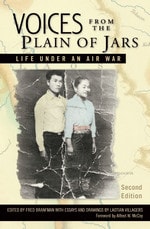
Voices from the Plain of Jars
Life under an Air WarEdited by Fred Branfman with essays and drawings by Laotian villagers; Foreword by Alfred W. McCoy
University of Wisconsin Press, 2013
When first published in 1972, this book was instrumental in exposing the bombing. In this expanded edition, Branfman follows the story forward in time, describing the hardships that Laotians faced after the war when they returned to find their farm fields littered with cluster munitions—explosives that continue to maim and kill today.