Results by title
4 books match the query 'Laqueur, Walter'
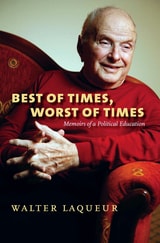
Best of Times, Worst of Times
Memoirs of a Political EducationWalter Laqueur
Brandeis University Press, 2009
Walter Laqueur has been writing and teaching for over six decades, primarily in the fields of twentieth century history and politics, always as a shrewd and thoughtful generalist in an age of specialization. In this engaging memoir, Laqueur focuses on the political and historical events that shaped his thinking and that have inspired his intellectual work throughout his life. He discusses living and attending school under Nazism; Marxism, the Soviet Union, and the part he played in Cold War politics; and the image his generation had of Zionism, Israel, and the Middle East. Laqueur shares his views on beltway politics and think tanks, and concludes with a look at guerrilla warfare and terrorism, and the future of Europe.
[more]
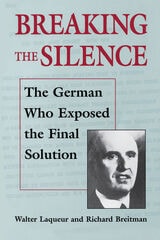
Breaking the Silence
The German Who Exposed the Final Solution.Walter Laqueur and Richard Breitman
Brandeis University Press, 1994
Through unparalleled historical detective work, noted scholars Walter Laqueur and Richard Breitman reveal the inspiring tale of Eduard Schulte, the Breslau business leader who risked his life to gather information about such Nazi activities as the revised date of the German attack on Poland and the Nazi plan for mass extermination of European Jews. First published in 1986, Breaking the Silence is reissued with both a new foreword and afterword by the authors.
[more]
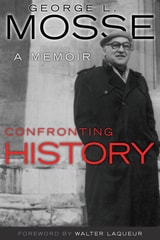
Confronting History
A MemoirGeorge L. Mosse; Foreword by Walter Laqueur
University of Wisconsin Press, 2000
Just two weeks before his death in January 1999, George L. Mosse, one of the great American historians, finished writing his memoir, a fascinating and fluent account of a remarkable life that spanned three continents and many of the major events of the twentieth century.
Confronting History describes Mosse's opulent childhood in Weimar Berlin; his exile in Paris and England, including boarding school and study at Cambridge University; his second exile in the U.S. at Haverford, Harvard, Iowa, and Wisconsin; and his extended stays in London and Jerusalem. Mosse discusses being a Jew and his attachment to Israel and Zionism, and he addresses his gayness, his coming out, and his growing scholarly interest in issues of sexuality. This touching memoir—told with the clarity, passion, and verve that entranced thousands of Mosse's students—is guided in part by his belief that "what man is, only history tells" and, most of all, by the importance of finding one's self through the pursuit of truth and through an honest and unflinching analysis of one's place in the context of the times.
Confronting History describes Mosse's opulent childhood in Weimar Berlin; his exile in Paris and England, including boarding school and study at Cambridge University; his second exile in the U.S. at Haverford, Harvard, Iowa, and Wisconsin; and his extended stays in London and Jerusalem. Mosse discusses being a Jew and his attachment to Israel and Zionism, and he addresses his gayness, his coming out, and his growing scholarly interest in issues of sexuality. This touching memoir—told with the clarity, passion, and verve that entranced thousands of Mosse's students—is guided in part by his belief that "what man is, only history tells" and, most of all, by the importance of finding one's self through the pursuit of truth and through an honest and unflinching analysis of one's place in the context of the times.
[more]
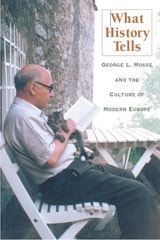
What History Tells
George L. Mosse and the Culture of Modern EuropeEdited by Stanley G. Payne, David J. Sorkin, and John S. Tortorice
University of Wisconsin Press, 2004
What History Tells presents an impressive collection of critical papers from the September 2001 conference "An Historian’s Legacy: George L. Mosse and Recent Research on Fascism, Society, and Culture." This book examines his historiographical legacy first within the context of his own life and the internal development of his work, and secondly by tracing the many ways in which Mosse influenced the subsequent study of contemporary history, European cultural history and modern Jewish history.
The contributors include Walter Laqueur, David Sabean, Johann Sommerville, Emilio Gentile, Roger Griffin, Saul Friedländer, Jay Winter, Rudy Koshar, Robert Nye, Janna Bourke, Shulamit Volkov, and Steven E. Aschheim.
The contributors include Walter Laqueur, David Sabean, Johann Sommerville, Emilio Gentile, Roger Griffin, Saul Friedländer, Jay Winter, Rudy Koshar, Robert Nye, Janna Bourke, Shulamit Volkov, and Steven E. Aschheim.
[more]