Results by title
6 books match the query 'Laredo'
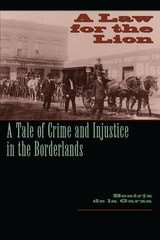
A Law for the Lion
A Tale of Crime and Injustice in the BorderlandsBy Beatriz de la Garza
University of Texas Press, 2003
"Esto no es cosa de armas" (this is not a matter for weapons). These were the last words of Don Francisco Gutiérrez before Alonzo W. Allee shot and killed him and his son, Manuel Gutiérrez. What began as a simple dispute over Allee's unauthorized tenancy on a Gutiérrez family ranch near Laredo, Texas, led not only to the slaying of these two prominent Mexican landowners but also to a blatant miscarriage of justice.
In this engrossing account of the 1912 crime and the subsequent trial of Allee, Beatriz de la Garza delves into the political, ethnic, and cultural worlds of the Texas-Mexico border to expose the tensions between the Anglo minority and the Mexican majority that propelled the killings and their aftermath. Drawing on original sources, she uncovers how influential Anglos financed a first-class legal team for Allee's defense and also discusses how Anglo-owned newspapers helped shape public opinion in Allee's favor. In telling the story of this long-ago crime and its tragic results, de la Garza sheds new light on the interethnic struggles that defined life on the border a century ago, on the mystique of the Texas Rangers (Allee was said to be a Ranger), and on the legal framework that once institutionalized violence and lawlessness in Texas.

Fiestas in Laredo
Matachines, Quinceañeras, and George Washington’s BirthdayNorma E. Cantú
University of North Texas Press, 2024
Life in Laredo
A Documentary History from the Laredo ArchivesRobert D. Wood
University of North Texas Press, 2004
Listening to Laredo
A Border City in a Globalized AgeMehnaaz Momen
University of Arizona Press, 2023
Bringing together issues of growth, globalization, and identity, Mehnaaz Momen traces Laredo’s trajectory through the voices of its people. In contrast to the many studies of border cities defined by the outside—and seldom by the people who live at the border—this volume collects oral histories from seventy-five in-depth interviews that collectively illuminate the evolution of the city’s cultural and economic infrastructure, its interdependence with its sister city across the national boundary, and, above all, the strength of its community as it adapts to and even challenges the national narrative regarding the border. The resonant and lively voices of Laredo’s people convey proud ownership of an archetypal border city that has time and again resurrected itself.
Technology and Place
Sustainable Architecture and the Blueprint FarmBy Steven A. Moore
University of Texas Press, 2001
Developing "sustainable" architectural and agricultural technologies was the intent behind Blueprint Farm, an experimental agricultural project designed to benefit farm workers displaced by the industrialization of agriculture in the Rio Grande Valley of Texas. Yet, despite its promise, the very institutions that created Blueprint Farm terminated the project after just four years (1987-1991).
In this book, Steven Moore demonstrates how the various stakeholders' competing definitions of "sustainability," "technology," and "place" ultimately doomed Blueprint Farm. He reconstructs the conflicting interests and goals of the founders, including Jim Hightower and the Texas Department of Agriculture, Laredo Junior College, and the Center for Maximum Potential Building Systems, and shows how, ironically, they unwittingly suppressed the self-determination of the very farm workers the project sought to benefit. From the instructive failure of Blueprint Farm, Moore extracts eight principles for a regenerative architecture, which he calls his "nonmodern manifesto."
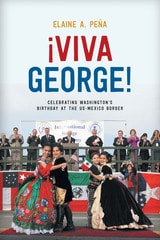
Viva George!
Celebrating Washington's Birthday at the US-Mexico BorderBy Elaine A. Peña
University of Texas Press, 2020
For 120 years, residents of the cross-border community of Laredo/Nuevo Laredo have celebrated George Washington's birthday together, and this account reveals the essential political work of a time-honored civic tradition.
Since 1898, residents of Laredo, Texas, and Nuevo Laredo, Tamaulipas, have reached across the US-Mexico border to celebrate George Washington's birthday. The celebration can last a whole month, with parade goers reveling in American and Mexican symbols; George Washington saluting; and “Pocahontas” riding on horseback. An international bridge ceremony, the heart and soul of the festivities, features children from both sides of the border marching toward each other to link the cities with an embrace. ¡Viva George! offers an ethnography and a history of this celebration, which emerges as both symbol and substance of cross-border community life. Anthropologist and Laredo native Elaine A. Peña shows how generations of border officials, civil society organizers, and everyday people have used the bridge ritual to protect shared economic and security interests as well as negotiate tensions amid natural disasters, drug-war violence, and immigration debates. Drawing on previously unknown sources and extensive fieldwork, Peña finds that border enactments like Washington's birthday are more than goodwill gestures. From the Rio Grande to the 38th Parallel, they do the meaningful political work that partisan polemics cannot.