Results by title
3 books match the query 'Last Tsar'
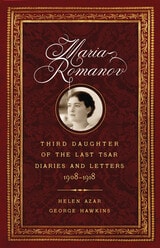
Maria Romanov
Third Daughter of the Last Tsar, Diaries and Letters, 1908–1918Helen Azar
Westholme Publishing, 2019
In the twilight of the nineteenth century, a third daughter was born to Tsar Nicholas II and his wife Alexandra. Grand Duchess Maria Nikolaevna—known to her family and friends simply as “Mashka”—grew into an empathetic, down-to-earth girl, unaffected by her imperial status. Often overshadowed by her two older sisters, Olga and Tatiana, and later, her brother Alexei and younger sister Anastasia, Maria ultimately proved to have a uniquely strong and solid personality.
In Maria Romanov: Third Daughter of the Last Tsar, Diaries and Letters, 1908–1918, by translator and researcher Helen Azar with George Hawkins, Mashka’s voice is heard again through her intimate writings, presented for the first time in English. The Grand Duchess was much more than a pretty princess wearing white dresses in hundreds of faded sepia photographs; Maria’s surviving diaries and letters offer a fascinating insight into the private life of a loving family—from festivals and faith, to Rasputin and the coming Revolution; it is clear why this middle child ultimately became a pillar of strength and hope for them all. Maria’s gentle character belied her incredible courage, which emerged in the darkest hours of her brief life. “The incarnation of modesty elevated by suffering,” as Maria was described during the last weeks of her life, she was able to maintain her kindness and optimism, even in the midst of violence and degradation.
On a stuffy summer night in 1918, only a few weeks after her nineteenth birthday, Maria was murdered along with the rest of her family in a cellar of a house chosen for this “special purpose.” Two sets of charred remains, confirmed to be Maria’s and her brother Alexei’s, were not discovered until almost ninety years later, separately from those of the other victims of the massacre. As the authors relate, it is still unknown if these remains will ever be allowed to be laid to rest.

Russia Under the Last Tsar
Theofanis George Stavrou, Editor
University of Minnesota Press, 1969
Russia Under the Last Tsar was first published in 1969. Minnesota Archive Editions uses digital technology to make long-unavailable books once again accessible, and are published unaltered from the original University of Minnesota Press editions.
The reign of Russia's last tsar, Nicholas II, from 1894 to 1917, constitutes a period of continuing controversy among historians. Interesting in its own right, it is also a time of great importance to an understanding of the cataclysmic events which followed in Russian history.
In this volume eight scholars contribute interpretive essays on some of the most significant forces and issues in Imperial Russia during the two decades before the revolutions. Professor Stavrou writes an introductory essay. The other essays and authors are: "on Interpreting the Fate of Imperial Russia" by Arthur Mendel, University of Michigan; "Russian Conservative Thought before the Revolution" by Robert F. Brynes, Indiana University; "Russian Radical Thought, 1894–1917" by Donald W. Treadgold, University of Washington; "Russian Constitutional Developments" by Thomas Riha, University of Colorado; "Problems of Industrialization in Russia" by Theodore Von Laue, Washington University; "Politics, Universities, and Science" by Alexander Vucinich, University of Illinois; "The Cultural Renaissance" by Gleb Struve, formerly of the University of California, Berkeley; and "Some Imperatives of Russian Foreign Policy" by Roderick E. McGrew, Temple University. The book is illustrated with photographs of some of the principal figures in the history of the period, and there are a bibliography and index.
As Professor Stavrou points out in his preface, the contributors did not consult with one another before preparing their respective essays, and the various approaches are refreshingly different in their assessments of the period. The book as a whole provides a panoramic view of the fascinating Russia of Nicholas and Alexandra. It will be interesting to general readers and especially useful as a textbook for courses in Russian or modern European history.
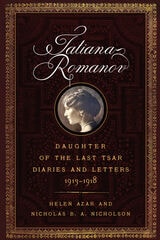
Tatiana Romanov, Daughter of the Last Tsar
Diaries and Letters, 1913–1918Helen Azar
Westholme Publishing, 2016
Grand Duchess Tatiana Nikolaevna of Russia was the second of the four daughters of Tsar Nicholas II and his wife, the Empress Alexandra Feodorovna. Long recognized by historians as the undisputed “beauty” of the family, Tatiana was acknowledged for her poise, her elegance, and her innate dignity within her own family. Helen Azar, translator of the diaries of Olga Romanov, and Nicholas B. A. Nicholson, Russian Imperial historian, have joined together to present a truly comprehensive picture of this extraordinarily gifted, complex, and intelligent woman in her own words. Tatiana Romanov, Daughter of the Last Tsar: Diaries and Letters, 1913–1918, presents translations of material never before published in Russian or in English, as well as materials never published in their entirety in the West.
The brisk, modern prose of Tatiana’s diary entries reveals the character of a young woman who was far more than the sheltered imperial beauty as she previously has been portrayed. While many historians and writers describe her as a cold, haughty, and distant aristocrat, this book shows instead a remarkably down-to-earth and humorous young woman, full of life and compassion. A detail-oriented and observant participant in some of the most important historical events of the early twentieth century, she left firsthand descriptions of the tercentenary celebrations of the House of Romanov, the early years of Russia’s involvement in World War I, and the road to her family’s final days in Siberian exile. Her writings reveal extraordinary details previously unknown or unacknowledged. Lavishly annotated for the benefit of the nonspecialist reader, this book is not only a reevaluation of Tatiana’s role as more than just one of four sisters, but also a valuable reference on Russia, the First World War, the Russian Revolution, and the people closest to the Grand Duchess and her family.