Results by title
4 books match the query 'Last Words'
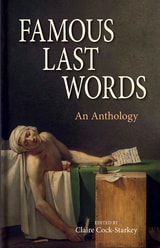
Famous Last Words
An AnthologyEdited by Claire Cock-Starkey
Bodleian Library Publishing, 2016
Over the years, family and loved ones have recorded an extraordinary number of famous last words, from kings and queens to politicians, philosophers, scientists, writers, and actors. These exit lines can impart keen insights from an extraordinary life, reveal a sense of humor indomitable in even the darkest hours, or tell us something about a celebrated person’s last moments of life. Perhaps unavoidably given their provenance, many last words have proven irresistible to embellishment or remain in question. King Charles II, for example, was said to have instructed his brothers to “let not Poor Nelly starve,” asking that his favorite mistress be provided a pension of 1,500 pounds a year. Although she did indeed receive said pension, some contend that Charles’s actual last words, following a long period of illness, were, “You must pardon me, gentlemen, for being a most unconscionable time a-dying.”
For Famous Last Words, Claire Cock-Starkey has collected the most interesting, insightful, and controversial last words, from deathbed desperation to the fondest of farewells.
Last Words of the Executed
Robert K. Elder
University of Chicago Press, 2010
Some beg for forgiveness. Others claim innocence. At least three cheer for their favorite football teams.
Death waits for us all, but only those sentenced to death know the day and the hour—and only they can be sure that their last words will be recorded for posterity. Last Words of the Executed presents an oral history of American capital punishment, as heard from the gallows, the chair, and the gurney.
The product of seven years of extensive research by journalist Robert K. Elder, the book explores the cultural value of these final statements and asks what we can learn from them. We hear from both the famous—such as Nathan Hale, Joe Hill, Ted Bundy, and John Brown—and the forgotten, and their words give us unprecedented glimpses into their lives, their crimes, and the world they inhabited. Organized by era and method of execution, these final statements range from heartfelt to horrific. Some are calls for peace or cries against injustice; others are accepting, confessional, or consoling; still others are venomous, rage-fueled diatribes. Even the chills evoked by some of these last words are brought on in part by the shared humanity we can’t ignore, their reminder that we all come to the same end, regardless of how we arrive there.
Last Words of the Executed is not a political book. Rather, Elder simply asks readers to listen closely to these voices that echo history. The result is a riveting, moving testament from the darkest corners of society.
Last Words of the Holy Ghost
Matt Cashion
University of North Texas Press, 2015
Last Words
Large Language Models and the AI ApocalypsePaul Kockelman
Prickly Paradigm Press, 2024
What kind of meaning can machines make—and why does it matter that it’s not the same as ours?
Anthropologist Paul Kockelman's Last Words offers a rigorous but accessible account of how large language models actually work—and why the meaning they produce is fundamentally different from human meaning-making. Drawing on the semiotics of C.S. Peirce, Kockelman’s witty and insightful pamphlet shows how LLMs are trained to predict word-word relations, not word-world relations, which explains both their uncanny fluency and their systematic blind spots. The result is a compact, essential guide to cutting through the hype: not a dismissal of AI, but a precise account of what it can and cannot do—and who profits from the confusion.