Results by title
7 books match the query 'Last years'
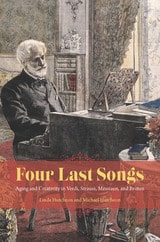
Four Last Songs
Aging and Creativity in Verdi, Strauss, Messiaen, and BrittenLinda Hutcheon and Michael Hutcheon
University of Chicago Press, 2015
Giuseppe Verdi (1813–1901), Richard Strauss (1864–1949), Olivier Messiaen (1908–92), and Benjamin Britten (1913–76) all wrote operas late in life, pieces that reveal unique responses to the challenges of growing older. Verdi’s Falstaff, his only comedic success, combated Richard Wagner’s influence by introducing young Italian composers to a new model of national music. Strauss, on the other hand, struggling with personal and political problems in Nazi Germany, composed the self-reflexive Capriccio, a “life review” of opera and his own legacy. Though it exhausted him physically and emotionally, Messiaen at the age of seventy-five finished his only opera, Saint François d’Assise, which marked the pinnacle of his career. Britten, meanwhile, suffering from heart problems, refused surgery until he had completed his masterpiece, Death in Venice. For all four composers, age, far from sapping their creative power, provided impetus for some of their best accomplishments.
With its deft treatment of these composers’ final years and works, Four Last Songs provides a valuable look at the challenges—and opportunities—that present themselves as artists grow older.
Full Moon at Noontide
A Daughter's Last GoodbyeAnn Putnam
University of Iowa Press, 2015

Preston Sturges
The Last Years of Hollywood's First Writer-DirectorNick Smedley and Tom Sturges
Intellect Books, 2019
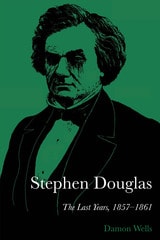
Stephen Douglas
The Last Years, 1857–1861By Damon Wells
University of Texas Press, 1971
Stephen Douglas and the old Union lived out their last years together. It was the most critical time in the life of both the Illinois senator and his country. During most of the period 1857–1861 the American nation could still choose between adjustment of its sectional differences and civil war, and the man they called the Little Giant seemed the one statesman most likely to lead the country onto a course of compromise and reconciliation.
But Douglas’ intense involvement with the American political scene—his great accomplishments in enacting the Compromises of 1850 and 1854, and his victory in the senatorial campaign of 1858—tended at times to disguise a growing alienation from the mainstream of American political life. By 1857 that alienation had reached acute proportions. In part, Douglas fell victim to his own virtues. He sought to be a nationalist in an age of sectionalism; he preached the value of compromise when most Americans questioned its worth.
In other respects, Douglas’ political failures are less excusable. His attempt to convert an apparently amoral attitude toward slavery into a principle—popular sovereignty—found him dismissed by antislavery citizens as immoral and by proslavery citizens as unreliable. For too long, Douglas, professing to “care not” about the future of slavery, overlooked how much Americans could care once their consciences had been aroused or their way of life supposedly threatened.
Douglas failed to win the presidential campaign of 1860 largely because he could satisfy neither the proponents nor the enemies of slavery. Yet if the last years of Douglas’ life were marred by failure, he was not ultimately the tragic figure some historians have suggested. During the campaign of 1860 a profound change began to take place in Stephen Douglas. The outmoded nationalism he had preached for so long began to give way to Unionism. In his eventual support of Lincoln and his defense of the Union, Douglas at last found a policy worthy of his great talents.
Damon Wells first became interested in Stephen Douglas in 1959 after seeing a Broadway dramatization of the Lincoln-Douglas Debates. Later, his studies convinced him that playwright and historian alike were often unfair to Douglas. If Lincoln was to be a hero, then Douglas had to be cast as a villain.
This study fills the need for a fresh and dispassionate look at Douglas and provides a fairer assessment than can be reached by simply endorsing contradictory views of apologists and critics. It places particular emphasis on the Little Giant’s struggle with President James Buchanan, the debates with Lincoln, the presidential campaign of 1860, Douglas’ complex relationship with the South, and a careful analysis of the elusive and at times exasperating principle of popular sovereignty.
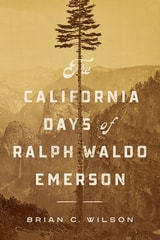
The California Days of Ralph Waldo Emerson
Brian C. Wilson
University of Massachusetts Press, 2022
In the spring of 1871, Ralph Waldo Emerson boarded a train in Concord, Massachusetts, bound for a month-and-a-half-long tour of California—an interlude that became one of the highlights of his life. On their journey across the American West, he and his companions would take in breathtaking vistas in the Rockies and along the Pacific Coast, speak with a young John Muir in the Yosemite Valley, stop off in Salt Lake City for a meeting with Brigham Young, and encounter a diversity of communities and cultures that would challenge their Yankee prejudices.
Based on original research employing newly discovered documents, The California Days of Ralph Waldo Emerson maps the public story of this group’s travels onto the private story of Emerson’s final years, as aphasia set in and increasingly robbed him of his words. Engaging and compelling, this travelogue makes it clear that Emerson was still capable of wonder, surprise, and friendship, debunking the presumed darkness of his last decade.
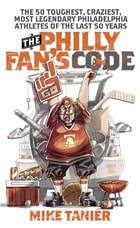
The Philly Fan's Code
The 50 Toughest, Craziest, Most Legendary Philadelphia Athletes of the Last 50 YearsMike Tanier
Temple University Press, 2011
Face it: Philadelphia athletes are often as tough as their fans are passionate. How else to explain the rabid appeal of the bone-crunching Broad Street Bullies? Chuck Bednarik was one of the looniest tunes in Philadelphia sports history, but fuggedabout him. In The Philly Fan's Code, New York Times sportswriter Mike Tanier provides fun and opinionated essays that evaluate the 50 greatest, toughest, and most eccentric legends of Philly sports since Concrete Charlie hung up his cleats.
Using his own "rubric" to calculate the impact of each athlete, Tanier ranks well-adjusted players like Mark Howe alongside both unpredictable athletes like Brad Lidge—who followed an almost perfect season with a 162-game catastrophe—and quirky ones, such as Wilt Chamberlain, who may be better known for bragging about his sexual conquests than for scoring 100 points in a game. And let's not forget our visitor from Planet Lovetron… Then there are the real wild cards-players like Terrell Owens, who does sit-ups in his driveway and whose impact—for better or worse— outlasted the few actual games he played for the Eagles. As for Tanier's choice for the No. 1 toughest, craziest, most legendary player, well, you'll have to read the book to see if you agree. Whether you do or don't, The Philly Fan's Code will provide hours of debates and memories of who our toughest sports heroes were—or weren't.

Times Remembered
The Final Years of the Bill Evans TrioJoe La Barbera
University of North Texas Press, 2021