Results by title
2 books match the query 'Late Derrida'
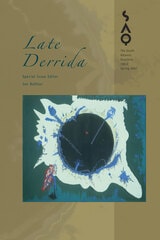
Late Derrida, Volume 106
Ian Balfour , ed.
Duke University Press, 0
The essays address a wide array of Derrida’s concerns: human rights, justice, religion, the performative, “the gift of death,” mourning, and sovereignty. They often put Derrida’s texts in conjunction with the works of others—Wordsworth, Agamben, Schelling, and Benjamin, to name a few—that resonate with and on occasion resist Derrida’s own thinking and writing. One essay offers a reading of Wordsworth’s elegy “Distressful gift!” as a dialogue with questions posed by Derrida, using as its frame the kind of nonnormative mourning that Derrida advocated, together with a haunting analysis of the character of survival. Other essays look at Derrida’s theory of performativity as advanced in his late works, continuing his emphasis on the power of language, and in general they emulate his vigilance in attending to force and violence everywhere.
Contributors. Ian Balfour, David L. Clark, Mary Jacobus, David E. Johnson, David Lloyd, J. Hillis Miller, Marc Redfield, Rei Terada, Elisabeth Weber
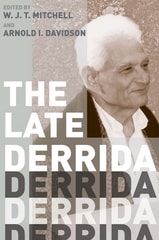
The Late Derrida
Edited by W. J. T. Mitchell and Arnold I. Davidson
University of Chicago Press, 2007
The rubric “The Late Derrida,” with all puns and ambiguities cheerfully intended, points to the late work of Jacques Derrida, the vast outpouring of new writing by and about him in the period roughly from 1994 to 2004. In this period Derrida published more than he had produced during his entire career up to that point. At the same time, this volume deconstructs the whole question of lateness and the usefulness of periodization. It calls into question the “fact” of his turn to politics, law, and ethics and highlights continuities throughout his oeuvre.
The scholars included here write of their understandings of Derrida’s newest work and how it impacts their earlier understandings of such classic texts as Glas and Of Grammatology. Some have been closely associated with Derrida since the beginning—both in France and in the United States—but none are Derrideans. That is, this volume is a work of critique and a deep and continued engagement with the thought of one of the most significant philosophers of our time. It represents a recognition that Derrida’s work has yet to be addressed—and perhaps can never be addressed—in its totality.