Results by title

5 books match the query 'Latin American'
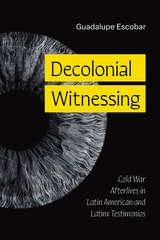
cover of Decolonial Witnessing: Cold War Afterlives in Latin American and Latinx Testimonios

Decolonial Witnessing

Cold War Afterlives in Latin American and Latinx Testimonios

Guadalupe Escobar

University of Texas Press, 2026

Examining the power of testimonios in illuminating political injustice in Latin America from the Cold War to the present.

During the Cold War, testimonio emerged as a powerful genre of political nonfiction in Latin America. Artists created first-person narratives of censorship and state violence, highlighting broader circumstances of oppression carried out by local right-wing oligarchies in collusion with the US empire. Decolonial Witnessing explores the continuing vitality of testimonio in the twenty-first century, as it has evolved into narratives contesting neoliberal dispossession and disposability.

Considering the cultural work of Ana Castillo, Regina José Galindo, Jayro Bustamante, Alberto Ledesma, Javier Zamora, Lila Downs, and others, Guadalupe Escobar shows how artists, authors, musicians, and filmmakers are using testimonial narratives to identify and resist the architecture of post–Cold War militarized democracy. Contemporary testimonios center migrant children, torture abolitionists, Indigenous land defenders—figures whose perspectives and, indeed, presence disrupt dominant paradigms of citizenship. Cast against the law, their stories—their memories—constitute a critical optic on the construction of belonging. In these acts of bearing witness, Escobar locates the possibility of a new, counterhegemonic political imagination.

[more]
cover of Latin American and Caribbean Library Resources in the British Isles: A Directory

Latin American and Caribbean Library Resources in the British Isles

A Directory

Alan Biggins and Valerie Cooper

University of London Press, 2001

[more]
cover of Mayaya Rising: Black Female Icons in Latin American and Caribbean Literature and Culture

Mayaya Rising

Black Female Icons in Latin American and Caribbean Literature and Culture

Dawn Duke

Bucknell University Press, 2023

Who are the Black heroines of Latin America and the Caribbean? Where do we turn for models of transcendence among women of African ancestry in the region? In answer to the historical dearth of such exemplars, Mayaya Rising explores and celebrates the work of writers who intentionally center powerful female cultural archetypes. In this inventive analysis, Duke proposes three case studies and a corresponding womanist methodology through which to study and rediscover these figures. The musical Cuban-Dominican sisters and former slaves Teodora and Micaela Ginés inspired Aida Cartagena Portalatin’s epic poem Yania tierra; the Nicaraguan matriarch of the May Pole, “Miss Lizzie,” figures prominently in four anthologies from the country’s Bluefields region; and the iconic palenqueras of Cartagena, Colombia are magnified in the work of poets María Teresa Ramírez Neiva and Mirian Díaz Pérez. In elevating these figures and foregrounding these works, Duke restores and repairs the scholarly record.
[more]
cover of The Financing of Politics: Latin American and European Perspectives

The Financing of Politics

Latin American and European Perspectives

Edited by Carlos Malamud and Eduardo Posada-Carbo

University of London Press, 2004

This volume stresses the need for a comparative approach when dealing with the funding of party politics and a major related aspect - corruption. This topic lies at the heart of any realistic discussion of the logic of democratic representation. Corruption, or the perception of corruption, has led to an ever-increasing concern with political financing. In some cases the trend is toward a greater role for the state in financing political parties, in others the reverse is true. In this collection the individual experiences of several Latin American countries (including Chile, Colombia, Mexico, Uruguay, and Venezuela) are examined against the background of Western Europe, with a view to identifying similarities as well as differences. Given the centrality of political parties to liberal democracies, this subject is of great significance.
Contributors include Angel Alvarez (Universidad Central, Venezuela), Kevin Casas Zamora (University of Costa Rica), Fernando Cepeda Ulloa (Universidad de los Andes, Colombia), Pilar del Castillo (Spanish Minister of Education), Justin Fisher (University of Brunel), Manuel Antonio Garreton (University of Chile), Emilio Lama de Espinosa (Real Instituto Espanol Elcano de Relaciones Internacionales y Estrategicas, Madrid, Spain), Juan Molinar Horcasitas (Partido de Accion Nacional, Mexico), Michael Pinto-Duschinsky (University of Brunel), Weronique Pujas (University of Grenoble, France), Martin Rhodes (European University Institute, Florence, Italy), Diego Urbaneja (Universidad Central, Venezuela), and Laurence Whitehead (Nuffield College, University of Oxford, UK).
[more]
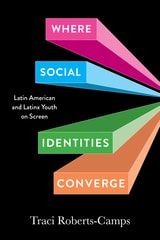
cover of Where Social Identities Converge: Latin American and Latinx Youth on Screen

Where Social Identities Converge

Latin American and Latinx Youth on Screen

Traci Roberts-Camps

Vanderbilt University Press, 2024

Where Social Identities Converge examines adolescent girlhood as a metaphorical site in Latin American and Latinx film. Author Traci Roberts‑Camps analyzes the work of a series of female directors from Argentina, Ecuador, Mexico, Peru, Venezuela, and the United States to understand how female adolescence and young adulthood are represented in film. She argues that using an intersectional lens reveals how these directors present the image of adolescent girlhood as a site of early trauma that presages women’s lived experiences with institutional, interconnected forms of oppression. The book thus considers intersectionality through young female protagonists who represent identity struggles in Latin America and US Latinx communities. In doing so, it examines a range of genres, such as fictional film, documentary, and television miniseries. Each chapter includes a close reading of specific scenes that offer insight into the young female protagonists’ multiple identity markers and a continuous comparison between chapters.
[more]