Results by title
3 books match the query 'Latin Americanists'
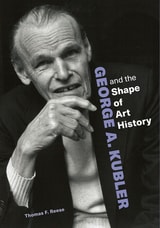
George A. Kubler and the Shape of Art History
Thomas F. Reese
J. Paul Getty Trust, The, 0
Art historian George A. Kubler (1912–1996) was a foundational scholar of ancient American art and archaeology as well as Spanish and Portuguese architecture. During over five decades at Yale University, he published seventeen books that included innovative monographs, major works of synthesis, and an influential theoretical treatise. In this biography, Thomas F. Reese analyzes the early formation, broad career, and writings of Kubler, casting nuanced light on the origins and development of his thinking.
Notable in Reese’s discussion and contextualization of Kubler’s writings is a revealing history and analysis of his Shape of Time—a book so influential to students, scholars, artists, and curious readers in multiple disciplines that it has been continuously in print since 1962. Reese reveals how pivotal its ideas were in Kubler’s own thinking: rather than focusing on problems of form as an ordering principle, he increasingly came to sequence works by how they communicate meaning. The author demonstrates how Kubler, who professed to have little interest in theory, devoted himself to the craft of art history, discovering and charting the rules that guided the propagation of structure and significance through time.
Looking South
The Evolution of Latin Americanist Scholarship in the United States, 1850-1975Helen Delpar
University of Alabama Press, 2007
The definitive history of how Latin American studies became a major field in American scholarship.
Looking South: The Evolution of Latin Americanist Scholarship in the United States, 1850-1975 is the first comprehensive history of the development of Latin American studies as a field of academic inquiry in the United States. In this ambitious and insightful work, historian Helen Delpar traces more than a century of intellectual engagement with Latin America, revealing how generations of historians, anthropologists, geographers, economists, sociologists, and political scientists shaped American understandings of the region and transformed Latin American studies into a recognized academic discipline.
A central contribution of the book lies in its exploration of the relationship between scholarship and historical context. Delpar demonstrates that academic interest in Latin America was never isolated from larger political, economic, and cultural developments in the United States. The expansion of hemispheric trade, the Good Neighbor era, World War II, the Cold War, and the Cuban Revolution all influenced how American scholars approached the region and what questions they considered important. By examining these intersections, she reveals how academic knowledge is shaped by changing national priorities, international events, and institutional support networks.
Beyond its contributions to Latin American history, Looking South is a major work of intellectual and academic history. It offers a compelling account of how scholarly fields are created, how academic communities develop, and how knowledge about world regions is produced, organized, and disseminated. Delpar's careful attention to both individual scholars and larger institutional structures makes the book an essential resource for understanding the history of area studies, the social sciences, and higher education in the United States.
Looking South remains an indispensable guide to the origins and evolution of Latin Americanist scholarship. It is essential reading for historians, Latin Americanists, anthropologists, political scientists, educators, and anyone interested in the intellectual history of the Americas and the development of knowledge across national and cultural boundaries.
The Exhaustion of Difference
The Politics of Latin American Cultural StudiesAlberto Moreiras
Duke University Press, 2001
What, asks Moreiras, is the function of critical reason in the present moment? What is regionalistic knowledge in the face of globalization? Can regionalistic knowledge be an effective tool for a critique of contemporary reason? What is the specificity of Latin Americanist reflection and how is it situated to deal with these questions? Through examinations of critical regionalism, restitutional excess, the historical genealogy of Latin American subalternism, testimonio literature, and the cultural politics of magical realism, Moreiras argues that while cultural studies is increasingly institutionalized and in danger of reproducing the dominant ideologies of late capitalism, it is also ripe for giving way to projects of theoretical reformulation. Ultimately, he claims, critical reason must abandon its allegiance to aesthetic-historicist projects and the destructive binaries upon which all cultural theories of modernity have been constructed.
The Exhaustion of Difference makes a significant contribution to the rethinking of Latin American cultural studies.