Results by title
5 books match the query 'Latin Americans in motion pictures'
Clicas
Gender, Sexuality, and Struggle in Latina/o/x Gang Literature and FilmFrank García
University of Texas Press, 2024
2026 Honorable Mention, Best Academic Themed Book, College Level, International Latino Book Awards
2025 First Book Prize Honorable Mention, Cultural Studies Association
How Latina/o/x gang literature and film represent women and gay gang members’ challenges to gendered, sexual, racial, and class oppression.
Clicas examines Latina/o/x literature and film by and/or about gay and women gang members. Through close readings of literature and film, Frank García reimagines the typical narratives describing gang membership and culture, amplifying and complicating critical gang studies in the social sciences and humanities and looking at gangs across racial, ethnic, and national identities. Analyzing how the autobiographical poetry of Ana Castillo presents gang fashion, culture, and violence to the outside world, the effects of women performing female masculinity in the novel Locas, and gay gang members’ experiences of community in the documentary Homeboy, García complicates the dialogue regarding hypermasculine gang cultures. He shows how they are accessible not only to straight men but also to women and gay men who can appropriate them in complicated ways, which can be harming and also, at times, emancipating. Reading gang members as (de)colonial agents who contest the power relations, inequalities, oppressions, and hierarchies of the United States, Clicas considers how women and gay gang members resist materially and psychologically within a milieu shaped by the intersection of race, gender, sexuality, and class.
Constructed Latinx(s) Identities
Racialized Bodies in Visual and Textual CultureEdited by José I. Lara
Amherst College Press, 2025
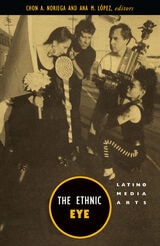
Ethnic Eye
Latino Media ArtsChon Noriega
University of Minnesota Press, 1996
The first in-depth treatment of Latino film and video.
This groundbreaking volume is the first to examine the range of Latino media arts, from independent feature production to documentary to experimental video. The essays explore the work of Chicano, Puerto Rican, Cuban American, and Latino film and video artists and address avant-garde practices, queer media, and performance art as well as more conventional film and video representations.
Contributors to The Ethnic Eye provide close readings of a wide variety of films and videos, including Stand and Deliver, American Me, Bedhead, El Mariachi, Carmelita Tropicana, Improper Conduct, Welcome to America’s Finest Tourist Plantation, Border Brujo, Mérida Proscrita, and Spitfire. The essays are unified by a concern with the creation of a common ground for Latino media arts, one that is pan-ethnic rather than narrowly transcribed by race, ethnicity, or national heritage. The volume also provides the first in-depth treatment of such artists as Robert Rodriquez, Ela Troyano, Raphael Montañez Ortiz, and Frances Salomé España. Eclectic in the range of media artists and works considered, The Ethnic Eye is unique in its inclusion of site-specific public art, as well as performance-based works. Contributors: Marcos Becquer; Charles Ramírez Berg, U of Texas; C. Ondine Chavoya; Marvin D’Lugo, Clark U; Claire F. Fox, Stanford U; Ilene S. Goldman; Carmen Huaco-Nuzum, U of California, Davis; Lillian Jiménez; Alisa Lebow; Scott MacDonald, Utica College; José Esteban Muñoz, New York U; Frances Negrón-Muntaner; Kathleen Newman, U of Iowa; Christopher Ortiz.
Narcomedia
Latinidad, Popular Culture, and America's War on DrugsJason Ruiz
University of Texas Press, 2023
2024 Honorable Mention — The Victor Villaseñor Best Latino Focused Nonfiction Book Award – English, Empowering Latino Futures’ International Latino Book Awards
Exploring representations of Latinx people from Scarface to Narcos, this book examines how pop culture has framed Latin America as the villain in America’s long and ineffectual War on Drugs.
If there is an enemy in the War on Drugs, it is people of color. That is the lesson of forty years of cultural production in the United States. Popular culture, from Scarface and Miami Vice to Narcos and Better Call Saul, has continually positioned Latinos as an alien people who threaten the US body politic with drugs. Jason Ruiz explores the creation and endurance of this trope, its effects on Latin Americans and Latinx people, and its role in the cultural politics of the War on Drugs.
Even as the focus of drug anxiety has shifted over the years from cocaine to crack and from methamphetamines to opioids, and even as significant strides have been made in representational politics in many areas of pop culture, Latinx people remain an unshakeable fixture in stories narrating the production, distribution, and sale of narcotics. Narcomedia argues that such representations of Latinx people, regardless of the intentions of their creators, are best understood as a cultural front in the War on Drugs. Latinos and Latin Americans are not actually America’s drug problem, yet many Americans think otherwise—and that is in no small part because popular culture has largely refused to imagine the drug trade any other way.
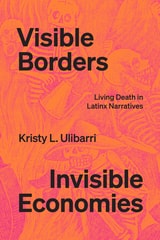
Visible Borders, Invisible Economies
Living Death in Latinx NarrativesKristy L. Ulibarri
University of Texas Press, 2022
2023 Outstanding Book Award, National Association for Ethnic Studies
A thorough examination of the political and economic exploitation of Latinx subjects, migrants, and workers through the lens of Latinx literature, photography, and film.
Globalization in the United States can seem paradoxical: free trade coincides with fortification of the southern border, while immigration is reimagined as a national-security threat. US politics turn aggressively against Latinx migrants and subjects even as post-NAFTA markets become thoroughly reliant on migrant and racialized workers. But in fact, there is no incongruity here. Rather, anti-immigrant politics reflect a strategy whereby capital uses specialized forms of violence to create a reserve army of the living, laboring dead.
Visible Borders, Invisible Economies turns to Latinx literature, photography, and films that render this unseen scheme shockingly vivid. Works such as Valeria Luiselli’s Tell Me How It Ends and Alex Rivera’s Sleep Dealer crystallize the experience of Latinx subjects and migrants subjugated to social death, their political existence erased by disenfranchisement and racist violence while their bodies still toil in behalf of corporate profits. In Kristy L. Ulibarri’s telling, art clarifies what power obscures: the national-security state performs anti-immigrant and xenophobic politics that substitute cathartic nationalism for protections from the free market while ensuring maximal corporate profits through the manufacture of disposable migrant labor.