Results by title

21 books match the query 'Latin language'
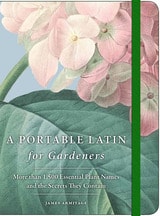
cover of A Portable Latin for Gardeners: More than 1,500 Essential Plant Names and the Secrets They Contain

A Portable Latin for Gardeners

More than 1,500 Essential Plant Names and the Secrets They Contain

James Armitage

University of Chicago Press, 2017

Having an understanding of botanical Latin unlocks an entirely new layer of the plant world. Gardeners deciding between a Crocus flavus and Crocus graveolens will know that one produces deep yellow flowers while the other boasts a prominent smell. They can tell whether a plant should have one (unifolius), two (diphyllus), or even nine leaves (enneaphyllus). And they can catch the nods to Sir Joseph Banks in Cordyline banksia and Queen Victoria in Agave victoriae-reginae.
A Portable Latin for Gardeners is the perfect quick reference for working in the garden, shopping for plants, or doing botanical research—and no prior knowledge of Latin is required. The 1,500 terms are grouped by categories, making it easy to describe color, size, form, habitat, scent, taste, and time. Gardeners will make new connections and discoveries in a way standard alphabetical lists simply don’t allow. Alternately, gardeners who want to look up a particular term can jump right into the alphabetical index. Each entry includes the different forms of the term, a basic pronunciation guide, the definition, and an example plant species.
Rich botanical illustrations make this guide as beautiful as it is useful, while a durable flexi-bound cover means the book can withstand both days in the garden and evenings on the nightstand.
[more]
cover of An Answer Key to 'A Primer of Ecclesiastical Latin'

An Answer Key to 'A Primer of Ecclesiastical Latin'

John R. Dunlap

Catholic University of America Press, 2006
[more]
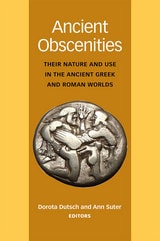
cover of Ancient Obscenities: Their Nature and Use in the Ancient Greek and Roman Worlds

Ancient Obscenities

Their Nature and Use in the Ancient Greek and Roman Worlds

Dorota Dutsch and Ann Suter, editors

University of Michigan Press, 2015
Ancient Obscenities inquires into the Greco-Roman handling of explicit representations of the body in its excretory and sexual functions, taking as its point of departure the modern preoccupation with the obscene. The essays in this volume offer new interpretations of materials that have been perceived by generations of modern readers as “obscene”: the explicit sexual references of Greek iambic poetry and Juvenal’s satires, Aristophanic aischrologia, Priapic poetics, and the scatology of Pompeian graffiti. Other essays venture in an even more provocative fashion into texts that are not immediately associated with the obscene: the Orphic Hymn to Demeter, Herodotus, the supposedly prim scripts of Plautus and the Attic orators. The volume focuses on texts but also includes a chapter devoted to visual representation, and many essays combine evidence from texts and material culture. Of all these texts, artifacts, and practices we ask the same questions: What kinds of cultural and emotional work do sexual and scatological references perform? Can we find a blueprintfor the ancient usage of this material?

 
[more]
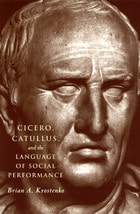
cover of Cicero, Catullus, and the Language of Social Performance

Cicero, Catullus, and the Language of Social Performance

Brian A. Krostenko

University of Chicago Press, 2001

Charm, wit, and style were critical, but dangerous, ingredients in the social repertoire of the Roman elite. Their use drew special attention, but also exposed one to potential ridicule or rejection for valuing style over substance. Brian A. Krostenko explores the complexities and ambiguities of charm, wit, and style in Roman literature of the late Republic by tracking the origins, development, and use of the terms that described them, which he calls "the language of social performance."

As Krostenko demonstrates, a key feature of this language is its capacity to express both approval and disdain—an artifact of its origins at a time when the "style" and "charm" of imported Greek cultural practices were greeted with both enthusiasm and hostility. Cicero played on that ambiguity, for example, by chastising lepidus ("fine") boys in the "Second Oration against Catiline" as degenerates, then arguing in his De Oratore that the successful speaker must have a certain charming lepos ("wit"). Catullus, in turn, exploited and inverted the political subtexts of this language for innovative poetic and erotic idioms.
[more]
cover of Ecclesiastical Latin: A Primer on the Language of the Church

Ecclesiastical Latin

A Primer on the Language of the Church

Charles G. Kim, Jr.

Catholic University of America Press, 2024
Ecclesiastical Latin: A Primer on the Language of the Church offers a thorough introduction to the Latin language in 32 chapters, which can be completed in one academic year. The text presents each section in plain language, fully explaining complicated grammar terms which may be unfamiliar to a contemporary audience. Every chapter includes copious examples and practice sentences of the grammar covered, as well as stories drawn from the Vulgate, or Church tradition. In addition to encountering the vocabulary and grammar in practice sentences, the text also offers prayers from the liturgy which illustrate the grammar, as well as sentences which come directly from the corpus of original Ecclesiastical Latin. By the end of the book, students will feel comfortable reading through the Vulgate or praying the liturgy in Latin with more understanding. The grammar structures for each chapter roughly follow the organization of grammar as it is presented in Hans Orberg's Lingua Latina. The student can thus practice more of the language in full immersion with confidence, while also learning the vocabulary and style of later Ecclesiastical Latin.
[more]
cover of English Words from Latin and Greek Elements

English Words from Latin and Greek Elements

Donald M. Ayers; Revised by Thomas D. Worthen

University of Arizona Press, 1986

Since its first publication in 1965, English Words from Latin and Greek Elements by Donald M. Ayers has empowered thousands of students to expand their vocabulary by uncovering the classical roots embedded in modern English. Now in its enduring second edition, this trusted resource proves that vocabulary is most effectively learned through understanding—not memorization.

Why dedicate an entire book to this approach? Because Ayers goes beyond the basics. Students are introduced to a broad spectrum of Latin and Greek roots, encounter new vocabulary in meaningful context, and reinforce their learning through targeted exercises. This method equips learners with lifelong tools to decode unfamiliar words and deepen their command of English.

Written for English learners—not classical language scholars—this book requires no prior knowledge of Latin or Greek. It’s proven effective across high school and college classrooms, and adaptable for both remedial and accelerated programs.
[more]
cover of From Puella to Platus: An Introduction to Latin Language and Thought, Volume 2

From Puella to Platus

An Introduction to Latin Language and Thought, Volume 2

Tamara Trykar-Lu

Catholic University of America Press, 2019
Whether to enlarge your general education, improve your English, or just because you are curious about the society that has had such a lasting influence on our history, our language, our thoughts, and our culture, you should and can learn Latin. Tamara Trykar-Lu's charming and delightful introduction to Latin, From Puella to Plautus, Part I, is designed for beginning to intermediate Latin study, at the high school or college level, either with the aid of a teacher and classroom or simply for personal enjoyment and enrichment. A thorough review of English grammar with detailed explanations makes it easy for the reader to grasp new concepts in Latin. Learning Latin vocabulary becomes manageable once you realize how much ‘Latin’ vocabulary there is in English. You will quickly learn to read Latin with short stories and, gradually, more demanding selections. Readers will translate the story of Romulus and Remus and the founding of Rome, but also the tale of Nivea -- Snow White -- and some parts of Shakespeare's plays. Short sections show how English developed, how Latin influenced it, and where they both belong in the world of languages. Each chapter ends with a brief outline of some aspect of Roman culture, such as housing, fauna and flora, games, crafts, water supply, and cooking – with recipes. And last but not least there are informative tidbits, drawings, cartoons, jokes, riddles, crossword puzzles, and, of course, pictures distributed throughout the book. For while foreign-language study should be logical, coherent, and rigorous, it need not be heavy-handed or pedantic, and certainly not dull. Ideal for use in courses or for brushing up your language skills, From Puella to Plautus is a lively and engaging book about the Latin language and life in the Roman Empire.
[more]
cover of From Puella to Plautus: An Introduction to Latin Language and Thought, Volume 1

From Puella to Plautus

An Introduction to Latin Language and Thought, Volume 1

Tamara Trykar-Lu

Catholic University of America Press, 2019

Whether to enlarge your general education, improve your English, or just because you are curious about the society that has had such a lasting influence on our history, our language, our thoughts, and our culture, you should and can learn Latin. Tamara Trykar-Lu's charming and delightful introduction to Latin, From Puella to Plautus, Part I, is designed for beginning to intermediate Latin study, at the high school or college level, either with the aid of a teacher and classroom or simply for personal enjoyment and enrichment. A thorough review of English grammar with detailed explanations makes it easy for the reader to grasp new concepts in Latin. Learning Latin vocabulary becomes manageable once you realize how much ‘Latin’ vocabulary there is in English. You will quickly learn to read Latin with short stories and, gradually, more demanding selections. Readers will translate the story of Romulus and Remus and the founding of Rome, but also the tale of Nivea -- Snow White -- and some parts of Shakespeare's plays. Short sections show how English developed, how Latin influenced it, and where they both belong in the world of languages. Each chapter ends with a brief outline of some aspect of Roman culture, such as housing, fauna and flora, games, crafts, water supply, and cooking – with recipes. And last but not least there are informative tidbits, drawings, cartoons, jokes, riddles, crossword puzzles, and, of course, pictures distributed throughout the book. For while foreign-language study should be logical, coherent, and rigorous, it need not be heavy-handed or pedantic, and certainly not dull. Ideal for use in courses or for brushing up your language skills, From Puella to Plautus is a lively and engaging book about the Latin language and life in the Roman Empire.
[more]
cover of Ireland and the Classical World

Ireland and the Classical World

By Philip Freeman

University of Texas Press, 2000

On the boundary of what the ancient Greeks and Romans considered the habitable world, Ireland was a land of myth and mystery in classical times. Classical authors frequently portrayed its people as savages—even as cannibals and devotees of incest—and evinced occasional uncertainty as to the island's shape, size, and actual location. Unlike neighboring Britain, Ireland never knew Roman occupation, yet literary and archaeological evidence prove that Iuverna was more than simply terra incognita in classical antiquity.

In this book, Philip Freeman explores the relations between ancient Ireland and the classical world through a comprehensive survey of all Greek and Latin literary sources that mention Ireland. He analyzes passages (given in both the original language and English) from over thirty authors, including Julius Caesar, Strabo, Tacitus, Ptolemy, and St. Jerome. To amplify the literary sources, he also briefly reviews the archaeological and linguistic evidence for contact between Ireland and the Mediterranean world.

Freeman's analysis of all these sources reveals that Ireland was known to the Greeks and Romans for hundreds of years and that Mediterranean goods and even travelers found their way to Ireland, while the Irish at least occasionally visited, traded, and raided in Roman lands. Everyone interested in ancient Irish history or Classics, whether scholar or enthusiast, will learn much from this pioneering book.
[more]
cover of Language and Authority in De Lingua Latina: Varro's Guide to Being Roman

Language and Authority in De Lingua Latina

Varro's Guide to Being Roman

Diana Spencer

University of Wisconsin Press, 2022
Diana Spencer, known for her scholarly focus on how ancient Romans conceptualized themselves as a people and how they responded to and helped shape the world they lived in, brings her expertise to an examination of the Roman scholar Varro and his treatise De Lingua Latina. This commentary on the origin and relationships of Latin words is an intriguing, but often puzzling, fragmentary work for classicists. Since Varro was engaged in defining how Romans saw themselves and how they talked about their world, Spencer reads along with Varro, following his themes and arcs, his poetic sparks, his political and cultural seams. Few scholars have accepted the challenge of tackling Varro and his work, and in this pioneering volume, Spencer provides a roadmap for considering these topics more thoroughly.
[more]
cover of Latin Grammar

Latin Grammar

Dirk Panhuis

University of Michigan Press, 2006

In Latin Grammar, Dirk Panhuis has created an innovative reference that makes use of many of the advances that have taken place in linguistics during the last half century. Using a syntactic—instead of the traditional morphological—approach to syntax, Panhuis explains linguistic concepts clearly, thoroughly describing the structure of the sentence and its parts. For ease of use, Panhuis often presents the theory in well-organized tables and charts, and provides the reader with illustrative texts by Latin authors.
Back Cover

Through clear structuring of language phenomena, Panhuis provides a reference that integrates traditional linguistic knowledge with linguistic innovation and didactic clarity. This concise reference, ideal for students and instructors of Latin in high schools and colleges, will supplant the out-dated grammars of Allen & Greenough and Hale & Buck.

Dirk Panhuis graduated in classical philology at the State University of Ghent, Belgium, in 1963 and obtained his PhD in linguistics at the University of Michigan, Ann Arbor, in 1981. He has been assistant and academic secretary of the Institut Supérieur Pédagogique in Kananga (Democratic Republic of Congo) and a teaching assistant at the University of Michigan. He taught classical languages in high schools of the Flemish Community in and around Louvain (Belgium) until his retirement in 2002.


"Panhuis brings a very welcome linguistic orientation to the study of Latin, an approach not found in the older traditional grammars currently used at the college level. Among the features likely to prove most helpful for students is the presentation of information in clear and easily readable charts and grids, and the explanations accompanying the English translations, allowing students to see clearly how to render a Latin structure into English both literally and idiomatically."
Back Cover continued
—Deborah Ross, Department of Classical Studies, University of Michigan

"This innovative grammar incorporates current viewpoints of syntax and semantics, making it a unique tool, especially for the study of sentence structure."—Philip Baldi, Professor of Linguistics and Classics, Pennsylvania State University

"In his Latin Grammar, Panhuis artfully integrates traditional description and modern analysis. It will provide intermediate and advancing Latin students mature help in understanding Latin syntax and offers material on the dynamics of text which is unique for an introductory reference tool. Not to be overlooked is its value as a resource to those who teach Latin."
—Charles Elerick, Professor of Languages and Linguistics, The University of Texas at El Paso
[more]
cover of Latin for Gardeners: Over 3,000 Plant Names Explained and Explored

Latin for Gardeners

Over 3,000 Plant Names Explained and Explored

Lorraine Harrison

University of Chicago Press, 2012

Since Latin became the standard language for plant naming in the eighteenth century, it has been intrinsically linked with botany. And while mastery of the classical language may not be a prerequisite for tending perennials, all gardeners stand to benefit from learning a bit of Latin and its conventions in the field. Without it, they might buy a Hellebores foetidus and be unprepared for its fetid smell, or a Potentilla reptans with the expectation that it will stand straight as a sentinel rather than creep along the ground.

An essential addition to the gardener’s library, this colorful, fully illustrated book details the history of naming plants, provides an overview of Latin naming conventions, and offers guidelines for pronunciation. Readers will learn to identify Latin terms that indicate the provenance of a given plant and provide clues to its color, shape, fragrance, taste, behavior, functions, and more. 
Full of expert instruction and practical guidance, Latin for Gardeners will allow novices and green thumbs alike to better appreciate the seemingly esoteric names behind the plants they work with, and to expertly converse with fellow enthusiasts. Soon they will realize that having a basic understanding of Latin before trips to the nursery or botanic garden is like possessing some knowledge of French before traveling to Paris; it enriches the whole experience.
[more]
cover of Latin for Reading: A Beginner's Textbook with Exercises

Latin for Reading

A Beginner's Textbook with Exercises

Glenn M. Knudsvig, Ruth S. Craig, and Gerda M. Seligson

University of Michigan Press, 1986
This text enables students to learn to read Latin
[more]
cover of Lives of the Great Languages: Arabic and Latin in the Medieval Mediterranean

Lives of the Great Languages

Arabic and Latin in the Medieval Mediterranean

Karla Mallette

University of Chicago Press, 2021

The story of how Latin and Arabic spread across the Mediterranean to create a cosmopolitan world of letters.
 
In this ambitious book, Karla Mallette studies the nature and behaviors of the medieval cosmopolitan languages of learning—classical Arabic and medieval Latin—as they crossed the Mediterranean. Through anecdotes of relationships among writers, compilers, translators, commentators, and copyists, Mallette tells a complex story about the transmission of knowledge in the period before the emergence of a national language system in the late Middle Ages and early modernity.

Mallette shows how the elite languages of learning and culture were only tenuously related to the languages of everyday life. These languages took years of study to master, marking the passage from intellectual childhood to maturity. In a coda to the book, Mallette speculates on the afterlife of cosmopolitan languages in the twenty-first century, the perils of monolingualism, and the ethics of language choice. The book offers insight for anyone interested in rethinking linguistic and literary tradition, the transmission of ideas, and cultural expression in an increasingly multilingual world.
 
[more]
cover of Metamorphosis of Language in Apuleius: A Study of Allusion in the Novel

Metamorphosis of Language in Apuleius

A Study of Allusion in the Novel

Ellen D. Finkelpearl

University of Michigan Press, 1998

Ellen D. Finkelpearl's Metamorphosis of Language in Apuleius studies the use of literary allusion by the Roman author Apuleius, in his second century C.E. novel the Metamorphoses, popularly known as The Golden Ass. Apuleius' work is enticing yet frustrating because of its enigmatic mixture of the comic and serious; a young man is transformed into a donkey, but eventually finds salvation with the goddess Isis. Finkelpearl's book represents the first attempt to place Apuleius' allusive practices within a consideration of the development of the ancient novel.
When Apuleius wrote his Metamorphoses, the novel--indeed the very concept of fiction in prose--was new. This study argues that Apuleius' repeated allusions to earlier Latin authors such as Vergil, Ovid, and Seneca represent an exploration on his part of the relationship between the novel and more established genres of the era. Apuleius' struggle with this tradition, Finkelpearl maintains, parallels the protagonist's move from an acceptance of the dominance of traditional forms to a sense of arrival and self- discovery.
An introductory chapter includes general discussion of the theory and practice of allusion. Finkelpearl then revisits the issues of parody in Apuleius. She also includes discussion of Apuleius' use of Vergil's Sinon, the Charite episode in relation to Apuleius' African origins, and the stepmother episode. Finally a new reading of Isis is offered, which emphasizes her associations with writing and matches the multiformity of the goddess with the novel's many voices.
This book will be of interest to scholars of literature and the origins of the novel, multiculturalism, and classical literature.
Ellen D. Finkelpearl is Associate Professor of Classics at Scripps College, Claremont, California.
[more]
cover of Ossa Latinitatis Sola Ad Mentem Reginaldi Rationemque

Ossa Latinitatis Sola Ad Mentem Reginaldi Rationemque

Reginaldus Thomas Foster

Catholic University of America Press, 2016
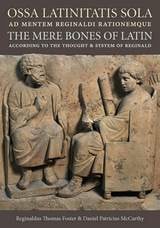
From the first encounter with the Latin language to its full presentation, the objective of Ossa Latinitatis Sola is to get people into immediate contact with and understanding of Latin authors, and for these encounters to grow into a love and use of the entire language in all its literary types and periods of time and authors of the past 2,300 years.
[more]
cover of Ossa Ostensa: A Proven System for Demystifying Latin, Book 2

Ossa Ostensa

A Proven System for Demystifying Latin, Book 2

Laura Pooley

Catholic University of America Press, 2023
Ossa Ostensa is the world’s first comprehensive example of how to teach and learn the Latin language using the unique teaching system of the internationally recognized authority Reginald Foster. Laura Pooley – prize-winning graduate of the University of Oxford and currently a supervisor at the University of Cambridge, brings to life the year she spent in Rome studying Latin with Reginaldus. His inspiring and transformative method of teaching combines with Laura’s twenty years of teaching experience to produce concise and crystal-clear explanations of the language. The three ‘experiences’ of Latin: beginners, intermediates and advanced, are divided between three user-friendly workbooks. Each workbook comprises around thirty lessons, where the language is presented in hand-out form requiring very little modification by prospective teachers. Each language area is then illustrated by translated reading examples. After each lesson, Laura provides translation practice targeted to the taught content. These Latin passages are divided into Classical and Post-Classical literature, to appeal to the interests of all Latin students. Not only that, but each passage is accompanied by teaching questions and translation hints, the mainstay of Reginaldus’ classroom persona and pedagogy so famously encapsulated in his Ludi. Students therefore can exercise recent language content and develop deep and spontaneous fluency in the Latin language. Enjoy continuing your experience of learning with Reginaldus with book 2 of the Ossa Ostensa series, where the significant language areas of participles and subjunctives are met for the first time.
[more]
cover of Ossa Ostensa: A proven system for demystifying Latin, Book One

Ossa Ostensa

A proven system for demystifying Latin, Book One

Laura Pooley

Catholic University of America Press, 2021
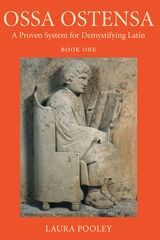
Ossa Ostensa is the world’s first comprehensive example of how to teach and learn the Latin language using the unique teaching system of the internationally recognized authority Reginald Foster. Laura Pooley – prize-winning graduate of the University of Oxford and currently a supervisor at the University of Cambridge, brings to life the year she spent in Rome studying Latin with Reginaldus. His inspiring and transformative method of teaching combines with Laura’s twenty years of teaching experience to produce concise and crystal-clear explanations of the language. The three ‘experiences’ of Latin: beginners, intermediates and advanced, are divided between three user-friendly workbooks. Each workbook comprises around thirty lessons, where the language is presented in hand-out form requiring very little modification by prospective teachers. Each language area is then illustrated by translated reading examples. After each lesson, Laura provides translation practice targeted to the taught content. These Latin passages are divided into Classical and Post-Classical literature, to appeal to the interests of all Latin students. Not only that, but each passage is accompanied by teaching questions and translation hints, the mainstay of Reginaldus’ classroom persona and pedagogy so famously encapsulated in his Ludi. Students therefore can exercise recent language content and develop deep and spontaneous fluency in the Latin language. For the first time, the experience of learning with Reginaldus is available to everyone.
[more]
cover of Ossium Carnes Multae e Marci Tullii Ciceronis Epistulis / The Bones’ Meats Abundant from the Epistles of Marcus Tullius Cicero

Ossium Carnes Multae e Marci Tullii Ciceronis Epistulis / The Bones’ Meats Abundant from the Epistles of Marcus Tullius Cicero

Reginaldus Thomas Foster

Catholic University of America Press, 2021
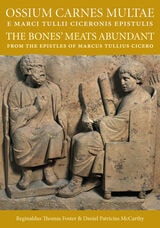
Beginners and experts alike will find a complete immersion into the workings and nature of the Latin language embodied in the incomparable, insuperable epistles of the great Marcus Tullius Cicero, something which other commentators pass over or scorn. This second volume puts “meat on the bones” of the Latin language presented in the first volume: Ossa Latinitatis Sola: The Mere Bones of Latin. The personal letters of Cicero provide ample meat to enflesh the skeletal structure of the language, thus the title: Ossium Carnes Multae: The Bones’ Meats Abundant from the epistles of Marcus Tullius Cicero. Part 1 presents 51 complete letters from the Tyrell-Purser text. Facing each letter is an image of its oldest manuscript edition as early as the ninth century, which are preserved and guarded in the Medicea Laurentiana library in Florence, Italy, witnessing to the human hand preserving this monument of world heritage for over two millennia. Part 2 follows with a most careful rendition into English of Tully’s living, telephone-like Latin discourse. A thorough treatment and explanation of noteworthy elements of his natural talk follows with numerous references to the Encounters in Volume I. All this has students, learners, teachers, experts of the Latin language in mind and is humbly designed to deepen the understanding and appreciation of specific expressions and peculiarities of Cicero’s language itself. Part 3 provides 500 sentences consisting of from 1 to 5 words and suited for the beginnings or continuation of Latin conversations: 200 declarations, 100 questions, 100 exclamations, 100 injunctions drawn from his letters. The volume is amply indexed. All this has been done to enhance the study and use of Latin, to popularize Cicero’s correspondence, to prepare the reader for Volume III which will deal again with the letters and their usefulness for Latin conversation.
[more]
cover of Reading Medieval Latin with the Legend of Barlaam and Josaphat

Reading Medieval Latin with the Legend of Barlaam and Josaphat

Donka D. Markus

University of Michigan Press, 2018

In Reading Medieval Latin with the Legend of Barlaam and Josaphat, Donka D. Markus offers comprehensive commentary on the 13th-century Dominican theologian Jacobus de Voragine’s retelling of the ancient story of the life of the Buddha that will resonate with contemporary students of Latin.

Jacobus’s version of the legend serves as a compelling, original Latin text. Vividly conveyed through parables, fables, and anecdotes, it naturally lends itself to a critical consideration of ethical principles and philosophical truths commonly shared across many cultures. With its rich stylistic devices and authentic classical Latin word order, it provides superb training for reading rhetorical prose before advancing to the works of more complex classical prose authors. At the same time, the text offers a unique opportunity for systematically learning the special features of Late and Medieval Latin. Included in this volume are two presentations of Jacobus’s text: one maintaining the original orthography reflecting Latin as it appears in medieval manuscripts, and one in which the orthography follows Classical Latin norms.

This textbook is designed for intermediate-level learners of Classical or Medieval Latin, whether in college, high school, or by self-directed study. The 5,000-word narrative text lends itself to a semester-long experience of reading one continuous work of prose. Each of the legend’s embedded stories can also be read as an independent selection with the help of the ample commentary, vocabulary, and grammar guidance. The extensive introduction provides the necessary background to contextualize the legend in its Latin iteration and sufficient historical information to make the reading meaningful for those without prior knowledge of Buddhism or medieval history. Additionally, this work makes Latin attractive to students of diverse backgrounds, as it highlights the language’s important role in disseminating the universally shared cultural legacy of humanity.
[more]
cover of Understanding Language: A Guide for Beginning Students of Greek and Latin

Understanding Language

A Guide for Beginning Students of Greek and Latin

Donald Fairbairn

Catholic University of America Press, 2011

Understanding Language includes major sections on the noun and verb systems of the classical languages.
[more]