Results by title
30 books match the query 'Latter Day Saint women'
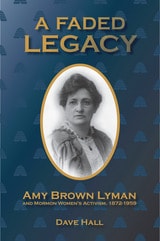
A Faded Legacy
Amy Brown Lyman and Mormon Women's Activism, 1872 - 1959Dave Hall
University of Utah Press, 2015
Placing Lyman’s story within a local and national context, award-winning author Dave Hall examines the roots and trajectory of Mormon women’s activism. Born into a polygamist family, Lyman entered the larger sphere of public life at the time when the practice of polygamy was ending and Mormonism had begun assimilating mainstream trends. The book follows her life as she prepared for a career, married, and sought meaning in a rapidly changing society. It recounts her involvement in the Relief Society, the Mormon women’s charity group that she led for many years and sought to transform into a force for social welfare, and it considers the influence of her connections with national and international women’s organizations. The final period of Lyman’s life, in which she resigned from the Relief Society amidst personal tragedy, offers insight into the reasons Mormon women abandoned their activist heritage for a more conservative role, a stance that is again evolving.
Winner of the Mormon History Association's Best First Book Award.
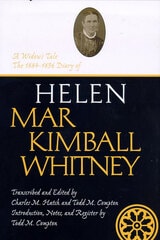
A Widow's Tale
1884-1896 Diary of Helen Mar Kimball WhitneyCharles M. Hatch and Todd Compton
Utah State University Press, 2003
Mormon culture has produced during its history an unusual number of historically valuable personal writings. Few such diaries, journals, and memoirs published have provided as rich and well rounded a window into their authors' lives and worlds as the diary of Helen Mar Kimball Whitney. Because it provides a rare account of the widely experienced situations and problems faced by widows, her record has relevance far beyond Mormon history though.
As a teenager Helen Kimball had been a polygamous wife of Mormon founder Joseph Smith. She subsequently married Horace Whitney. Her children included the noted Mormon author, religious authority, and politician Orson F. Whitney. She herself was a leading woman in her church and society and a writer known especially for her defense of plural marriage. Upon Horace's death, she began keeping a diary. In it, she recorded her economic, physical, and psychological struggles to meet the challenges of widowhood. Her writing was introspective and revelatory. She also commented on the changing society around her, as Salt Lake City in the last decades of the nineteenth century underwent rapid transformation, modernizing and opening up from its pioneer beginnings. She remained a well-connected member of an elite group of leading Latter-day Saint women, and prominent Utah and Mormon historical figures appear frequently in her daily entries. Above all, though, her diary is an unusual record of difficulties faced in many times and places by women, of all classes, whose husbands died and left them without sufficient means to carry on the types of lives to which they had been accustomed.
At Last She Said It
Honest Conversations About Faith, Church, and Everything in BetweenSusan Hinckley and Cynthia Winward
Signature Books, 2025
“Women of faith, discussing complicated things.” That’s how authors Susan Hinckley and Cynthia Winward describe At Last She Said It, and they don’t expect the knots to untangle themselves. Even with two very different personalities and a decade or so between them, as their friendship developed they kept stumbling onto what felt like an uncanny amount of common ground in their church experiences. Often their conversations ended with, “Why isn’t anyone talking about this? Someone should do a podcast!” So they did. They had a hunch they weren’t the only women wishing they had a place to discuss the things they were thinking about, a lot of which they’d never said—or heard—out loud. That hunch was right. Their 200-and-counting recorded conversations have been downloaded some two million times. Hinckley and Winward have learned, right along with their listeners, that there’s no power quite like finding out you’re not alone.
Their book now asks Latter-day Saints to think about old ideas in new ways. Stretching can be uncomfortable, but the willingness to consider diverse perspectives—even on the things we hold most dear—feels essential in an evolving world. So does being open to changing our minds, including how we think about ourselves. Faith is alive when it’s growing, and growing means change. Hopefully, these conversations will be the beginning of thousands more.
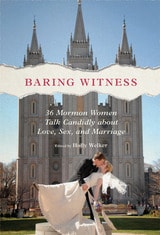
Baring Witness
36 Mormon Women Talk Candidly about Love, Sex, and MarriageEdited by Holly Welker
University of Illinois Press, 2016
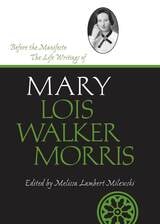
Before the Manifesto
The Life Writings of Mary Lois Walker MorrisMelissa Lambert Milewski
Utah State University Press, 2007
Mary Morris's memoir frames her 1879 to 1887 diary with both reflections on earlier years and passages that parallel entries in the day book, giving readers a better understanding of how she retrospectively saw her life. The thoroughly annotated diary offers the daily experience of a woman who kept a largely self-sufficient household, had a wide social network, ran her own business, wrote poetry, and was intellectually curious. The years of "the Raid" (federal prosecution of polygamists) led Mary and Elias Morris to hide their marriage on "the underground," and her to perjury in court during Elias's trial for unlawful cohabitation. The book ends with Mary Lois's arrival at the Salt Lake Depot after three years in exile in Mexico with a polygamist colony.
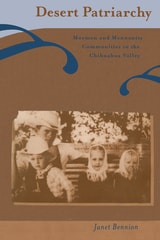
Desert Patriarchy
Mormon and Mennonite Communities in the Chihuahua ValleyJanet Bennion
University of Arizona Press, 2004
Janet Bennion has lived and worked among these people, and in this book she introduces a new paradigm—"desert patriarchy"—to explain their way of life. This perspective sheds light not only on these particular communities but also on the role of the desert environment in the development and maintenance of fundamentalist ideology in other parts of the United States and around the globe.
Making new connections between the arid environment, opposition to technology, and gender ideology, Bennion shows that it is the interplay of the desert and the unique social traditions and gender dynamics embedded in Anglo patriarchal fundamentalism that accounts for the successful longevity of the Mexican colonies. Her model defines the process by which male supremacy, female autonomous networking, and religious fundamentalism all facilitate successful adaptation to the environment.
More than a theoretical analysis, Desert Patriarchy provides an intimate glimpse into the daily lives of these people, showing how they have taken refuge in the desert to escape religious persecution, the forced secular education of their children, and economic and political marginalization. It particularly sheds light on the ironic autonomy of women within a patriarchal system, showing how fundamentalist women in Chihuahua are finding numerous creative ways to access power and satisfaction in a society structured to subordinate and even degrade them.
Desert Patriarchy richly expands the literature on nontraditional religious movements as it enhances our understanding of how environment can shape society. It offers unique insights into women's status in patriarchal communities and provides a new way of looking at similar communities worldwide.
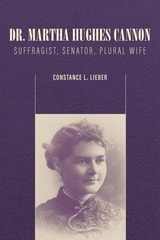
Dr. Martha Hughes Cannon
Suffragist, Senator, Plural WifeConstance L. Lieber
Signature Books, 2022
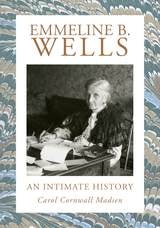
Emmeline B. Wells
An Intimate HistoryCarol Cornwall Madsen
University of Utah Press, 2016
Emmeline B. Wells was the most noted Utah Mormon woman of her time. Lauded nationally for her energetic support of the women’s rights movement of the nineteenth century, she was a self-made woman who channeled her lifelong sense of destiny into ambitious altruism. Her public acclaim and activism belied the introspective, self-appraising, and emotional persona she expressed in the pages of her forty-seven extant diaries. Yet she wrote, “I have risen triumphant,” after reconciling herself to the heartaches of plural marriage, and she pursued a self-directed life in earnest.
This new biography tells the story of the private Emmeline. The unusual circumstances of her marriages, the complicated lives of her five daughters, losses and disappointments interspersed with bright moments and achievements, all engendered the idea that her life was a romance, with all the mysterious, tragic, and sentimental elements of that genre. Her responses to that perception made it so. This volume, drawing heavily on Emmeline Wells’s own words, tells the complicated story of a woman of ambition, strength, tenderness, and faith.
Winner of the Mormon History Association's Best Biography Award.
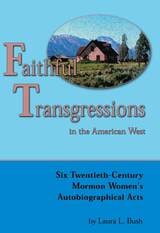
Faithful Transgressions In The American West
Six Twentieth-Century Mormon Women's Autobiographical ActsLaura L. Bush
Utah State University Press, 2004
The central issue Bush finds in these works is how their authors have dealt with the authority of Mormon Church leaders. As she puts it in her preface, "I use the phrase 'faithful transgression' to describe moments in the texts when each writer, explicitly or implicitly, commits herself in writing to trust her own ideas and authority over official religious authority while also conceiving of and depicting herself to be a 'faithful' member of the Church." Bush recognizes her book as her own act of faithful transgression. Writing it involved wrestling, she states, "with my own deeply ingrained religious beliefs and my equally compelling education in feminist theories that mean to liberate and empower women."
Faithful Transgressions examines a remarkable group of authors and their highly readable and entertaining books. In producing the first significant book-length study of Mormon women's autobiographical writing, Bush rides a wave of memoir publishing and academic interest in autobiography and other life narratives. As she elucidates these works in relation to the religious tradition that played a major role in shaping them, she not only positions them in relation to feminist theory and current work on women's life writings but ties them to the long literary tradition of spiritual autobiography.
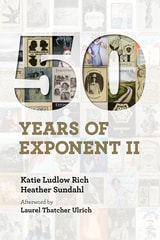
Fifty Years of Exponent II
Katie Ludlow Rich
Signature Books, 2024
On a sweltering day in June 1974, a group of housewives, graduate students, and young professionals gathered in the Boston suburbs. Their mission: to produce the first issue of Exponent II, a “humble yet sincere” newspaper “poised on the dual platforms of Mormonism and Feminism.” They viewed their work as an act of devotion, not rebellion, and were naïve of the cold reception they would soon receive from LDS Church leaders. Nevertheless, the paper became a national platform connecting Mormon feminists. It provided a vital space for them to question and integrate different aspects of their dual—and sometimes dueling—identities. From the Equal Rights Amendment to queer identity, Exponent II has hosted some of the most urgent conversations of its time while also embracing life’s dailiness.
This comprehensive history and anthology celebrate five decades of Exponent II. Through meticulous research and compelling storytelling, the authors chronicle the organization’s evolution from a kitchen-table-style newspaper to a quarterly magazine, blog, and annual retreat. Its transformative impact on the lives of its participants stands as a testament to the power of connection, resilience, and community over ideological purity.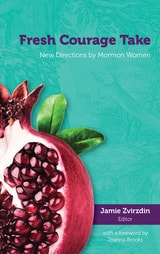
Fresh Courage Take
New Directions by Mormon WomenJamie Zvirzdin
Signature Books, 2015
The twelve essays in this anthology provide a refreshing array of female perspectives, personalities, and circumstances. Along with an introduction by Jamie Zvirzdin, the essays invite readers to recognize and own their personal struggles, gifts, faults, and desires and to accept where they stand on the spectrum of humanity. Fresh Courage Take demonstrates that the road to heaven is not a conveyor belt powered by a checklist of religious obligations, cooked casseroles, and a collection of children. If anything, it is a complex network of interchanges and decisions … including long, often solitary paths.
The authors span a wide range of views and situations in life: politically conservative to progressive, single to married with many children, highly educated to working-class, stay-at-home moms to the professionally successful, of European or African heritage, religiously orthodox to heterodox. In short, they define, from their diversity, what being a Mormon woman means and what type of path they feel they must take to be true to themselves and their beliefs.
Authors include Carli Anderson, Rachael Decker Bailey, Erika Ball, Rachel Brown, Karen Critchfield, Ashley Mae Hoiland, Sylvia Lankford, Marcee Ludlow, Brooke Stoneman, Camille Strate Fairbanks, Colleen Whitley, and Jamie Zvirzdin.
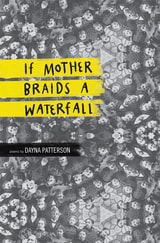
If Mother Braids a Waterfall
Dayna Patterson
Signature Books, 2020
Dayna Patterson has produced a book obsessed with motherhood and daughterhood, ancestry, and transition—of home, family, faith, and the narratives woven to uphold the Self. In her debut collection of poetry and lyric essay, Patterson grapples with a patriarchal and polygamous heritage. After learning about her mother’s bisexuality, Patterson befriends doubt while simultaneously feeling the urge to unearth a feminist theology, one that envisions God the Mother taking pride in her place at the banquet table.
In Sacred Loneliness
The DocumentsTodd Compton
Signature Books, 2022
This volume includes many autobiographical writings, diaries, and letters, with Compton providing annotations and introductory material that illuminates these crucial primary sources. This allows readers to take their understanding of this unique group of women to a new level and to drive home that fact that their lives go far beyond the Nauvoo experiment that forever links them to Mormonism’s founding prophet.
In Sacred Loneliness
The Plural Wives of Joseph SmithTodd Compton
Signature Books, 1997
The majority of Smith’s wives were younger than he, and one-third were between fourteen and twenty years of age. Another third were already married, and some of the husbands served as witnesses at their own wife’s polyandrous wedding. In addition, some of the wives hinted that they bore Smith children—most notably Sylvia Sessions’s daughter Josephine—although the children carried their stepfather’s surname.
For all of Smith’s wives, the experience of being secretly married was socially isolating, emotionally draining, and sexually frustrating. Despite the spiritual and temporal benefits, which they acknowledged, they found their faith tested to the limit of its endurance. After Smith’s death in 1844, their lives became even more “lonely and desolate.” One even joined a convent. The majority were appropriated by Smith’s successors, based on the Old Testament law of the Levirate, and had children by them, though they considered these guardianships unsatisfying. Others stayed in the Midwest and remarried, while one moved to California. But all considered their lives unhappy, except for the joy they found in their children and grandchildren.
Mormon Healer Folk Poet
Mary Susannah Fowler's Life of 'Unselfish Usefulness'Margaret Brady
Utah State University Press, 2000
Mormon Midwife
edited by Donna Toland Smart
Utah State University Press, 1999
Mormon Sisters
Women In Early UtahClaudia Bushman
Utah State University Press, 1997
Mormon Women at the Crossroads
Global Narratives and the Power of ConnectednessCaroline Kline
University of Illinois Press, 2022
Winner of the Mormon History Association Best International Book Award
The Church of Jesus Christ of Latter-day Saints continues to contend with longstanding tensions surrounding gender and race. Yet women of color in the United States and across the Global South adopt and adapt the faith to their contexts, many sharing the high level of satisfaction expressed by Latter-day Saints in general. Caroline Kline explores the ways Latter-day Saint women of color in Mexico, Botswana, and the United States navigate gender norms, but also how their moral priorities and actions challenge Western feminist assumptions. Kline analyzes these traditional religious women through non-oppressive connectedness, a worldview that blends elements of female empowerment and liberation with a broader focus on fostering positive and productive relationships in different realms. Even as members of a patriarchal institution, the women feel a sense of liberation that empowers them to work against oppression and against alienation from both God and other human beings.
Vivid and groundbreaking, Mormon Women at the Crossroads merges interviews with theory to offer a rare discussion of Latter-day Saint women from a global perspective.
No Place To Call Home
The 1807-1857 Life Writings of Caroline Barnes Crosby, Chronicler of Outlying Mormon CommunitiesEdward Leo Lyman, Susan Ward Payne, and S. George Ellsworth
Utah State University Press, 2020
Caroline Crosby's life took a wandering course between her 1834 marriage to Jonathan Crosby and conversion to the infant Mormon Church and her departure for her final home, Utah, on New Year's Day, 1858. In the intervening years, she lived in many places but never long enough to set firm roots. Her adherence to a frontier religion on the move kept her moving, even after the church began to settle down in Utah. Despite the impermanence of her situation—perhaps even because of it—Caroline Crosby left a remarkably rich record of her life and travels, thereby telling us not only much about herself and her family but also about times and places of which her documentary record provides a virtually unparalleled view. A notable aspect of her memoirs and journals is what they convey of the character of their author, who, despite the many challenges of transience and poverty she faced, appears to have remained curious, dedicated, observant, and optimistic.
From Caroline's home in Canada, she and Jonathan Crosby first went to the headquarters of Joseph Smith's new church in Kirtland, Ohio. She recounts, in a memoir, the early struggles of his followers there. As the church moved west, the Crosbys did as well, but, as became characteristic, they did not move immediately with the main body to the center of the religion. For a while they settled in Indiana, finally reaching the new Mormon center of Nauvoo in 1842. Fleeing Nauvoo with the last of the Mormons in 1846, they spent two years in Iowa and set out for Utah in 1848, the account of which is the first of Caroline Crosby's vivid trail journals. The Crosbys were able to rest in Salt Lake City for less than two years before Brigham Young sent them on a church mission to the Society and Austral Islands in the South Pacific. She recorded, in detail, their overland travel to San Francisco and then by sea to French Polynesia and their service on the islands. In late 1852 the Crosbys returned to California, beginning what is probably the most historically significant time recorded in her writings, her diaries of life. First, in immediately post-Gold-Rush San Francisco and, second, in the new Mormon village of San Bernardino in southern California. There is no comparable record by a woman of 1850s life in these growing communities. The Crosbys responded in 1857 to Brigham Young's call for church members to gather in Utah and again abandoned a new home—the nicest one they had built and one of the finest houses in San Bernardino—again displaying their unquestioning loyalty to the Mormon church.
On Gender, Labor, and Inequality
Ruth Milkman
University of Illinois Press, 2016
Milkman's introduction frames a career-spanning scholarly project: her interrogation of historical and contemporary intersections of class and gender inequalities in the workplace, and the efforts to challenge those inequalities. Early chapters focus on her pioneering work on women's labor during the Great Depression and the World War II years. In the book's second half, Milkman turns to the past fifty years, a period that saw a dramatic decline in gender inequality even as growing class imbalances created greater-than-ever class disparity among women. She concludes with a previously unpublished essay comparing the impact of the Great Depression and the Great Recession on women workers.
A first-of-its-kind collection, On Gender, Labor, and Inequality is an indispensable text by one of the world's top scholars of gender, equality, and work.
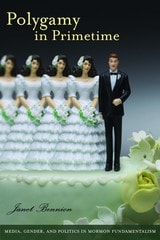
Polygamy in Primetime
Media, Gender, and Politics in Mormon FundamentalismJanet Bennion
Brandeis University Press, 2011
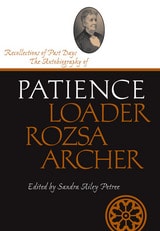
Recollections of Past Days
The Autobiography of Patience Loader Rozsa Archeredited by Sandra Ailey Petree
Utah State University Press, 2006
For visitors to the Martin's Cove historic site in Wyoming, Patience Loader has become an icon of the disastrous winter entrapment of the Martin and Willie handcart companies. Her record of those events is important, but there is much else of interest in her autobiography. In fact, it is a bit unusual that someone such as her would have left such an engaging record of her life.
The daughter of an English gardener, Patience Loader became a boarding house servant, domestic maid, and seamstress. Converted to Mormonism, she shipped with her parents to America. They joined the ill-fated Martin company, which because of poor planning and a late start west, was caught poorly prepared by severe high plains snowstorms in October and November 1856. The combined fatalities of the Martin and Willie companies made this the worst disaster in the history of overland travel. Patience = s father was one of those who died. After reaching Utah, Patience took the unusual step for a Mormon of marrying a soldier, John Rozsa, stationed at Camp Floyd. The troops there had made up the Utah Expedition, sent to ensure federal authority over the Mormons. Rozsa was a Hungarian immigrant and Mormon convert. When the Utah troops were recalled for the Civil War, Patience accompanied her husband, as an army laundress, to Washington, D.C., running a boarding house while Rozsa fought. After the war, he died at Fort Leavenworth of consumption, and Patience returned alone to Utah, where she became a cook at a mining camp in American Fork Canyon. Her autobiography ends there in 1872, though she lived till 1922.
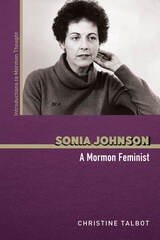
Sonia Johnson
A Mormon FeministChristine Talbot
University of Illinois Press, 2024
Few figures in the history of the Church of Jesus Christ of Latter-day Saints provoke such visceral responses as Sonia Johnson. Her unrelenting public support of the Equal Rights Amendment (ERA) made her the face of LDS feminism while her subsequent excommunication roiled the faith community.
Christine Talbot tells the story of Sonia’s historic confrontation with the Church within the context of the faith’s first large-scale engagement with the feminist movement. A typical if well-educated Latter-day Saints homemaker, Sonia was moved to action by the all-male LDS leadership’s opposition to the ERA and a belief the Church should stay out of politics. Talbot uses the activist’s experiences and criticisms to explore the ways Sonia’s ideas and situation sparked critical questions about LDS thought, culture, and belief. She also illuminates how Sonia’s excommunication shaped LDS feminism, the Church’s antagonism to feminist critiques, and the Church itself in the years to come.
A revealing and long-overdue account, Sonia Johnson explores the life, work, and impact of the LDS feminist.
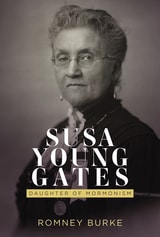
Susa Young Gates
Daughter of MormonismRomney Burke
Signature Books, 2022
After divorcing her first husband, Alma Dunford, the trauma associated with that union was such that she steadfastly refused to mention it ever again. She also lost some of her children over the course of her life and was unable to reconcile her older sister’s departure from the LDS Church and conversion to Catholicism. Yet despite her trials, Susa found fulfillment in her faith through service, as a prolific writer—co-authoring with her daughter Leah Dunford Widtsoe the 1930 biography of her father, Life Story of Brigham Young, founding the Young Women’s Journal in 1889, the Relief Society Magazine in 1915, and in her associations with such prominent women’s advocates such as Susan B. Anthony.
The Diaries of Carol Lynn Pearson—Mormon Author, Feminist, and Activist
Volume 1: 1956–1990Pearson, Carol Lynn
Signature Books, 2025
“I feel somehow that of all the writing I am doing, my diary is the most important.” So wrote the beloved and bestselling author, poet, and playwright Carol Lynn Pearson in her 1979 diary. Several years before, she recorded, “I feel the imperative of history. . . . Add that to my being a household word to many and I cannot escape the feeling that in many years there might be a number of people interested in these pages.” That time has now come.
Unbeknownst to almost everyone but herself, Pearson kept a near-daily diary since she was a teenager, recording her remarkable story in the context of twentieth- and twenty-first-century Mormon America. In this first of a four-volume series, Pearson chronicles her love for her church but also her troubling experiences and concerns with its patriarchy, historic doctrine of polygamy, omission of a feminine divine, and homophobia. Readers will rejoice with her as her first book of poetry, Beginnings, sells an astonishing 150,000+ copies and puts her on the map in the 1960s, empathize with her as she watches her church help kill the Equal Rights Amendment in the 1970s, and mourn with her as her mixed-orientation marriage ends and she cares for her former husband in her home as he dies of AIDS in the 1980s. The sensitive-girl-turned-strong-woman who emerges in these diaries insists that we move from patriarchy into partnership, change our destructive policies towards Queer people, and invite God the Mother back into our heavenly family.
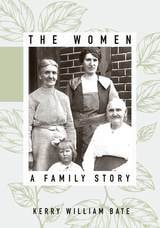
The Women
A Family StoryKerry William Bate
University of Utah Press, 2016
Kerry Bate proceeds on the premise that a story centering on the women of the clan could provide fresh perspective and insight. He portrays real people with well-rounded, flawed characters; builds from deep research; writes with a bit of style; and includes the rich context and detail of these lives. His main subjects are four generations of impressive women: the pioneer Catherine Campbell Steele; her daughter Young Elizabeth, the first Mormon child born in Utah; Kate, an accomplished community leader; and Sarah, a gifted seamstress trapped in an unhappy marriage. To enter their hardscrabble lives in small southern Utah communities is to meet women who pioneered in their own modest but determined ways.
Winner of the Mormon History Association's Best Personal History/Memoir Award.
Interview with Tom Williams on Access Utah
Winter Quarters
Maurine Ward
Utah State University Press, 2002
Volume 1, Life Writings of Frontier Women series, edited by Maureen Ursenbach Beecher
Mary Richard's journals and letters record a young woman's rare, but richly detailed view of life in the temporary Mormon pioneer communities in Iowa.
Women and Mormonism
Historical and Contemporary PerspectivesEdited by Kate Holbrook and Matthew Bowman
University of Utah Press, 2016
This engaging and seminal volume employs a variety of sources—vivid primary documents, candid surveys, and illuminating oral histories—to explore the perspectives of Latter-day Saint (LDS) women. The expansive approach of this essay collection highlights an assortment of individuals, viewpoints, and challenges that ultimately invigorate our understanding of women and religion. Contributors include lay members and prominent scholars in multiple disciplines, including both LDS and non-LDS viewpoints.
Worth Their Salt
Colleen Whitley
Utah State University Press, 1996
Worth Their Salt Too
More Notable But Often Unnoted Women of UtahColleen Whitley
Utah State University Press, 2000