Results by title
3 books match the query 'Laudatory poetry, Latin'
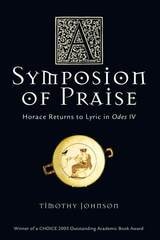
A Symposion of Praise
Horace Returns to Lyric in Odes IVTimothy Johnson
University of Wisconsin Press, 2007
Ten years after publishing his first collection of lyric poetry, Odes I-III, Horace (65 B.C.-8 B.C.) returned to lyric and published another book of fifteen odes, Odes IV. These later lyrics, which praise Augustus, the imperial family, and other political insiders, have often been treated more as propaganda than art. But in A Symposion of Praise, Timothy Johnson examines the richly textured ambiguities of Odes IV that engage the audience in the communal or "sympotic" formulation of Horace's praise. Surpassing propaganda, Odes IV reflects the finely nuanced and imaginative poetry of Callimachus rather than the traditions of Aristotelian and Ciceronian rhetoric, which advise that praise should present commonly admitted virtues and vices. In this way, Johnson demonstrates that Horace's application of competing perspectives establishes him as Pindar's rival.
Johnson shows the Horatian panegyrist is more than a dependent poet representing only the desires of his patrons. The poet forges the panegyric agenda, setting out the character of the praise (its mode, lyric, and content both positive and negative), and calls together a community to join in the creation and adaptation of Roman identities and civic ideologies. With this insightful reading, A Symposion of Praise will be of interest to historians of the Augustan period and its literature, and to scholars interested in the dynamics between personal expression and political power.
Johnson shows the Horatian panegyrist is more than a dependent poet representing only the desires of his patrons. The poet forges the panegyric agenda, setting out the character of the praise (its mode, lyric, and content both positive and negative), and calls together a community to join in the creation and adaptation of Roman identities and civic ideologies. With this insightful reading, A Symposion of Praise will be of interest to historians of the Augustan period and its literature, and to scholars interested in the dynamics between personal expression and political power.
[more]
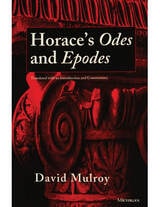
Horace's Odes and Epodes
Translated with an Introduction and CommentaryDavid Mulroy
University of Michigan Press, 1994
In his new book David Mulroy presents a translation of the Odes and Epodes of Horace, who was one of the Augustan regime’s best known and most talented poets. Intended for those with little knowledge of these works as well as for those with a more experienced ear, David Mulroy’s translations are accompanied by explanatory notes on the individual poems. Appendices are also provided that offer information on Suetonius’ biography of Horace, on ambiguity in Horace’s personal allusions, and on the theme of sadism in Horace’s writings.Teachers of Latin writers in translation will want to use this book to make Horace accessible to their students; scholars of Latin literature will find much of value in the notes and appendices as well as in the linguistically satisfying translations.
[more]
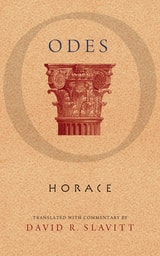
Odes
Horace, Translated with commentary by David R. Slavitt
University of Wisconsin Press, 2014
The Odes of Horace are a treasure of Western civilization, and this new English translation is a lively rendition by one of the prominent poet-translators of our own time, David R. Slavitt. Horace was one of the great poets of Rome’s Augustan age, benefiting (as did fellow poet Vergil) from the friendship of the powerful statesman and cultural patron Maecenas. These Odes, which take as their formal models Greek poems of the seventh century BCE—especially the work of Sappho and Alcaeus—are the observations of a wry, subtle mind on events and occasions of everyday life. At first reading, they are modest works but build toward a comprehensive attitude that might fairly be called a philosophy. Charming, shrewd, and intimate, the voice of the Odes is that of a sociable wise man talking amusingly but candidly to admiring friends.
This edition is also notable for Slavitt’s extensive notes and commentary about the art of translation. He presents the problems he encountered in making the translation, discussing possible solutions and the choices he made among them. The effect of the notes is to bring the reader even closer to the original Latin and to understand better how to gauge the distance between the two languages.
This edition is also notable for Slavitt’s extensive notes and commentary about the art of translation. He presents the problems he encountered in making the translation, discussing possible solutions and the choices he made among them. The effect of the notes is to bring the reader even closer to the original Latin and to understand better how to gauge the distance between the two languages.
[more]