Results by title
3 books match the query 'Law, John'

Aircraft Stories
Decentering the Object in TechnoscienceJohn Law
Duke University Press, 2002
In Aircraft Stories noted sociologist of technoscience John Law tells “stories” about a British attempt to build a military aircraft—the TSR2. The intertwining of these stories demonstrates the ways in which particular technological projects can be understood in a world of complex contexts.
Law works to upset the binary between the modernist concept of knowledge, subjects, and objects as having centered and concrete essences and the postmodernist notion that all is fragmented and centerless. The structure and content of Aircraft Stories reflect Law’s contention that knowledge, subjects, and—particularly— objects are “fractionally coherent”: that is, they are drawn together without necessarily being centered. In studying the process of this particular aircraft’s design, construction, and eventual cancellation, Law develops a range of metaphors to describe both its fractional character and the ways its various aspects interact with each other. Offering numerous insights into the way we theorize the working of systems, he explores the overlaps between singularity and multiplicity and reveals rich new meaning in such concepts as oscillation, interference, fractionality, and rhizomatic networks.
The methodology and insights of Aircraft Stories will be invaluable to students in science and technology studies and will engage others who are interested in the ways that contemporary paradigms have limited our ability to see objects in their true complexity.
[more]

Complexities
Social Studies of Knowledge PracticesJohn Law and Annemarie Mol, eds.
Duke University Press, 2002
Although much recent social science and humanities work has been a revolt against simplification, this volume explores the contrast between simplicity and complexity to reveal that this dichotomy, itself, is too simplistic. John Law and Annemarie Mol have gathered a distinguished panel of contributors to offer—particularly within the field of science studies—approaches to a theory of complexity, and at the same time a theoretical introduction to the topic. Indeed, they examine not only ways of relating to complexity but complexity in practice.
Individual essays study complexity from a variety of perspectives, addressing market behavior, medical interventions, aeronautical design, the governing of supranational states, ecology, roadbuilding, meteorology, the science of complexity itself, and the psychology of childhood trauma. Other topics include complex wholes (holism) in the sciences, moral complexity in seemingly amoral endeavors, and issues relating to the protection of African elephants. With a focus on such concepts as multiplicity, partial connections, and ebbs and flows, the collection includes narratives from Kenya, Great Britain, Papua New Guinea, the Netherlands, France, and the meetings of the European Commission, written by anthropologists, economists, philosophers, psychologists, sociologists, and scholars of science, technology, and society.
Contributors. Andrew Barry, Steven D. Brown, Michel Callon, Chunglin Kwa, John Law, Nick Lee, Annemarie Mol, Marilyn Strathern, Laurent Thévenot, Charis Thompson
[more]
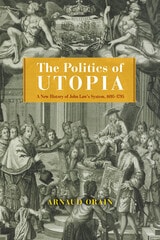
The Politics of Utopia
A New History of John Law's System, 1695–1795Arnaud Orain
University of Chicago Press, 2024
A fascinating retelling of the first banking and financial collapse in eighteenth-century France.
The Scottish economist John Law has been described as the architect of modern central banking. His “System,” established in Regency France between 1716 and 1720, saw the founding of a bank issuing paper money and the establishment of state commercial and colonial enterprises aimed at consolidating public debt. What at first seemed like financial wizardry, however, resulted in rampant speculation and, ultimately, economic collapse. In The Politics of Utopia, historian Arnaud Orain offers a provocative rereading of this well-known episode.
Starting his story in the seventeenth century, Orain reconstructs the figures and ideas, long predating Law, that anticipated and laid the groundwork for the System, which, he argues, is best understood as a failed social utopia aimed at the total transformation of society. Overturning familiar narratives of this seismic event, this book rewrites a stunning chapter in economic history by dealing with the cultural, colonial, religious, and political dimensions of the (in)famous System up to the French Revolution, revealing new lessons for today’s fraught financial landscape.
[more]