Results by title

14 books match the query 'Law, Medieval'

cover of Canonical Collections of the Early Middle Ages (ca. 400-1400)

Canonical Collections of the Early Middle Ages (ca. 400-1400)

Lotte Kery

Catholic University of America Press, 1999
[more]
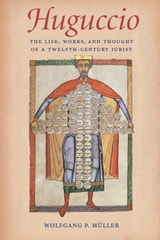
cover of Huguccio: The Life, Works, and Thought of a Twelfth-Century Jurist

Huguccio

The Life, Works, and Thought of a Twelfth-Century Jurist

Wolfgang Muller

Catholic University of America Press, 1994

Huguccio was an important lawyer of the medieval church, bishop of Ferrara, and one of the greatest representatives of twelfth-century scholasticism. In this book-length study of this influential figure, Wolfgang P. Müller provides a critical account of the biographical information on the man and his writings. He discusses the various aspects of Huguccio's career and thought as well as the manuscript tradition of some of his works. The author's scholarship rests on direct consultation and painstaking analysis of enormous quantities of manuscript material.

This book provides the point of departure for anyone wishing to study Huguccio first-hand. It will be worthy reading for students of medieval canon law and an essential addition to all libraries supporting research in medieval studies.
[more]
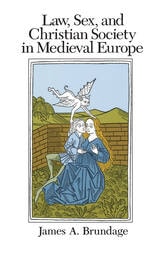
cover of Law, Sex, and Christian Society in Medieval Europe

Law, Sex, and Christian Society in Medieval Europe

James A. Brundage

University of Chicago Press, 1990

This monumental study of medieval law and sexual conduct explores the origin and develpment of the Christian church's sex law and the systems of belief upon which that law rested. Focusing on the Church's own legal system of canon law, James A. Brundage offers a comprehensive history of legal doctrines–covering the millennium from A.D. 500 to 1500–concerning a wide variety of sexual behavior, including marital sex, adultery, homosexuality, concubinage, prostitution, masturbation, and incest. His survey makes strikingly clear how the system of sexual control in a world we have half-forgotten has shaped the world in which we live today. The regulation of marriage and divorce as we know it today, together with the outlawing of bigamy and polygamy and the imposition of criminal sanctions on such activities as sodomy, fellatio, cunnilingus, and bestiality, are all based in large measure upon ideas and beliefs about sexual morality that became law in Christian Europe in the Middle Ages.

"Brundage's book is consistently learned, enormously useful, and frequently entertaining. It is the best we have on the relationships between theological norms, legal principles, and sexual practice."—Peter Iver Kaufman, Church History
[more]
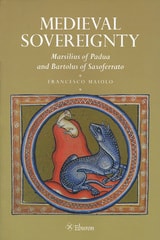
cover of Medieval Sovereignty: Marsilius of Padua and Bartolous of Saxoferrato

Medieval Sovereignty

Marsilius of Padua and Bartolous of Saxoferrato

Francesco Maiolo

Eburon Academic Publishers, 2007
Medieval Sovereignty examines the idea of sovereignty in the Middle Ages and asks if it can be considered a fundamental element of medieval constitutional order. Francesco Maiolo analyzes the writings of Marsilius of Padua (1275/80–1342/43) and Bartolous of Saxoferrato (1314–57) and assesses their relative contributions as early proponents of popular sovereignty. Both are credited with having provided the legal justification for medieval popular government. Maiolo’s cogent reconsideration of this primacy is an important addition to current medieval studies.
[more]
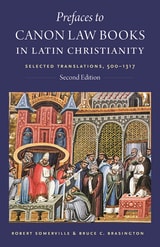
cover of Prefaces to Canon Law Books in Latin Christianity: Selected Translations, 500-1317, second edition

Prefaces to Canon Law Books in Latin Christianity

Selected Translations, 500-1317, second edition

Robert Somerville

Catholic University of America Press, 2021
An updated and expanded version of the original edition, published in 1998. That original edition went up through 1245. This new version extends to 1317 and adds two important prefaces. Praise for the First Edition “Both students and specialists can be grateful to the authors for this major contribution in English to the study of medieval canon law. It is a clear statement--one emphasized by the late John Gilchrist-that because of its critical importance in medieval life and culture canon law should not remain the obscure domain of specialists, but should be shared with students and non-specialists alike.” – The American Journal of Legal History “[A] learned and useful book, which for the first time assembles a body of canonistic prefaces, presents them in an accessible form, and provides students of medieval canonical thought with a valuable new resource for study and teaching.” – The Catholic Historical Review “This volume is an important and welcome addition to a field of studies where translations into English are few and far between. The breadth of the works selected, the quality of the translations, and the attention to detail that has long characterized the work of both editors make this a valuable resource for specialist and student alike.” – Church History “A welcome combination: a text that is informative for students and professionals alike. The translations succeed in rendering accessible to a general audience some otherwise highly inaccessible material. Somerville and Brasington are to be greatly commended for undertaking this very original enterprise and bringing it to successful parturition.” – Journal of Law and Religion “Somerville and Brasington have chosen to let their compilers and commentators speak for themselves. In doing so, they have had to wrestle with often obscure Latin and frequently less than satisfactory editions. That they succeed in making these texts intelligible through translation and annotation is no small feat.” – Sixteenth Century Journal “This is a significant, elegantly presented contribution to the field of theology, cultural history, and canon law.” – Theological Studies
[more]
cover of The Common Legal Past of Europe, 1000–1800

The Common Legal Past of Europe, 1000–1800

Manlio Bellomo

Catholic University of America Press, 1995
With a vigor and passion rarely found in a scholarly text, Manlio Bellomo has written a broad history of the western European legal tradition. It is now made available to an English-speaking audience in an elegant and lucid translation from the original Italian.
[more]
cover of The Hibernensis: Book 1: A Study and Edition

The Hibernensis

Book 1: A Study and Edition

Roy Flechner

Catholic University of America Press, 2019

The Hibernensis is the longest and most comprehensive canon-law text to have circulated in Carolingian Europe. Compiled in Ireland in the late seventh or early eighth century, it exerted a strong and long-lasting influence on the development of European canon law. The present edition offers—for the first time—a complete text of the Hibernensis combining the two main branches of its manuscript transmission. This is accompanied by an English translation and a commentary that is both historical and philological. The Hibernensis is an invaluable source for those interested in church history, the history of canon law, social-economic history, as well as intellectual history, and the history of the book.

Widely recognized as the single most important source for the history of the church in early medieval Ireland, the Hibernensis is also our best index for knowing what books were available in Ireland at the time of its compilation: it consists of excerpted material from the Bible, Church Fathers and doctors, hagiography, church histories, chronicles, wisdom texts, and insular normative material unattested elsewhere. This in addition to the staple sources of canonical collections, comprising the acta of church councils and papal letters. Altogether there are forty-two cited authors and 135 cited texts. But unlike previous canonical collections, the contents of the Hibernensis are not simply derivative: they have been modified and systematically organised, offering an important insight into the manner in which contemporary clerical scholars attempted to define, interpret, and codify law for the use of a growing Christian society.
[more]
cover of The Hibernensis: Book 2: Translation, Commentary, and Indexes

The Hibernensis

Book 2: Translation, Commentary, and Indexes

Roy Flechner

Catholic University of America Press, 2019

The Hibernensis is the longest and most comprehensive canon-law text to have circulated in Carolingian Europe. Compiled in Ireland in the late seventh or early eighth century, it exerted a strong and long-lasting influence on the development of European canon law. The present edition offers—for the first time—a complete text of the Hibernensis combining the two main branches of its manuscript transmission. This is accompanied by an English translation and a commentary that is both historical and philological. The Hibernensis is an invaluable source for those interested in church history, the history of canon law, social-economic history, as well as intellectual history, and the history of the book.

Widely recognized as the single most important source for the history of the church in early medieval Ireland, the Hibernensis is also our best index for knowing what books were available in Ireland at the time of its compilation: it consists of excerpted material from the Bible, Church Fathers and doctors, hagiography, church histories, chronicles, wisdom texts, and insular normative material unattested elsewhere. This in addition to the staple sources of canonical collections, comprising the acta of church councils and papal letters. Altogether there are forty-two cited authors and 135 cited texts. But unlike previous canonical collections, the contents of the Hibernensis are not simply derivative: they have been modified and systematically organised, offering an important insight into the manner in which contemporary clerical scholars attempted to define, interpret, and codify law for the use of a growing Christian society.
[more]
cover of The Law of the Other: The Mixed Jury and Changing Conceptions of Citizenship, Law, and Knowledge

The Law of the Other

The Mixed Jury and Changing Conceptions of Citizenship, Law, and Knowledge

Marianne Constable

University of Chicago Press, 1994

The Law of the Other is an account of the English doctrine of the "mixed jury". Constable's excavation of the historical, rhetorical, and theoretical foundations of modern law recasts our legal and sociological understandings of the American jury and our contemporary conceptions of law, citizenship, and truth.

The "mixed jury" doctrine allowed resident foreigners to have law suits against English natives tried before juries composed half of natives and half of aliens like themselves. As she traces the transformations in this doctrine from the Middle Ages to its abolition in 1870, Constable also reveals the emergence of a world where law rooted in actual practices and customs of communities is replaced by law determined by officials, where juries no longer strive to speak the truth but to ascertain the facts.
[more]
cover of The Marriage Exchange: Property, Social Place, and Gender in Cities of the Low Countries, 1300-1550

The Marriage Exchange

Property, Social Place, and Gender in Cities of the Low Countries, 1300-1550

Martha C. Howell

University of Chicago Press, 1998

Medieval Douai was one of the wealthiest cloth towns of Flanders, and it left an enormous archive documenting the personal financial affairs of its citizens—wills, marriage agreements, business contracts, and records of court disputes over property rights of all kinds.

Based on extensive research in this archive, this book reveals how these documents were produced in a centuries-long effort to regulate—and ultimately to redefine—property and gender relations. At the center of the transformation was a shift from a marital property regime based on custom to one based on contract. In the former, a widow typically inherited her husband's property; in the latter, she shared it with or simply held it for his family or offspring. Howell asks why the law changed as it did and assesses the law's effects on both social and gender meanings but she insists that the reform did not originate in general dissatisfaction with custom or a desire to disempower widows. Instead, it was born in a complex economic, social and cultural history during which Douaisiens gradually came to think about both property and gender in new ways.
[more]
cover of The Medieval Origins of the Legal Profession: Canonists, Civilians, and Courts

The Medieval Origins of the Legal Profession

Canonists, Civilians, and Courts

James A. Brundage

University of Chicago Press, 2008

In the aftermath of sixth-century barbarian invasions, the legal profession that had grown and flourished during the Roman Empire vanished. Nonetheless, professional lawyers suddenly reappeared in Western Europe seven hundred years later during the 1230s when church councils and public authorities began to impose a body of ethical obligations on those who practiced law. James Brundage’s The Medieval Origins of the Legal Profession traces the history of legal practice from its genesis in ancient Rome to its rebirth in the early Middle Ages and eventual resurgence in the courts of the medieval church.
                        By the end of the eleventh century, Brundage argues, renewed interest in Roman law combined with the rise of canon law of the Western church to trigger a series of consolidations in the profession. New legal procedures emerged, and formal training for proctors and advocates became necessary in order to practice law in the reorganized church courts. Brundage demonstrates that many features that characterize legal advocacy today were already in place by 1250, as lawyers trained in Roman and canon law became professionals in every sense of the term. A sweeping examination of the centuries-long power struggle between local courts and the Christian church, secular rule and religious edict, The Medieval Origins of the Legal Profession will be a resource for the professional and the student alike.

[more]
cover of The Politics of Ecology: Land, Life, and Law in Medieval Britain

The Politics of Ecology

Land, Life, and Law in Medieval Britain

Edited by Randy P. Schiff and Joseph Taylor

The Ohio State University Press, 2016

If medieval literary studies is, like so many fields, currently conditioned by an ecological turn that dislodges the human from its central place in materialist analysis, then why now focus on the law? Is not the law the most human, if not indeed the human, institution? In proposing that all life in medieval Britain, whether animal or vegetable, was subject to the same legal machine that enabled claims on land, are we not ignoring the ecocritical demand that we counteract human exceptionalism and reframe the past with inhuman eyes?
 
This volume, edited by Randy P. Schiff and Joseph Taylor, presents a diverse and stimulating group of interconnected essays that respond to these questions by infusing biopolitical material and theory into ecocentric studies of medieval life. The Politics of Ecology: Land, Life, and Law in Medieval Britain pursues the political power of sovereign law as it disciplines and manages various forms of natural life, and discloses the literary biopolitics played out in texts that work out the fraught interactions of life and law, in all its forms. Contributors to this volume explore such issues as legal networks and death, Arthurian bare life, Chaucerian medical biopolitics, the biopolitics of fur, ecologies of sainthood, arboreal political theology, conservation and political ecology, and geographical melancholy.
 
Bringing together both established and rising critical voices, The Politics of Ecology creates a place for cutting-edge medievalist ecocriticism focused on the intersections of land, life, and law in medieval English, French, and Latin literature.
 
[more]
cover of Thomas Aquinas and Medieval Canon Law

Thomas Aquinas and Medieval Canon Law

Justin M. Anderson

Catholic University of America Press, 2025
Thomas Aquinas and Medieval Canon Law bridges, for the first time, two worlds of scholarship that have never been explored in book-length form and investigates an under-researched area in Thomistic studies, namely the question of how Thomas Aquinas engaged the ecclesiastical law and jurisprudence of his day. Neither historians of medieval canon law nor experts on Thomas's thought have previously paid much attention to the canon law tradition as a source for Thomas's work and an influence on his thought. But, as this volume shows, his consideration of mendicant life, law, justice, oaths, penance, clerical orders, the Eucharist, baptism, property, commerce, marriage and more reveal engagement with key canon law texts and concepts and with the jurisprudence of major canonists. The book uncovers how Aquinas encountered canonical regulations and jurisprudence as a Dominican, an educator in both theology and pastoral care, and a participant in the secular-mendicant controversy. In his life, education, community, and his way of thought, Thomas Aquinas could not avoid and necessarily encountered and dealt with the canonical tradition. He did so in a distinctive way, working as he did with his theological and philosophical source material to craft his own great synthesis. What this volume shows, if nothing else, is that the canon law tradition should be taken into consideration when assessing Thomas's synthetic thought. Following the editors' introduction, thirteen scholarly contributions and an epilogue explore Aquinas's interaction with medieval canon law through four major themes: Dominican Matters; Foundations Matters of Faith, Truth, and Law; Moral Matters; and Sacramental Matters. Approximately half the contributors are specialists from the field of medieval canon law, and half are grounded in Thomistic tradition. The result is a unique and scholarly contribution to two major research areas that may open avenues for similar studies of other key figures in the scholastic tradition.
[more]
cover of Traditions of Natural Law in Medieval Philosophy

Traditions of Natural Law in Medieval Philosophy

Dominic Farrell

Catholic University of America Press, 2022

Reflection on natural law reaches a highpoint during the Middle Ages. Not only do Christian thinkers work out the first systematic accounts of natural law and articulate the framework for subsequent reflection, the Jewish and Islamic traditions also develop their own canonical statements on the moral authority of reason vis-à-vis divine law. In the view of some, they thereby articulate their own theories of natural law.

These various traditions of medieval reflection on natural law, and their interrelation, merit further study, particularly since they touch upon many current philosophical concerns. They grapple with the problem of ethical and religious pluralism. They consider whether universally valid standards of action and social life are accessible to those who rely on reason rather than divine law. In so doing, they develop sophisticated accounts of many central issues in metaethics, action theory, jurisprudence, and the philosophy of religion. However, do they reach a consensus about natural law, or do they end up defending incommensurable ethical frameworks? Do they confirm the value of arguments based on natural law or do they cast doubt on it?

This collection brings together contributions from various expert scholars to explore these issues and the pluralism that exists within medieval reflection on natural law. It is the first one to study the relation between the natural law theories of these various traditions of medieval philosophy: Jewish, Islamic, Byzantine, and Latin.

Each of the first four essays surveys the ‘natural law theory’ of one of the religious traditions of medieval philosophy—Jewish, Islamic, Byzantine, and Latin—and its relation to the others. The next four essays explore some of the alternative accounts of natural law that arise within the Latin tradition. They range over St. Bonaventure, Peter of Tarentaise, Matthew of Aquasparta, John Duns Scotus, and Marsilius of Padua.
[more]