Results by title
3 books match the query 'Law and anthropology'
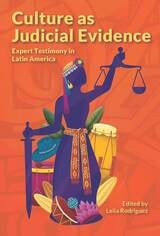
Culture as Judicial Evidence
Expert Testimony in Latin AmericaEdited by Leila Rodriguez
University of Minnesota Press, 2020
In Latin America, as early as 1975 testimony given under oath by anthropologists has been applied in the civil law systems in a number of Latin American countries. Called peritajes antropológicos culturales, this testimony can come in the form of written affidavits and/or oral testimony. These experts build bridges of intercultural dialogue, which overcome language and cultural barriers that have historically limited equal access to justice for indigenous and ethnic people all over the word.
Culture as Judicial Evidence in Latin America summarizes the current state of this work in six countries: Mexico, Costa Rica, Peru, Chile, Colombia, and Uruguay, and lays out the challenges and dilemmas involved in the creation and use of cultural expert testimony. Organized into three sections, the book advances a framework for the use of cultural evidence, and presents readers with nine case studies based on trials in six individual countries. These countries have implemented legal reform, constitutional amendments and the adoption of international legislation to create the legal frameworks that enable this new form of legal evidence to be admissible in Latin American courts. The contributing authors are cultural anthropologists with vast experience researching the impact of cultural expert witness testimony. A forward-looking final section examines the dilemmas and challenges of this work that remain to be solved.
Culture as Judicial Evidence in Latin America summarizes the current state of this work in six countries: Mexico, Costa Rica, Peru, Chile, Colombia, and Uruguay, and lays out the challenges and dilemmas involved in the creation and use of cultural expert testimony. Organized into three sections, the book advances a framework for the use of cultural evidence, and presents readers with nine case studies based on trials in six individual countries. These countries have implemented legal reform, constitutional amendments and the adoption of international legislation to create the legal frameworks that enable this new form of legal evidence to be admissible in Latin American courts. The contributing authors are cultural anthropologists with vast experience researching the impact of cultural expert witness testimony. A forward-looking final section examines the dilemmas and challenges of this work that remain to be solved.
[more]

Globalisation
Studies in AnthropologyEdited by Thomas Hylland Eriksen
Pluto Press, 2003
[more]
Rules and Processes
John L. Comaroff and Simon Roberts
University of Chicago Press, 1986
Rules and Processes is at once a compelling essay in social theory and a pathbreaking ethnography of dispute in an African society. On the basis of a sensitive study of the Tswana of southern Africa, John Comaroff and Simon Roberts challenge most of the orthodoxies of legal anthropology. They argue that the social world, and the dispute processes that occur within it, are given form and meaning by a dialectical relationship between sociocultural structures and individual experience. The authors explore in a novel way the relations between culture and ideology, system and practice, social action and human intention. They develop a model that lays bare the form and content of "legal" and "political" discourse in all its variations—a model that accounts for the outcome of conflict processes and explains why the Tswana, like people in other cultures, conceive of their world in an apparently contradictory manner—as rule-governed yet inherently open to pragmatic individualism; orderly yet inherently fluid and shifting. Rules and Processes offers a fresh and persuasive approach to our understanding of the dialectics of social life.
"A work of impressive scholarship in which theoretical sophistication and ethnographic richness are convincingly matched."—Ian Hamnett, Times Higher Education Supplement.
"A work of impressive scholarship in which theoretical sophistication and ethnographic richness are convincingly matched."—Ian Hamnett, Times Higher Education Supplement.
[more]