Results by title
6 books match the query 'Law and ethics'
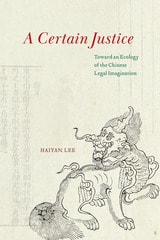
A Certain Justice
Toward an Ecology of the Chinese Legal ImaginationHaiyan Lee
University of Chicago Press, 2023
To many outsiders, China has an image as a realm of Oriental despotism where law is at best window dressing and at worst an instrument of coercion and tyranny. In this highly original contribution to the interdisciplinary field of law and humanities, Haiyan Lee contends that this image arises from a skewed understanding of China’s political-legal culture, particularly the failure to distinguish what she calls high justice and low justice.
In the Chinese legal imagination, Lee shows, justice is a vertical concept, with low justice between individuals firmly subordinated to the high justice of the state. China’s political-legal culture is marked by a mistrust of law’s powers, and as a result, it privileges substantive over procedural justice. Calling on a wide array of narratives—stories of crime and punishment, subterfuge and exposé, guilt and redemption—A Certain Justice helps us recognize the fight for justice outside the familiar arenas of liberal democracy and the rule of law.
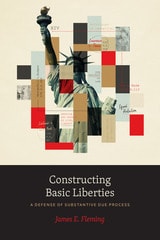
Constructing Basic Liberties
A Defense of Substantive Due ProcessJames E. Fleming
University of Chicago Press, 2022
From reproductive rights to marriage for same-sex couples, many of our basic liberties owe their protection to landmark Supreme Court decisions that have hinged on the doctrine of substantive due process. This doctrine is controversial—a battleground for opposing views around the relationship between law and morality in circumstances of moral pluralism—and is deeply vulnerable today.
Against recurring charges that the practice of substantive due process is dangerously indeterminate and irredeemably undemocratic, Constructing Basic Liberties reveals the underlying coherence and structure of substantive due process and defends it as integral to our constitutional democracy. Reviewing the development of the doctrine over the last half-century, James E. Fleming rebuts popular arguments against substantive due process and shows that the Supreme Court has constructed basic liberties through common law constitutional interpretation: reasoning by analogy from one case to the next and making complex normative judgments about what basic liberties are significant for personal self-government.
Elaborating key distinctions and tools for interpretation, Fleming makes a powerful case that substantive due process is a worthy practice that is based on the best understanding of our constitutional commitments to protecting ordered liberty and securing the status and benefits of equal citizenship for all.

The American Moralist
On Law, Ethics, And GovernmentGeorge Anastaplo
Ohio University Press, 1994
The Rule of Rules
Morality, Rules, and the Dilemmas of LawLarry Alexander and Emily Sherwin
Duke University Press, 2001
Once the importance of this moral and practical conflict is acknowledged, the authors argue, authoritative rules become the central problems of jurisprudence. The inevitable gap between rules and background morality cannot be bridged, they claim, although many contemporary jurisprudential schools of thought are misguided attempts to do so. Alexander and Sherwin work through this dilemma, which lies at the heart of such ongoing jurisprudential controversies as how judges should reason in deciding cases, what effect should be given to legal precedent, and what status, if any, should be accorded to “legal principles.” In the end, their rigorous discussion sheds light on such topics as the nature of interpretation, the ancient dispute among legal theorists over natural law versus positivism, the obligation to obey law, constitutionalism, and the relation between law and coercion.
Those interested in jurisprudence, legal theory, and political philosophy will benefit from the edifying discussion in The Rule of Rules.
Trialectic
The Confluence of Law, Neuroscience, and MoralityPeter A. Alces
University of Chicago Press, 2023
A thought-provoking examination of how insights from neuroscience challenge deeply held assumptions about morality and law.
As emerging neuroscientific insights change our understanding of what it means to be human, the law must grapple with monumental questions, both metaphysical and practical. Recent advances pose significant philosophical challenges: how do neuroscientific revelations redefine our conception of morality, and how should the law adjust accordingly?
Trialectic takes account of those advances, arguing that they will challenge normative theory most profoundly. If all sentient beings are the coincidence of mechanical forces, as science suggests, then it follows that the time has come to reevaluate laws grounded in theories dependent on the immaterial that distinguish the mental and emotional from the physical. Legal expert Peter A. Alces contends that such theories are misguided—so misguided that they undermine law and, ultimately, human thriving.
Building on the foundation outlined in his previous work, The Moral Conflict of Law and Neuroscience, Alces further investigates the implications for legal doctrine and practice.
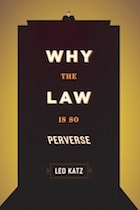
Why the Law Is So Perverse
Leo Katz
University of Chicago Press, 2011
Conundrums, puzzles, and perversities: these are Leo Katz’s stock-in-trade, and in Why the Law Is So Perverse, he focuses on four fundamental features of our legal system, all of which seem to not make sense on some level and to demand explanation. First, legal decisions are essentially made in an either/or fashion—guilty or not guilty, liable or not liable, either it’s a contract or it’s not—but reality is rarely as clear-cut. Why aren’t there any in-between verdicts? Second, the law is full of loopholes. No one seems to like them, but somehow they cannot be made to disappear. Why? Third, legal systems are loath to punish certain kinds of highly immoral conduct while prosecuting other far less pernicious behaviors. What makes a villainy a felony? Finally, why does the law often prohibit what are sometimes called win-win transactions, such as organ sales or surrogacy contracts?
Katz asserts that these perversions arise out of a cluster of logical difficulties related to multicriterial decision making. The discovery of these difficulties dates back to Condorcet’s eighteenth-century exploration of voting rules, which marked the beginning of what we know today as social choice theory. Condorcet’s voting cycles, Arrow’s Theorem, Sen’s Libertarian Paradox—every seeming perversity of the law turns out to be the counterpart of one of the many voting paradoxes that lie at the heart of social choice. Katz’s lucid explanations and apt examples show why they resist any easy resolutions.
The New York Times Book Review called Katz’s first book “a fascinating romp through the philosophical side of the law.” Why the Law Is So Perverse is sure to provide its readers a similar experience.