Results by title

5 books match the query 'Law of the sea'
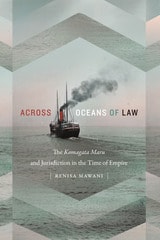
cover of Across Oceans of Law: The Komagata Maru and Jurisdiction in the Time of Empire

Across Oceans of Law

The Komagata Maru and Jurisdiction in the Time of Empire

Renisa Mawani

Duke University Press, 2018
In 1914 the British-built and Japanese-owned steamship Komagata Maru left Hong Kong for Vancouver carrying 376 Punjabi migrants. Chartered by railway contractor and purported rubber planter Gurdit Singh, the ship and its passengers were denied entry into Canada and two months later were deported to Calcutta. In Across Oceans of Law Renisa Mawani retells this well-known story of the Komagata Maru. Drawing on "oceans as method"—a mode of thinking and writing that repositions land and sea—Mawani examines the historical and conceptual stakes of situating histories of Indian migration within maritime worlds. Through close readings of the ship, the manifest, the trial, and the anticolonial writings of Singh and others, Mawani argues that the Komagata Maru's landing raised urgent questions regarding the jurisdictional tensions between the common law and admiralty law, and, ultimately, the legal status of the sea. By following the movements of a single ship and bringing oceans into sharper view, Mawani traces British imperial power through racial, temporal, and legal contests and offers a novel method of writing colonial legal history.
[more]
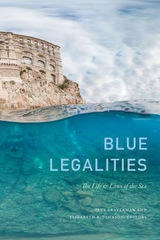
cover of Blue Legalities: The Life and Laws of the Sea

Blue Legalities

The Life and Laws of the Sea

Irus Braverman and Elizabeth R. Johnson, editors

Duke University Press, 2019

The ocean and its inhabitants sketch and stretch our understandings of law in unexpected ways. Inspired by the blue turn in the social sciences and humanities, Blue Legalities explores how regulatory frameworks and governmental infrastructures are made, reworked, and contested in the oceans. Its interdisciplinary contributors analyze topics that range from militarization and Maori cosmologies to island building in the South China Sea and underwater robotics. Throughout, Blue Legalities illuminates the vast and unusual challenges associated with regulating the turbulent materialities and lives of the sea. Offering much more than an analysis of legal frameworks, the chapters in this volume show how the more-than-human ocean is central to the construction of terrestrial institutions and modes of governance. By thinking with the more-than-human ocean, Blue Legalities questions what we think we know—and what we don’t know—about oceans, our earthly planet, and ourselves.  

Contributors. Stacy Alaimo, Amy Braun, Irus Braverman, Holly Jean Buck, Jennifer L. Gaynor, Stefan Helmreich, Elizabeth R. Johnson, Stephanie Jones, Zsofia Korosy, Berit Kristoffersen, Jessica Lehman, Astrida Neimanis, Susan Reid, Alison Rieser, Katherine G. Sammler, Astrid Schrader, Kristen L. Shake, Phil Steinberg

[more]
cover of Building a New Legal Order for the Oceans

Building a New Legal Order for the Oceans

Tommy Koh

National University of Singapore Press, 2019

The United Nations Convention on the Law of the Sea, or UNCLOS, has been called a constitution for the oceans. It keeps order in the world’s oceans and regulates nations’ use of their natural resources. Tommy Koh served as president of the third convention, a multi-year meeting that resulted in this important treaty for the government of the global commons. In Building a New Legal Order for the Oceans, Koh brings a unique, insider’s perspective on the UNCLOS negotiation process, and the concepts, tensions, and intentions that underlie today’s Law of the Sea.

In this book, Koh fully explains the many new concepts of international law that arose from UNCLOS III, such as the Exclusive Economic Zone, Archipelagic State, Straits Used for International Navigation, Transit Passage, Archipelagic Sealane Passage, and the Common Heritage of Mankind. He also discusses current threats to maritime security and explains the intricacies of the disputes in the South China Sea. Koh asks What can be learned from the success of UNCLOS? How can we build on that success and manage the new tensions that arise in the Law of the Sea? There is no better guide to this aspect of international law than Koh.
[more]
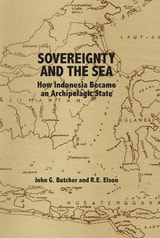
cover of Sovereignty and the Sea: How Indonesia Became an Archipelagic State

Sovereignty and the Sea

How Indonesia Became an Archipelagic State

John G. Butcher and R. E. Elson

National University of Singapore Press, 2017

Until the mid-1950s nearly all of the sea between the far-flung islands of the Indonesian archipelago was open to ships of all nations, but in 1957, the Indonesian government declared that it had absolute sovereignty over all the waters lying within straight baselines drawn between the outermost islands of Indonesia.  In this single step, Indonesia made its lands and seas a unified entity for the first time, a claim formally recognized in 1982 by the United Nations Convention on the Law of the Sea. Sovereignty and the Sea explores how Indonesia succeeded in its extraordinary claim despite its low international profile. John G. Butcher and R. E. Elson reveal that at the heart of Indonesia’s archipelagic campaign was a small group of Indonesian diplomats whose dogged persistence, negotiating skills, and willingness to make difficult compromises resulted in Indonesia becoming the greatest archipelagic state in the world.
 
[more]
cover of Who Rules the Waves?: Piracy, Overfishing and Mining the Oceans

Who Rules the Waves?

Piracy, Overfishing and Mining the Oceans

Denise Russell

Pluto Press, 2010

With piracy raging in the Indian Ocean, international disputes over undersea oil and gas, and chronic overfishing, the oceans have rarely been subject to such varied and environmentally damaging conflict outside a world war. In Who Rules the Waves? Denise Russell gives us a rare insight into these issues and how they could be resolved.

International law states that a coastal country has territorial rights for 12 miles into the sea beyond its coastline, and economic rights for 200 miles, but in practice many countries have virtually no control over their own waters, and there is no international agency powerful enough to settle disputes. Russell provides a thorough examination of the politics of the sea, showing that without a radical change in ocean governance, accelerating climate change and overuse of the sea's resources is likely to have catastrophic effects.

[more]