Results by title
15 books match the query 'Lévinas, Emmanuel'

Addressing Levinas
Eric Sean Nelson
Northwestern University Press, 2005
In their radical singularity, these essays reveal the inalienable alterity at the heart of Levinas's ethics. At the same time, each essay remains open to the others, and to the perspectives and positions they advocate. Thus the volume, in its quality and diversity, enacts an authentic encounter with Levinas's thought, embodying an intellectual ethics by virtue of its style. Bringing together contributions from philosophy, theology, literary theory, gender studies, and political theory, this book offers a deeper and more thorough encounter with Levinas's ethics than any yet written.
Altered Reading
Levinas and LiteratureJill Robbins
University of Chicago Press, 1999
With an attitude at once respectful and interrogative, closely attentive to Levinas's texts while in dialogue with readings by Derrida, Blanchot, and Bataille, Altered Reading shows how the thread of the literary leads directly to the internal tensions of Levinas's ethical discourse. Jill Robbins provides a comprehensive critical account of Levinas's early and mature philosophy as well as later key transitional essays. In an invaluable appendix, she includes her own translation of an important, previously untranslated essay by Bataille on Levinas.
Altered Reading will interest philosophers, literary critics, scholars of religion, and others drawn to Levinas's work.

Being and God
A Systematic Approach in Confrontation with Martin Heidegger, Emmanuel Levinas, and Jean-Luc MarionLorenz B. Puntel and Alan White
Northwestern University Press, 2011

Beyond
The Philosophy of Emmanuel LevinasAdriaan Theodoor Peperzak
Northwestern University Press, 1997
Peperzak's examination begins with a general overview of Levinas's life and thought, and shows how issues of ethics, politics, and religion are intertwined in Levinas's philosophy. Peperzak also discusses the development of Levinas's relations with Husserl and Heidegger, demonstrating thematically the evolution of both Levinas's anti-Heideggerian view of technology and his critical attitude toward nature.
Elevations
The Height of the Good in Rosenzweig and LevinasRichard A. Cohen
University of Chicago Press, 1994
Cohen also explores the ethical philosophy of these two thinkers in relation to Nietzsche, Husserl, Heidegger, Buber, Sartre, and Derrida. The result is one of the most wide-ranging and lucid studies yet written on these crucial figures in philosophy and Jewish thought.
Essential Vulnerabilities
Plato and Levinas on Relations to the OtherDeborah Achtenberg
Northwestern University Press, 2014

Levinas on the Primacy of the Ethical
Philosophy as ProphecyJeffrey Bloechl
Northwestern University Press, 2023
The philosophy of Emmanuel Levinas affirms both the urgency of peace and the fact that peace is never finally assured. This tension is a question of responsibility and of the ethical relation in which that responsibility is grounded. Jeffrey Bloechl pursues this prophetic dimension of Levinas’s philosophy—his commitment to phenomenology and to a philosophy of religion—to make the case for the mutual reinforcement and intelligibility of these two threads.
Levinas on the Primacy of the Ethical traces the emergence of Levinas’s early thought in relation to modern political philosophy, his revision of Martin Heidegger’s existential phenomenology, the consolidation of his mature position, his important differences with Freudian psychoanalysis, the turn from metaphysics to language in his later philosophy, and his complex relationship with Christian theology. Starting with an exposition of how positive notions of religious transcendence are already present in some of Levinas’s early phenomenological texts, Bloechl then stakes the reverse claim: that Levinas’s conception of God is dependent on his existential phenomenology. Proceeding chronologically, but with frequent nods to later developments, this book builds toward the ultimate assertion that Levinas offers us a phenomenology of event and of relation without appeal to any foundation, ground, or causal principle. Only in this way is Levinas able to generate an argument—and not merely an exhortation—for the primacy of the ethical as he conceives it.
Levinas's Existential Analytic
A Commentary on Totality and InfinityJames R. Mensch
Northwestern University Press, 2015
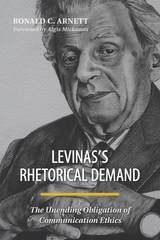
Levinas's Rhetorical Demand
The Unending Obligation of Communication EthicsRonald C. Arnett. Foreword by Algis Mickunas
Southern Illinois University Press, 2017
Distinguished Book Award, Philosophy of Communication Division, National Communication Association, 2017
Top Book Award, Communication Ethics Division, National Communication Association, 2017
Philosopher Emmanuel Levinas’s ethics as first philosophy explicates a human obligation and responsibility to and for the Other that is an unending and imperfect commitment. In Levinas’s Rhetorical Demand: The Unending Obligation of Communication Ethics, Ronald C. Arnett underscores the profundity of Levinas’s insights for communication ethics.Arnett outlines communication ethics as a primordial call of responsibility central to Levinas’s writing and mission, analyzing it through a Levinasian lens with examination of social artifacts ranging from the Heidegger-Cassirer debate to Rupert Murdoch’s News of the World story concerning illicit possession of information.
Levinas’s Rhetorical Demand offers an account of Levinas’s project and the pragmatic implications of attending to a call of responsibility to and for the Other. This book yields a rich and nuanced understanding of Levinas’s work, revealing the practical importance of his insights, and including a discussion of related theorists and thinkers.
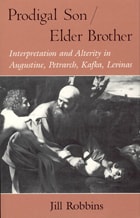
Prodigal Son/Elder Brother
Interpretation and Alterity in Augustine, Petrarch, Kafka, LevinasJill Robbins
University of Chicago Press, 1991
"Through a creative reading of the prodigal son parable, Jill Robbins demonstrates the hermeneutical impasse of the Christian exegete who must and yet cannot incorporate the Old Testament. Having disclosed the aporia at the heart of Christian hermeneutics, she proposes an alternative approach to the Hebrew Bible and new interpretations of Augustine, Petrarch, Kafka, and Levinas. Robbins brilliantly integrates the discourses of biblical texts, literary works, and critical analysis."—Mark C. Taylor, Williams College
Prophetic Politics
Emmanuel Levinas and the Sanctification of SufferingPhilip J. Harold
Ohio University Press, 2009
In Prophetic Politics, Philip J. Harold offers an original interpretation of the political dimension of Emmanuel Levinas’s thought. Harold argues that Levinas’s mature position in Otherwise Than Being breaks radically with the dialogical inclinations of his earlier Totality and Infinity and that transformation manifests itself most clearly in the peculiar nature of Levinas’s relationship to politics.
Levinas’s philosophy is concerned not with the ethical per se, in either its applied or its transcendent forms, but with the source of ethics. Once this source is revealed to be an anarchic interruption of our efforts to think the ethical, Levinas’s political claims cannot be read as straightforward ideological positions or principles for political action. They are instead to be understood “prophetically,” a position that Harold finds comparable to the communitarian critique of liberalism offered by such writers as Alasdair MacIntyre and Charles Taylor. In developing this interpretation, which runs counter to formative influences from the phenomenological tradition, Harold traces Levinas’s debt to phenomenological descriptions of such experiences as empathy and playfulness.
Prophetic Politics will highlight the relevance of the phenomenological tradition to contemporary ethical and political thought—a long-standing goal of the series—while also making a significant and original contribution to Levinas scholarship.
The Art of Time
Levinas, Ethics, and the Contemporary Peninsular NovelNina L. Molinaro
Bucknell University Press, 2019
Academicians and journalists in Spain and abroad have recently fastened on an emerging cluster of peninsular writers who, they argue, pertain to a discernible literary generation, provisionally referred to as Generación X. These writers are distinct from their predecessors; they and their literary texts are closely related to the specific socio-political and historical circumstances in Spain and their novels relate stories of more and less proximity, more and less responsibility, and more and less temporality. In short, they trace the temporal movement of alterity through narrative.
Published by Bucknell University Press. Distributed worldwide by Rutgers University Press.

The Figural Jew
Politics and Identity in Postwar French ThoughtSarah Hammerschlag
University of Chicago Press, 2010
The rootless Jew, wandering disconnected from history, homeland, and nature, was often the target of early twentieth-century nationalist rhetoric aimed against modern culture. But following World War II, a number of prominent French philosophers recast this maligned figure in positive terms, and in so doing transformed postwar conceptions of politics and identity.
Sarah Hammerschlag explores this figure of the Jew from its prewar usage to its resuscitation by Jean-Paul Sartre, Emmanuel Levinas, Maurice Blanchot, and Jacques Derrida. Sartre and Levinas idealized the Jew’s rootlessness in order to rethink the foundations of political identity. Blanchot and Derrida, in turn, used the figure of the Jew to call into question the very nature of group identification. By chronicling this evolution in thinking, Hammerschlag ultimately reveals how the figural Jew can function as a critical mechanism that exposes the political dangers of mythic allegiance, whether couched in universalizing or particularizing terms.
Both an intellectual history and a philosophical argument, The Figural Jew will set the agenda for all further consideration of Jewish identity, modern Jewish thought, and continental philosophy.

The Trace of Judaism
Dostoevsky, Babel, Mandelstam, LevinasVal Vinokur
Northwestern University Press, 2009
The defining quality of Russian literature, for most critics, is its ethical seriousness expressed through formal originality. The Trace of Judaism addresses this characteristic through the thought of the Lithuanian-born Franco-Jewish philosopher Emmanuel Levinas. Steeped in the Russian classics from an early age, Levinas drew significantly from Dostoevsky in his ethical thought. One can profitably read Russian literature through Levinas, and vice versa.
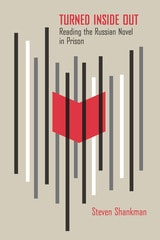
Turned Inside Out
Reading the Russian Novel in PrisonSteven Shankman
Northwestern University Press, 2017
Turned Inside Out will appeal to readers with interests in the classic novels of Russian literature, in prisons and pedagogy, or in Levinas and phenomenology. At a time when the humanities are struggling to justify the centrality of their mission in today’s colleges and universities, Steven Shankman by example makes an undeniably powerful case for the transformative power of reading great texts.